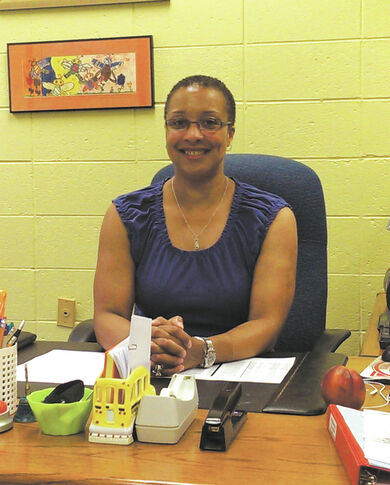
Parkway Principal Nicole Harris.
In its inaugural issue in September 2003, the Ewing Observer published a front-page story on Parkway Elementary School featuring an interview with then Principal Laurence Fieber.
In commemoration of its 10th anniversary, the Observer spoke with current Principal Nicole Harris to talk about the issues facing Parkway — and educators in general — today, and also with Fieber about the decade he spent as principal of the school.
Only a little more than two weeks until the beginning of the 2013-14 school year, and Parkway School Principal Nicole Harris sat at her desk, the warm breeze from a nearby open window rustling piles of paperwork on her desk. The temperature outside was in the high 80s, and it wasn’t much cooler inside the building — the school’s air conditioning was under repair.
Harris opened the windows and ran a fan in an effort to keep cool. She was hopeful that the air conditioning would soon be up and running, and that the building would be comfortably cooler by the first day of school on Sept. 9.
Harris, who is entering her seventh year as principal at Parkway, takes such problems in stride. The building’s HVAC problem was just another item in a long list of issues that come up as part of being a school administrator. She said that although the job can be trying at times, she wouldn’t have it any other way.
“As much as being an administrator has its times of frustration, I truly believe I’m doing what I’m supposed to be doing, where I’m supposed to be doing it,” she said.
For former Principal Laurence Fieber, who retired from Parkway about nine years ago, the decision to leave his long-time position as assistant principal at West Windsor-Plainsboro High School South to go to Parkway was one of the best of his career. Fieber is currently the executive director of the Center for Future Educators at the College of New Jersey.
Some didn’t see it that way though. Fieber said that when he told them he had taken the job at Parkway, some of his colleagues questioned why he wanted to go an work in an urban-rim district.
“Well, when I went there, my life changed and my professional world changed,” he said. “My mission was always to connect with kids, and the Ewing community was, and will always be, a very sacred place in my life in terms of understanding urban rim kids and my passion for reaching out to those kids. Because they can do what everybody else does, if you believe it. And I do. I have the track record there (at Parkway) to back me up.”
Harris has a similar pride in Parkway, and said that one of the first things she did when she became principal there was to try to spread the word about the good things they were doing at the school.
“In the six years that I’ve been here, we’ve worked very hard to put out into the community the flavor of Parkway,” Harris explained. “Prior to coming here I didn’t know a lot about Parkway even though I worked in the district. When I first came here I said to the staff, ‘I feel like we’re the best kept secret in the district. We have all these great things going on here but nobody really knows about them. ”
In addition to overseeing facility repairs, planning events, and getting ready for opening day, another task that she and other school officials work on at time of year is evaluating data from last year’s N.J. ASK tests.
“We try to use the data to help our instruction so that we can help the students be better thinkers,” she continued. “We don’t really do specific test prep until April. That’s more about teaching the kids how to navigate the mechanics of the test.”
While the test scores can be a valuable tool in helping to evaluate the school’s curriculum, they come far from telling the entire story.
According to Harris, teaching kids today involves having students work with partners, doing group work and having class-wide discussion. The teacher listens to the discussions and ask the kids questions to see what they know and what they don’t know.
According to Harris, standardized tests are different altogether, and don’t lend themselves to that type of instruction. She points out that many districts find that kids struggle with the language arts and math sections of the test but do just fine when it comes to science.
“The science test was developed by teachers,” she said. “The language arts and math were not. The science test more closely mirrors the way we teach the students. That’s why so many of them are able to demonstrate proficiency in science.”
Part of the problem is generational, as well, she said.
“In a general sense, kids aren’t made to be as imaginative as we were when we were growing up,” Harris said. “A lot of kids nowadays aren’t made to interact with other kids. They aren’t made to problem solve on their own. We had to problem solve, but today, someone does a lot of that for them.”
One positive development, that was started by the state about a year ago, is data relating to student growth as part of the test results, Harris said.
In the past, the results reported whether a child was partially proficient, proficient, or advanced proficient. The new results show a child’s improvement from year to year.
So, for example, a child may attain a score of partially proficient in both third and fourth grade, but the results track whether the child has shown improvement in their score from the previous year. By looking at the data, educators can evaluate growth results for an entire grade, a specific teacher’s class, or even a specific students.
Just as important as helping students grow academically is helping them grow as people. Parkway uses a system called Positive Behavior Support to help kids make good choices and be kind and considerate.
We stand firm here at Parkway on our “Four Rs,” Harris said. “We want the kids to be ready, responsible, respectful and resourceful. When we talk to the kids about making choices and being good students, everything focuses around the Four Rs.”
PBS does not only help the kids become good people, it also helps academically.
“Research tells us that the more time on task that teachers have with instruction, the more they’re able to teach students and the more students are able to learn,” Harris said.
Parkway was the first school in the district to implement PBS, and the program, which has been in effect for about seven years, has been a great success. Harris said there has been a steady decrease over the years of students being sent to the office due to behavioral issues. She said that in her first year there were about 300 office referrals, as compared to last year when they were down to about 110.
If a child does show a history of behavioral issue, the next step is for school staff to try to evaluate what might be causing the issues.
“Kids come to school nowadays with a lot of baggage,” Harris said. “They worry about a lot more things than we did when we were younger. This is for many different reasons. It might be financial, or the dynamics at home. There might be something going on in their neighborhood, or maybe there’s a health or emotional issue.”
If they can address the problems that are going on, then children are clear to absorb everything the teacher is giving them, she said.
A child’s performance when they first enter elementary school often, in many ways, correlates to their experiences before going to school. Kids who went to preschool or whose parents read to them frequently often do better than students who didn’t have the same experiences.
Often, , through no fault of their own, parents don’t realize the effect these efforts can have on a child’s success in school, said Harris.
“When you have a baby, and you’re in the hospital, they make sure you know how to diaper the baby, feed the baby, and give the baby a bath. They talk to you about certain health issues,” Harris said. “But they don’t tell you things like you should read to your child every day. That you should have conversations with your baby. And when they start talking back, ask them to count the number of chicken nuggets they have on their plate.”
Another issue Parkway has to deal with is a rate of economically disadvantaged students that’s higher than other schools in the district.
“Parkway School is unique in that our makeup is not really reflective of Ewing Township as a whole,” said Harris. “The community is about 50 percent Caucasian and 50 percent minority. As a township, the percentage of (economically) disadvantaged families is probably around 30 percent. Parkway school is 20 percent Caucasian, and we’re about 60 percent disadvantaged families.”
“That brings us some challenges that we have to work to deal with as far as our families are concerned, what their needs are and what we need to do to assist them,” she said.
For example, Parkway has a program to supplement the free or reduced cost breakfast or lunches for disadvantaged students. The school, in partnership with Mercer Street Friends, provides backpacks full of food to the students to help feed them over the weekend.
Fieber said that the challenges of being principal go beyond academic concerns. They included coming in early to clean up bottles and trash from the playground, or coexisting with the prostitutes that lived down the street or the nearby crack house.
“You can’t be a weak person and be principal of that school,” Fieber said.
He said there were times where he had to address difficult issues with parents.
“I had to get tough with some of them once in a while who were not doing good things for their kids., Fieber said. “You let your second grader out at 9 p.m. at night to go spray paint cars? I think I’m going to have plenty to say about that. You send your kid filthy to school? He hasn’t had a bath for three days? Yeah, I’m going to say something about what we can do to get that kid cleaned up.”
Harris, a Ewing resident who lives “across the street and around the corner” from Parkway School, was hired 16 years ago by Ewing as assistant principal at Antheil School and served in that role until being named principal at Parkway.
Her husband, Napoleon, is a firefighter in Trenton. Her daughter is a fourth grade student at Antheil, because Harris wanted her to attend a different school in the district. “I just thought it would be too much for me to be her mother and her principal every day.
A native of Jersey City, Harris earned her bachelor’s degree from Rutgers University’s Douglas College and then a masters degree from Rutgers Graduate School of Education. Her father is a retired detective with the Jersey City Police Department, and her mother works in the director’s office at the Jersey City Department of Public Works.
Harris came to Ewing after working for a year as an assistant principal in South Brunswick, and before that, for four years as a first grade teacher in Highland Park.
Harris decided to focus on education because she knew that she liked working with children from her days as a camp counselor when she was a teenager. She entered the elementary teacher program at Rutgers and became a student teacher.
“I very much enjoyed student teaching, but I had another one of those moments. I wondered whether I saw myself being a teacher for 30 years,” Harris said regarding her decision to pursue administration at the beginning of her career.
The decision was an unorthodox one, Harris said. “Most people now graduate, get a teaching job for a few years and then go into an administrative program. With me, I finished student teaching in December, and in January, I started the administrative program.”
After earning her masters degree, Harris got her first teaching job in Highland Park, where she student-taught, and after three years got her letter of eligibility to work as an administrator. About a year later, she went to work in South Brunwsick.
When all is said and done, said Harris, the bottom line is that it’s much more difficult to be a student — and a teacher — today than it was even 10 years ago.
“Once upon a time school was more straightforward,” she said. “We could teach kids to read, write and add. Then we’d do some science and social studies and throw in some phys ed and everything was fine. But now there’s a whole host of other things that we need to teach them, unteach them and answer for them before we can teach them to read and write and throw in some science and social studies on the side.”
She said as a resident, parent, and employee of Ewing Schools, she supports the district on many levels.
“The issues that plague education here, plague education everywhere. Some of what will help us get over those hurdles is for all of us within the community to come together. As teachers and families we need to start sharing more of those responsibilities to clear our plates so we can focus more on the teaching academics.”
“Education went from being a partnership between the families and schools to being more on the schools and less on the families now,” said Harris. “We need to work together to balance that partnership a little bit.”
,

