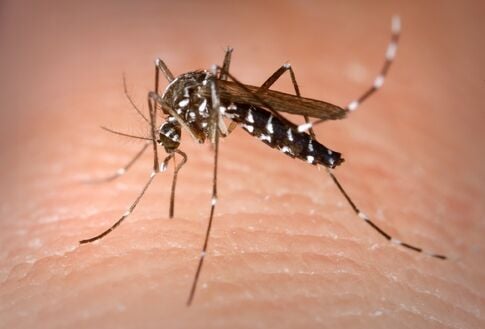
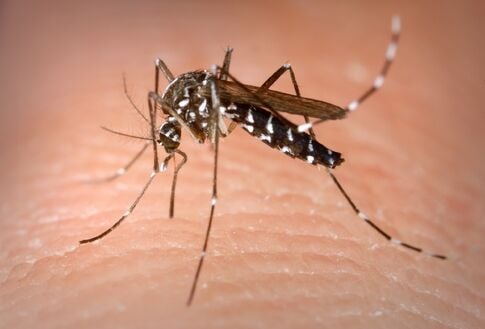
The Asian tiger mosquito, which can carry some 30 different diseases, can breed in containers as small as a bottle cap.
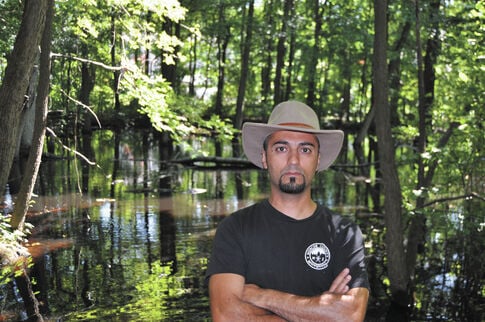
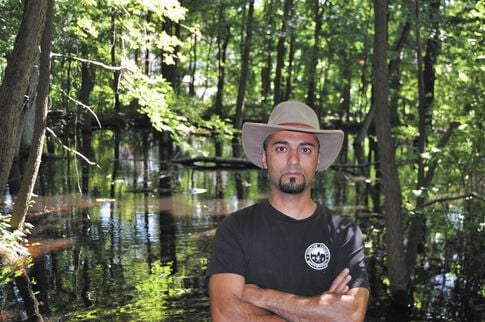
Ewing resident Ary Farajollahi, superintendent of Mercer County Mosquito Control, wants residents to be aware of the Asian tiger mosquito.
Mercer County Mosquito Control superintendent explains how to protect your backyard from Asian tiger mosquitoes
by Kathleen McGinn Spring
Ary Farajollahi wants you!
The superintendent of Mercer County Mosquito Control, Farajollahi wants to enlist the aid of every Mercer County resident in preventing a frightening health menace from arising right in their back yard — the outbreak of an exotic sub-tropical disease.
“It’s only a matter of time before there is a local epidemic. It’s a very real threat,” said Farajollahi, a Ewing resident.
Farajollahi’s nemesis is the Asian tiger mosquito, an insect with unusual strengths, including the ability to spread 30 deadly diseases through virtually any victim — bird, pig or human. Named for the black and white stripes on its body, the Asian tiger can spread diseases such as the West Nile virus, Yellow fever, dengue fever and two types of encephalitis. The mosquito became endemic to this area in the mid-2000s.
Fortunately, the pest has one weakness that makes it conquerable — the inability to fly much more than 300 feet, and generally only 150 feet. This means that if humans disrupt its habitat — perhaps the bed of a Matchbox car tow truck abandoned under a backyard picnic table, a spare tire propped up next to a garage, or the folds of a tarp thrown over a barbecue — its menace will be blunted.
Farajollahi is responsible for keeping many kinds of mosquitoes in check, and he speaks confidently about his department’s ability to deal with most garden-variety Garden State mosquitoes, even as he worries about the Asian tiger, an insect he can’t defeat without substantial help from his neighbors.
Farajollahi, 39, is a scholar, a Rutgers Ph.D. candidate, the author of hundreds of papers on the science of mosquito control, a speaker at international symposia, a researcher and a master of a multitude of sophisticated mosquito management strategies. Aiding him are 10 full-time employees and 10 seasonal employees.
In August, a research article co-authored by Farajollahi was selected for a new Public Library of Science collection titled “The Ecological Impacts of Climate Change.”
The paper, written by Farajollahi and three other researchers, focused on the expansion of the Asian tiger into the Northeast and its impact on public health. It was chosen as one of the 16 most influential and prescient articles published in two PLOS journals.
Farajollahi maintained that mosquito fighting is serious business — one that began right here in New Jersey. He explains that mosquito control was invented by the first chair of the Rutgers entomology department, J.D. Smith. That was 100 years ago. In fact, New Jersey’s mosquito control department is older than its national counterpart, which is only 77 years old.
The state’s approach, which from the start placed a department of mosquito control in each county, gave rise to the international mosquito control movement.
The drive to tame each year’s mosquito outbreak began pretty much as a tourism promotion effort.
“Hordes of mosquitoes kept people away from beaches,” Farajollahi said. “Mosquito control was invented to combat salt marsh mosquitoes.”
Unlike the Asian tigers, these native mosquitoes are excellent fliers, capable of traveling for miles. Most active at dawn and dusk, they can make any outdoor activity miserable. Left unchecked, said Farajollahi, they would have put an end to leisure trips to the state’s beaches.
Annoying in the extreme, and also disease carriers, the domestic mosquitoes don’t worry Farajollahi much.
“For over 100 years we have fine-tuned our program (to eradicate them),” he said. “We know where their habitats are. We have woodland pools mapped. We have ideal products to respond.”
The approach to domestic mosquito control relies on knowing where the insects will lay eggs — often in storm water drains and shallow ponds as well as in marshes — and destroying them with larvicides before they can hatch.
Adults may be doused with adulticides when pools of water were missed, and therefore escaped treatment before a hatch occurred. These mosquito habitats are often discovered when a resident calls the department to complain about being bitten by the pests.
Many residents are wary of the use of chemicals of any sort, Farajollahi said. A surprising number of them recall the days when trucks wound their way around New Jersey’s suburban cul-de-sacs and beachside streets spewing clouds of DEET—as local kids joyfully rode alongside the slow-moving sprayer trucks on their bicycles. It is his job to convince residents that things have changed.
“We’re science-driven now,” he said. “We use integrated pest management.”
That could mean anything from draining standing water to using predator mosquitoes to destroy other mosquitoes.
But sometimes, in his view, chemicals are necessary. “Chemicals have a very valid position,” he said. “Certain times we have to use them.”
Larvicides, he assures, do no harm to humans, animals or plants. They only destroy their targets. And the adulticides used today are a far cry, both in composition and in volume, from the sprays that Baby Boomers recall.
Where, formerly, DEET may have been pretty much sprayed with a hose, chemicals are now spread “in minuscule amounts, microns in size,” he said. His department only sprays at night, when few humans are out and about, and spraying is only a small part of its mosquito prevention program. Getting at the insects before they hatch is much more effective, he said.
While mosquitoes are tiny, the job of keeping them in check worldwide is huge and the stakes are staggering. Farajollahi referred to an article in the Public Health Perspectives blog by science writer Linda Marsa, who called the creatures “airborne angels of death, delivering payloads of lethal pathogens that sicken half a billion people and claim at least a million lives annually.”
For now, the majority of these deaths take place in crowded cities in tropical countries in Asia, Africa and South America. But global warming is extending the mosquito’s range. Farajollahi said he worries that the Asian tiger mosquitoes, already present in New Jersey, could soon make themselves at home in all the major cities of the Northeast.
The Asian tigers first arrived in the United States by hitching a ride in tires being imported from Japan or Taiwan. Farajollahi explained that, in contrast to our native mosquitoes, which thrive in relatively large pools of water, the Asian tigers are container insects. They like dark, moist environments.
The tires were ideal and could transport them even if they were dry. This is so because the Asian tigers’ eggs can live for a long time — a year or more — without water. They sit dormant, waiting for a few drops of rain, and then they begin the process of hatching.
The first Asian tigers to fly around in the United States, Farajollahi guesses, arrived in tires that were placed on a dock. The tires probably were dry inside until a passing shower created tiny puddles — an ideal habitat for the new U.S. residents.
The first Asian tigers probably hatched in Houston, Texas, in about 1985. They first spread throughout the Southeast and then headed north. According to Farajollahi, they were first found in New Jersey in 1998 in Keyport.
“The population remained low in central and south New Jersey until we had several mild winters in the early 2000s,” Farajollahi said. “They can’t withstand colder winters.”
Gradually, the insects will become a little more hardy, just as winters are projected to become a little less forbiddingly cold. “They’re selected for continuation,” he said. “More survived and bred the following year.”
“We capture mosquitoes, count them and get the species,” Farajollahi said of his department’s extensive record keeping. “We found only a few pools (of Asian tigers) in 2003. By 2005, they started exploding. Since then, it has expanded.”
Farajollahi’s department takes calls from all over the county from residents being chewed up by mosquitoes. This year, there have been exponentially more calls.
“This year started off bad, with the wettest June on record,” he said. “We’re getting 60 service requests a day. My busiest week in the past, there were 60 calls all week.”
The calls come from all around the county. The harassed residents often report being bitten at all hours of the day by tiny bugs sporting black and white stripes. Follow-up by Farajollahi’s department almost always turns up Asian tigers. In addition to being incredibly efficient spreaders of multiple deadly diseases, these mosquitoes, unlike their domestic cousins, bite all day long.
“The advice to stay indoors at dawn and dusk doesn’t work,” said Farajollahi.
As potentially devastating as the Asian tigers’ bites can be, their menace can be reduced enormously through small, easy steps. And Farajollahi very much wants every Mercer resident to take these steps right away.
Knocking out the Asian tigers is as easy as taking a leisurely walk around your yard or the courtyard in front of your condo or apartment. Look for and remove any container that could hold water. It could be something as small as a bottle cap.
Farajollahi said that toy trucks and the little plates put under plants are common Asian tiger habitats. Shake lawn chair and barbecue covers dry after any rain and outfit the tops of rain barrels with screens. Hunt for and discard any debris that might have blown under a bush. Pay special attention to shady areas. The insects love moist, dark, shady spots.
“You won’t get bitten in the middle of a sunny yard,” Farajollahi said.
Removing yard-based water catchers is nearly a 100 percent foolproof way to prevent a catastrophic Asian tiger-caused outbreak of a deadly disease. Herein lies Farajollahi’s frustration.
He can keep millions of high-flying domestic mosquitoes at bay, but he is powerless against the Asian tigers if he can’t enlist all of his Mercer County neighbors in the fight. “I can’t go door to door,” he said.
Farajollahi does not have the temperament of an alarmist. Soft-spoken, calm, and articulate, he is a man of science, yet he is alarmed by the threat posed by the tiny striped mosquitoes.
And he is clearly a man who knows his insects. He grew up in southern California, where his dad worked as an importer/exporter and his mother tended to the house and the kids.
“My mom and dad exposed us to the outdoors,” he said. “My fondest memories involving camping and playing with insects. I was into entomology since I was young.”
He recalls driving to Costa Rica with his brother when they were teenagers. “Everyone else was at the beach surfing, but we got a permit to collect insects.”
He went on to earn a B.S. in biology from the University of LaVerne, California (Class of 2000). From there he crossed the country to work with Wayne Crans, a renowned mosquito expert at Rutgers, where he earned a masters in 2005, and where he is working on his Ph.D. in entomology.
He was offered the Mercer County mosquito control job in 2003. “My wife said it was too good an opportunity to pass up,” he said. So he and his wife, Lisa, and their two children, seven-year-old Ayla and four-year-old Xavi, have made their home in the Churchill Green section of Ewing.
There is so much in life that no one can control, but the Asian tiger threat is something that can easily be swatted away. The insects’ short flight patterns mean that bites will almost always come from a bug hatched right near your own front door.
“When we go out on a call, we always find the container right in the yard,” said Farajollahi. His message: Prevent the outbreak of a deadly disease. Rid your yard of every type of water container.
,
,