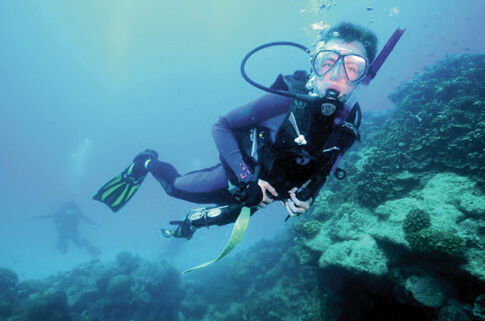
Andrew Pisetzner, who visited Australia as part of a study abroad program at Susquehana University, scuba dives at the Great Barrier Reef.
By Lacey Ross
When Ewing resident Andrew Pisetzner received his high school diploma, he never imagined that three years later he would be scuba diving in the Great Barrier Reef off the coast of Australia, swimming past a school of barracuda.
But that’s exactly where he ended up, thanks to a study abroad program at his college, Susquehanna University. Pisetzner, a rising senior, was one of 14 students who travelled across the world with two professors to explore the cultural and environmental aspects of Australia from May 18 to June 9.
Susquehanna University has a Global Opportunities program that requires students to participate in at least one study abroad trip to fulfil their graduation requirements. A biology major, with minors in healthcare studies and music performance, Pisetzner applied to Focus Australia and was selected to embark on the adventure last fall. The trip, which requires both a pre-departure course and a post-trip course, was worth six college credits.
“We all met as a group at the end of the semester just to go over some logistics,” he said. “In the spring semester, we met once a week as a class for credit to go over some cultural differences and some environmental and biological aspects of Australia as a pre-departure class and that was the biggest thing we did to get ready.”
Independently, however, Pisetzner had other ways to prepare himself for the trip. One of the first things he did was sign up for classes to earn his scuba certification.
“It was something that I’ve always wanted to do and I figured that I would only be in Australia on this once in a lifetime trip, so this would be the best opportunity to do it,” he said.
Pisetzner spent about $500 of his own money getting certified and purchasing his own scuba mask, fins, snorkel and other pieces of equipment. He also bought a camera.
When his flight roared out of John F. Kennedy Airport for what would be about a 20-hour flight, with one stop in Los Angeles, Pisetzner was armed with his headphones and iPad.
According to Pisetzner, the flight was long, but worth it.
“I remember New York being really hot when we left and Sydney was surprisingly cool when we landed,” he said.
After leaving the airport in Sydney, they settled into their youth hostel and immediately began exploring the city to stay awake and avoid jetlag. They spent a week there taking in famous attractions, including the city’s botanical gardens, the Hyde Park Barracks Museum and the Opera House, where they were able to sit in the seats reserved for the queen.
“I think the most amazing part of the botanical gardens was how large the plants were and how much of a diverse group of species they had,” he said, adding that they visited the gardens in both Sydney and Cairns.
One of the highlights for Pisetzner was climbing over the Sydney Harbour Bridge, which stands 439 feet above the water and crosses over several lanes of noisy traffic. He was connected to a cable for safety and wore an earpiece so that the guide could point out famous sites as they climbed.
“The closer to the top we got, I remember the windier it became,” he said. “At the top, the view is unbelievable. You can almost see the entire city from that view.”
Overall, Pisetzner described Sydney as a lot like an American city, but much cleaner.
Next the group ventured to Alice Springs, a dry, desert region in the center of the country.
“I would describe [Alice Springs] almost like Ewing but much smaller, and there really wasn’t anything to do around there, unlike Sydney where there was always something to do,” he said. “But going back to the course, this was their way of comparing the different aspects of Australian environments.”
From there they drove five hours through the desert to Uluru, which Pisetzner said was not like an average “drive around the corner.”
“It was very flat with some bushes here and there and a lot of sand,” he said. “The sand out there is very red because of the amount of iron that’s in the ground. When iron rusts it turns red, so it’s kind of like you’re driving on mars.”
While they were not lucky enough to spot a wild kangaroo on the drive, Pisetzner said they witnessed a rare event while hiking Kata Tjuta.
“It was interesting because it was actually raining in the desert, which really doesn’t happen too often,” he said. “So we were actually pretty lucky to see that. We saw all kinds of waterfalls coming off of the rocks because of the rain.”
There was a lot of hiking on the trip, but Pisetzner said his favorite was the famous King’s Canyon, where he was probably about 300-400 feet high.
“The area was very red, and you’re climbing really steep climbs that you have to be really careful with,” he said.
The last part of the trip took the group to Cairns, a tropical rainforest region. Pisetzner and his classmates were led through one of the rainforests by an aboriginal elder, who told them different stories about his tribe. It was humid but peaceful as the students trekked through, trying not to disturb any of the wildlife.
“The forest looked really chaotic in terms of the plant and tree growth, which surprised me a lot,” Pisetzner said. “I knew there would be a lot of plant life, but I did not imagine that there would be this much of it. All of the plants are competing for sunlight, so that is why the growth is so chaotic.”
Cairns is also where Pisetzner was able to fulfill his dream of scuba diving in the Great Barrier Reef. Alone with one of the professors, Andrew was the only student who was certified to scuba dive. According to Pisetzner, the cost of his certification and equipment was well worth the experience of diving down about 40 feet and exploring the deep, where he was able to spot barracuda, clownfish and a reef shark.
“Scuba diving was probably my favorite part of the entire trip,” he said. “The coral that we saw was probably 10-20 feet high, if not more. Basically, it just grows on top of each other, all the species grow on top of one another.”
Finally, Pisetzner said he did get a chance to see and feed some kangaroos at a wildlife preserve before leaving Cairns.
“They are very solid and muscular animals, but also very curious, at least the ones that we fed,” he said. “Their fur is very soft, but their coat is not as thick since they are mostly desert-dwelling animals. Some of them at the preserve even had babies in their pouches and that was really neat to see.”
They also saw some wild kangaroos throughout the trip, which Pisetzner said were a lot like wild deer here in the U.S.
“They watch you from a distance but if you try to get close to them they will run or, rather, hop away,” he said.
One of the professors who lead the trip was Dr. Mary Lou Klotz, an associate professor of psychology at Susquehanna University. This was her 10th time travelling with students to Australia. She described Pisetzner as a “serious, hard-working” student and an “asset” to the trip.
“He was eager to dive into Australian culture and try everything,” she said. “However, he embraced the goal of going beyond being a tourist—he instead became a traveler, observing and respecting the similarities and differences between American and Australian culture.
The ultimate goal of the trip was to help students gain a new, deeper perspective on their own culture and what culture really means. This is accomplished, Klotz said, through “immersing” them in a different culture.
“Most of our students have not traveled outside of the U.S.,” she said. “In fact, some have never flown. Interacting with people in a different country, they start to see their own culture in a more objective way.”
This was the case for Pisetzner. Seeing what life is like for the aborigines, who get by on very little, gave him a greater appreciation for the things he has at home and increased his love for nature.
“I kind of realized how much we rely on different forms of technology here, like cell phones and even simple things like having electricity and running water,” he said. “I have a greater appreciation for different cultures that are different from us. In terms of the environment, I believe that we need to be more environmentally friendly.”
Now that he is home, Pisetzner is focused on graduation and studying for the entrance exam to optometry school so that he can eventually become an eye doctor.
“I want to be able to help people but I also think that it’s a science that is such a growing field and there is a lot of work to be done,” he said. “That would be something great to get into.”
In the future, Pisetzner said he definitely wants to travel more and hopes to return to Australia. He also would like to see the Amazon rainforests and explore Europe.
As for other students considering a trip abroad, whether for a whole semester or just a short trip, Pisetzner suggests just going for it.
“Australia is a great place but there are so many other countries out there that I would love to see and experience at some point,” he said. “The reason I chose Susquehanna in particular is because of the great study abroad opportunity that they offer and it was one of the many factors that brought me to this school. Overall, the college experience there has been really great and I’ll definitely miss it when I graduate this year.”
,

