The state of New Jersey has begun implementing various regulations to allow the cultivation and sale of recreational cannabis over the past six months.
The latest was opening of retail recreational marijuana shops throughout the state in April.
Although the only recreational establishment currently open in the Mercer County area is Zen Leaf on Route 1 in Lawrence Township, Ewing is planning to allow grow, manufacturing and retail shops within the community.
Recreational cannabis was one of the topics covered in a recent interview with Mayor Bert Steinmann. An edited version of the interview, conducted by Ewing Observer editor Bill Sanservino, appears in the Q&A below.
Articles covering other topics discussed during the interview appeared in the March, April and May issue of the Observer and can be read online at communitynews.org.
* * *
Ewing Observer: It seems clear to me that despite some of the challenges out there in the economy, Ewing still has enough amenities to be able to attract businesses and people to the township?
Bert Steinmann: We do. We have to do some creative thinking for some of these things, but we’ve been very open and receptive to various businesses and we try to work with them.
I’m optimistic that will continue, but for us to sit on our hands and do nothing is not an option. We always need to look at new ideas, new things or new approaches to the way we do business.
We don’t want grass growing under our feet. We want to try to keep moving forward as best as we possibly can with the best interest of our taxpayers in mind. I know some people don’t believe that, but that’s what we strive for.
EO: If you’re not moving forward or at least thinking about moving forward, then you’re going to stagnate.
BS: Yeah, exactly. I guess the latest thing now is the (recreational) cannabis business. Our approach is that, okay, we will welcome those businesses, but we have got a lot of restrictions in place. We’re following mostly state guideline in that sense, but we’ve got a game plan.
We’ve got areas in town that are set aside. We’ve got a situation where there’s, I think, five retail spot for shops. But they’re not next to one another. They are located away from schools and things like that.
EO: What’s the distance business can locate away from schools?
BS: I believe it’s 1,000 feet. We are more than a thousand. There are some areas in the state of New Jersey where you can’t even have one business because they’re so small and they’re close to a school or some other. You probably wouldn’t be able to put a cannabis business in Allentown. The town is so small and the high school is right there.
* * *
We looked at it and there are advantages of having cannabis businesses in the town, especially a grow facility. For everything that they grow Ewing Township, we get 2%, which is a lot of money at the end of the day. And that money just comes to Ewing Township. It doesn’t go anywhere else and it can be used to offset our budget obviously, which is a good thing.
They will be in locations where there are industrial spaces. We got a ton of applicants, but not everybody’s going to get a license from the state. We interview groups of individuals that want to do it.
EO: I understand that you’ve put together a committee that reviews the applicants made up of officials and citizens?
BS: That’s correct. So before that happened, it was two people who were reviewing applicants—our township planner Chuck Latini and myself.
Chuck and I were going through this process, and I said to Chuck, “This really doesn’t work out. I think we should look at a better way of how to handle this situation.”
So that’s when we came up with this committee. We wanted to make sure the membership included a business owner, a professional, obviously a member from our for our town council, myself and our planner involved. And then we would interviewed these particular individuals (cannabis business applicants) and then make recommendations.
Everybody’s got a good pitch, but trust me when I tell you that you can tell the difference between the people that are really into it because they’ve had the experience and they want to do it as opposed to individuals that are in for the quick dollar. So that’s working out really well.
EO: Does the council and/or the township endorse any of the applications?
BS: Before we had this particular group and there was really nothing in place, we approved two or three people to move forward and we gave a letter of recommendation. That was for medical cannabis.
We had about 25 interviews and we recommended three to the state. The state picked one, which was Justice Grown. The state gave them a license and they’re building it now.
Now that we’ve moved on to recreational and we put this committee together, there were four applicants. With three of them, the township council said, “Okay, we can support them and gave a letter of recommendation,” and one they didn’t. I’m not going to get into the specifics of that.
Out of those three, they’re not all going to get a license. That’s up to the state. Once the state says, “Okay, you can get a license,” then they need to come back here and then go through the planning board, and go through all of that before they say, “Okay, here you go.”
There’s a lot of steps that they have to take to go through that.
EO: Right now you have just have the one medical facility—Justice Grown, which is under construction. Are they going to want to move into the recreational area?
BS: I believe so. I mean, I didn’t really have a conversation with them as to that but all indications are that’s where they are going to go.
EO: I’m not just talking about recreational retail, but also grow facilities and manufacturing facilities.
BS: Exactly. So their grow facility is under construction and they’ll be done, I would probably say, in the next eight or nine months. Their retail facility for medical is being constructed on Olden Avenue, and they’ll be finished in the next few months. So they’ll be open for business soon.
Will they apply for a license for recreational use? Probably. I’m not saying that they can’t, but right now there’s a rule against that you can’t operate out of the same building (medical and recreational sales) or it has to be separated, but who knows? I mean, that can all change.
EO: How many different facilities is the township allowing for in terms of grow and manufacturing?
BS: There is no limit to that. There is a limit to five on retail. As far as the grow and manufacturing is concerned, that’s all a positive for the town.
That’s all 2% income that we wind up getting from their sales. So that just helps the township and they will be located in areas that aren’t really not visible to anybody.
There’s also environmental controls as far as odor emission and everything like that, so they will have to mitigate to mitigate those kinds of things
Although we have no limit, there is a limit in the sense that there’s only so many places that they can be built. How many that is? I don’t know. It’s not really a whole lot.
EO: What are the areas in the town that these businesses can be located?
BS: So basically, you got Commerce office park, which is off of Ewingville Road. It’s an industrial complex where warehousing is.
It’s allowed on Fourth Street. There are some homes there, but it’s mostly industrial. There’s also Olden Avenue and Phillips Boulevard off of Lower Ferry Road.
EO: How about the retail. Where could those five retail businesses go?
BS: North Olden Avenue. Parkway Avenue up from the Ewing Town Center is a location. We have a micro that’s interested on Edgar’s Crossing Road. We have one retailer that’s more of a boutique type. That’s on Jane Street, which is off a fourth.
The thing is with the state, one of their mandates is that we have to have public transportation to be able to get there to let the under-served be served. So like, Calhoun probably would be a place where we can put one. You got have public transportation. There’s a whole host of things that kind of fit into that situation. So, it’s not easy.
EO: I guess in the long run, if you can make more money for the town one way or another, it can be a good thing.
BS: Again, the best thing about it is that the towns don’t have to share the revenue (unlike property taxes, which the township has to with the county and school district).
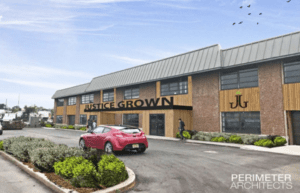
An architectural rendering of the Justice Grown facility under construction in Ewing.,

