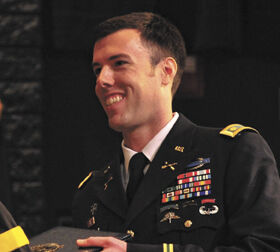
Alan Van Saun has graduated from two military schools, served in both Iraq and Afghanistan, and started a family, but he hasn’t forgotten his roots. A Ewing High School alumnus who was born and raised in the township, Van Saun credits its diverse cultural landscape and the high school’s faculty for giving him the tools and experiences to thrive in new environments.
“I felt that Ewing High School and especially its English Department set me up very well, education-wise,” he said. “To grow up in a multi-cultural place like Ewing Township really gave me a broad perspective of the world and the ability to make friends with different kinds of people from different backgrounds. And what’s neat about Ewing is that, being on the border of Trenton, having that diverse experience helped me out as I transitioned to West Point and then the Army.” That foundation set him up for success first at the United States Military Academy at West Point in New York, from which he graduated in 2004, and more recently at the Naval War College in Newport, Rhode Island, where he finished at the top of his class and was named Honor Grad—a distinction that is conferred upon a student with remarkable academic, community service, and extracurricular records.
Van Saun doesn’t come from a military background, though his nearly lifelong dream of joining the Army was largely born of a need to help others and make a difference in the world—desires that were rooted in his early experiences with the Boy Scouts, which he said is “definitely a family tradition.” His two older brothers both grew up in the organization and his father remains an active advisor to candidates for the Eagle Scout rank, an early honor that Van Saun has also earned. The project he spearheaded to reach scouting’s highest achievement, like the Boy Scouts itself, is also steeped in familial relevance. “I worked on a project over at Washington Crossing Park where I put in a bird sanctuary at the Nature Center, which is still there today,” Van Saun said. “Washington Crossing Park was one of those places I used to go all the time with my dad and my brothers to go hiking and just enjoy the park. It was something I wanted to give back to since the park has been such a huge part of our lives.”
Indeed, while Van Saun half-jokingly refers to the movies that influenced him as a boy to first consider a career in the military, the driving need to give back—first to his local community and later his country—was what propelled him toward the Army specifically. “I always knew that I wanted to get into the military, which I think was just a combination of watching a lot of movies as a child and just having an interest in public service and helping others,” he said. “I always have been drawn to the military, specifically the Army, ever since I can remember. When I was looking at the different academies and at the different services, it just seemed that the Army had the way to most directly impact others.”
But he also knew that he wanted a college education; finding out that West Point would allow him the chance to pursue both avenues made his post-high school path clear.
Upon graduating from West Point, Van Saun chose the infantry as the branch of the Army he would serve in, “which you tend to think of as your grunt soldier on the ground fighting,” he said. His first assignment was with the 101st Airborne Division, based in Fort Campbell, Kentucky, as a lieutenant: From there, he was deployed to Northern Iraq as a platoon leader commanding nearly 40 soldiers. “While we were there, my platoon and I were mentoring and helping to build up the Iraqi police force so they could secure the city of Kirkuk, which is a key oil city in Northern Iraq,” Van Saun said. “I did that for a year. While I was there, I also had the opportunity to work with a whole bunch of different units and organizations, including some Army special forces, the Green Berets.”
Intrigued by the Green Berets, a special operations force specializing in unconventional missions and warfare, and their work in smaller units directly alongside a partner nation’s own Army and police force, Van Saun put in an application for the special force soon after his return from Iraq.
As a new captain, he soon was given the opportunity to go to Selection, a monthlong physical process that led to a year spent on what’s colloquially referred to as the Q Course—Special Forces Qualification Course—while learning how to become a Green Beret. Rigorous lessons in small-units tactics training and leadership, learning a foreign language, and survival training all culminated in Van Saun completing the Q Course in 2009. Of the five active special services groups, Van Saun was assigned to the one that was then concentrated on the Central Asian States and based in Fort Bragg, North Carolina. He did two deployments with the 3rd Special Forces Group, spending much of his time in Afghanistan as a Detachment Commander.
“I had a 12-man team of Green Berets and we partnered with Afghan security forces—the Afghan army and Afghan police—and helped them to secure the country, so we were out there fighting alongside the Afghans at those two deployments.”
Last year, Van Saun was presented the opportunity to attend the Naval War College, where he earned a master’s degree in National Defense and Securities Studies. As each rank in the military has a corresponding military school, the majors are eligible for Intermediate Level Education; it was the master’s program at the Navy’s institute in Rhode Island that appealed the most to Van Saun. There, he studied everything from national defense strategies to military history to leadership.
When he wasn’t applying himself to classroom endeavors, Van Saun was invited to be a panel member at various conferences and seminars, penned an award-winning research paper slated for publication this year in one of the military’s journals, completed the Boston Marathon, and organized monthly get-togethers for the school’s students and professors alike to enjoy dinner and professional conversation in an informal environment. It is this degree of involvement compounded by the academic success of graduating at the top of his class that earned him the distinction of Honor Grad—though the practical education he received at his time with the Naval War College is a standout experience for Van Saun. “The experience reinforced what I’d already done at that point in the military,” he said. “One semester was spent working on historical case studies of all the major wars and using that historical perspective to look at strategic thought and strategic decision-making. Another semester, we learned about military operational planning, and we actually planned fictional scenarios using the lessons that had been learned from previous wars and those case studies.”
Connectivity and perspective were recurring themes in his graduate education, and having the opportunity to look at the entirety of American government provided a uniquely personal vantage point.
“We talked about how the military may not always solve the problem: There could be a diplomatic, economic or informational solution,” Van Saun said. “Being at the tactical level for 12 years, you start to think, ‘My unit is the solution to the world’s problems,’ and then you realize that the Army is one small part of the military, and the military is just one part of the government and the country as a whole. You get a real appreciation for that, and it’s given me a new perspective on how I fit into the bigger picture.”
These days, Van Saun is still stationed in Fort Bragg, though he, his wife, and their young daughter live off-post just north of the base. He is currently an executive officer, managing a 30-person staff supporting deployable soldiers by synchronizing personnel, intelligence, logistics, medial and other necessary functions. A friend from his Ewing High School days introduced Van Saun to his wife Brooke before his last year at West Point; while their daughter was born in the Fort Bragg hospital three years ago, they still consider New Jersey their home. While Van Saun is in no rush to leave military life behind, having a family of his own to care for does have him thinking about the future. His desire to serve his community has left him with a lingering interest in law enforcement—he originally thought he’d pursue a career in military police—and can see himself one day transitioning into civilian life via a route through federal agencies. In the meantime, Van Saun is occasionally called upon to provide some advice to his father’s scouts when they express an interest in applying to West Point, and is always willing to help guide the next generation of soldiers.
“I think there’s a lot of misperceptions about what the various services and different branches do, so I would say to just learn as much as you can about the service that you’re thinking about so you know what it is you’re signing up for,” he said.
,