
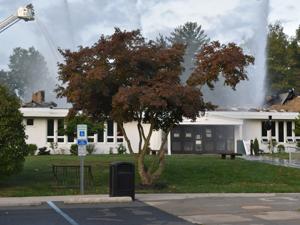

It’s been seven months since the Ewing Senior and Community Center suffered significant damage in an early-morning fire on Sept. 30. The five-alarm blaze destroyed the gymnasium and damaged other parts of the ESCC, rendering the facility unusable.
Since then, the ESCC—a major hub for community activity—and outdoor facilities at the center have been closed, and most of the programs and offices, including Community Affairs and Recreation and the Senior Office, have been relocated to the Hollowbrook Community Center at 320 Hollowbrook Drive.
Ewing Observer editor Bill Sanservino recently sat down with Mayor Bert Steinmann to talk about various issues and concerns in the township in 2023.
The progress on the ESCC in addition to the state of township finances were two of the topics discussed. An edited version of the interview appears below, starting with the ESCC. The conversation regarding township finance starts on page cktk.
Ewing Observer: So, what’s the status of the ESCC right now?
Bert Steinmann: Well, that’s what we’re debating going back and forth now, but we are going to have the pool open this summer. We are going to have summer camp like we did, except summer camp is going to now be held at Fisher Middle School for the kids, because I can’t really do anything on the ESCC site because it’s in the process of being remediated—getting the asbestos out of the building. And then we’re going to tear it down and obviously start the reconstruction of the building.
EO: Is that a total rebuild?
BS: It’s going to be a total rebuild. We’re meeting with the insurance company next week. They think we can save some of it, but the problem with that is—and maybe it can and maybe it can’t be, that was just one guy’s opinion—I had a building that was already stretched to capacity.
Why am I putting a building back that’s going to be stretched to capacity, because somebody says we shouldn’t do that.
So we’re looking to rebuild the building—make it a 50,000 square foot or somewhere in that area as opposed to the 32,000 that it was, so that we have growth for the future.
I don’t want to put up a building where we’re already behind the eight ball. It makes no sense that anybody, and you’re throwing good money after bad. So that’s where we are.
We’ll go sit with the insurance company. Will they give us all the money that we think we should be entitled to? Probably not. But they’re going to give us more than what they said they’re going to give us. In any event.
EO: Is there any kind of timeline on that?
BS: The timeline is now. I’ve got the specialist remediation, and some people ask, “Why are you doing the specialist remediation if you’re going to tear the building down?” The reason is, if we don’t do that, then that whole structure is deemed contaminated. So that is a different type of process.
All the debris that comes out of there now has to be shipped to Ohio for cleanup and everything like that. And that’s an astronomical cost. I’d rather spend whatever it is—I think it’s like $100,000— now and just clean up what needs to be cleaned up, then tear the building down.
Now we only have to worry about asbestos with a portion of it. Not everything. So that’s the reason for it. It’s all about cost.
EO: So broad estimate—when do you think you could see another building there? A couple of years?
BS: I would think. Right now, we have an architect on board doing the design. They’re telling us that they can have the design done and ready to go out to bid sometime in August. I believe (it will be done) the early part of 2025, and that’s our timeframe.
EO: And the Hollowbrook Center has been weathering the storm in terms of handling all of the senior and recreation programs?
BS: We’ve been able to find places for most of the programs, although there were some we couldn’t. For example, we don’t have like a pool table anymore, although, I think there was a group that they found another spot that they could use. For the most part we were able to place people either at the Community Center at Hollowbrook or in other areas.
The school district has stepped up and allowed us to use their facilities for basketball and indoor soccer—which they always had, but they have had to expand that some more. And they’re allowing us to use Fisher for the camps, as I mentioned. We’ve been getting great cooperation throughout the community. Some of the churches have opened up their doors for us to do it, and The College of New Jersey has stepped up big time to help us. The Katzenbach School helped us for the basketball program and soccer.
I think that the community has come together while we’re going through this particular process, but it comes together for so only so long. If they don’t see any progress, then I lose credibility. And, people say, “Well they’re not going to do anything anyway.” No. We have a very, very aggressive time frame to get this rebuilt—or at least I do. Hopefully everybody cooperates and we’ll go from there.
EO: If not, you’ll just light a fire under their ass.
BS: I have no problem doing that.
EO: I think it’s something you specialize in.
BS: Yeah, yeah. I had the demolition guys telling me they’ll be done sometime in August. I said, “No, you won’t. You’re going to be done the end of June or the beginning of July. I don’t want to hear this crap.”
I kept telling them, “Look, guys, don’t use this as a fill in job for something else. This is not a fill-in job. Get it down. Get it done.”
The economy and municipal budget
EO: Let’s talk about one of the things that’s on everybody’s mind—the state of the economy and the budget. A lot of companies are seeing price increases from their vendors. I’m sure as a township, you’re dealing with some price increases as well.
BS: Our biggest price increase has been our health care system. So basically, our policy increased by a little bit over $1 million. It’s a big jump from one year to the next.
We are looking at potentially using other companies. But what we found out, and I’m sure it’s no secret to anybody, is when you go with different types of companies, there are tradeoffs for that.
The co-pays would be different, or the prescription plan would be a little different. Things like that. So, in some cases, it may not be worth it to change. In some cases, they’ll give us a break for the first year, but then they increase the prices the following year. One way or the other they’re going to cover their costs. They may let some of it go, their profits for one year, but certainly not for a long period of time.
We decided that we were going to stay with the state health benefits program, at least for this year. And we do have our insurance people, Brown and Brown, looking at other possibilities. But that won’t come until the end of this year or the beginning of next year.
EO: What does Brown and Brown do?
BS: They kind of look at all our proforma with insurance policies.
EO: Like a consultant?
BS: Right. Exactly. To also handle our prescription program.
Because of HIPPA laws, we can’t know employees’ medical information—like what medicines they take—so a third party has to do that. For example, reimbursements for prescriptions, go through Brown and Brown and everyone’s privacy rights are protected.
They make sure all our properties are insured. They’re reviewing and updating our cybersecurity, right now, because they cover our technology as well. We need to make sure we train people and make sure they know how to recognize phishing. We test regularly to make sure people don’t get caught. But that’s part of the JIF—every town is part of the joint insurance fund. There are 38 towns that are part of our JIF and they all have a broker making sure we comply with all of the rules.
So, we have those types of contracts, and they go up every year. Like with our health coverage, some doctors aren’t on the plans that other companies offer.
That kind of puts a burden on some individuals, because if you’ve been going to a doctor for a long time, you’re comfortable and people don’t want to give that up. We’re trying to kind of balance all of that out and see if they find anything where we would benefit, then we would certainly go that route.
EO: $1 million dollars is a pretty big hit to take.
BS: It is a big hit to take, and what’s kind of depressing, in a way, is that we’re in the same plan as the state has, and the state was able to hold the line for their employees and use some of the money that they had from surplus and other things. Unfortunately, they did not pass that along to all the other towns and cities that were under that same plan.
We had to eat all of the cost increases where we thought the state would be more helpful than they have been. So that’s been a little bone of contention. But we’ll get through it.
EO: What are some other areas where the town is seeing some increased costs? Because I know there’s supply line issues with a lot of products?
BS: Exactly. So, with ink cartridges, for instance. They’re small items, but they’re increasing. If we do some recreational stuff or buy recreational equipment, they’ve had not only big increases, but also the time frame as to when we can get equipment is longer. Whether it’s playground equipment or other types of equipment.
I’ll give you a perfect example. We’re redoing the firehouse on Pennington Road, with the banquet hall. We’re turning that into the new construction office because we just ran out of room. And we’re also putting in a new brand-new generator to power that building in case of a power failure. The lead time on the generator is over a year before we even get delivery.
It’s loosened up a little bit, but the last year we bought two brand new fire trucks. Now they’re on order, but we’re not going to construction until 2024. It’s a two year wait. So we’re buying a 2022 model, basically, and not getting it until sometime in 2025 or 2026. I mean, it seems ridiculous, but that’s just the way it is.
We can’t increase our fleet, because we’ve got some aging cars that we have to replace, and it’s now seven or eight months before we even get the car. We can order it now, but the delivery date is that far out. Those are the types of things that are kind of hurting and also where there are significant cost increases.
EO: What about the 2023 municipal budget?
BS: We’re going through that process now. What I can tell you is that financially, Ewing Township is probably in the best shape it’s ever been. And that’s no small thanks to our CFO. She really has a pulse on exactly what’s being done.
Sometimes she’ll come to me and say, “Hey, we got to watch this area, we got to watch that area.” So, then we control how all that goes. But she’s been a godsend in Ewing Township.
EO: What’s her name?
BS: Johanna Mustafa. She’s really done a good job. The whole the whole department has done a good job. Most of our employees pitch in every day and do what they need to do. Our tax office is another one. I know nobody likes to talk to the tax department, but at the end of the day, the gentleman that is running it now has done a tremendous job communicating with the public.
EO: The tax collector? What’s his name?
BS: Abe Conesa. And again, he’s done some new initiatives in the tax office. It’s run better. I mean, look, nobody likes to come into the building and pay taxes, right? I mean, that’s just not what you want to do. But they handle it pretty well. His staff does a really nice job, and he keeps everybody up to date.
He makes sure that when notices go out, they’re really way ahead of when they’re supposed to be out, so people have ample time. And he reminds them, “Okay, you’ve got a date coming up, where you need to think about it. Again, very good management there.
The clerk’s office is running really well. Our biggest thing in that particular office is the number of OPRAs (Open Public Records Act) that are requested. It is what it is.
And then there’s the assessor’s office. We pay for the assessor’s office, but it’s really a county type thing, where they really report to the County Board of Taxation. Obviously, we have some small input here or there, but they’ve got to follow the guidelines.
Then there’s our construction department, which we revamped a little bit. That’s certainly running much smoother than it used to be. People used to dread coming in here and get permits in order to get inspection. It wasn’t days, it was months. Now it is days or weeks—a couple of weeks out for some inspection. It certainly has been much, much better.
Our police department is running very smoothly under the direction of our chief, Albert Rhodes. They’re doing a fine job. The police have always done a really great job. You may not always see eye to eye, but they do good work, and I think they’re well respected in the neighborhoods. So, we’re happy with that.
EO: I guess it depends on the neighborhood.
BS: Well, I guess to some extent, but we have community policing. They go around to different neighborhoods and talk to people. The program has been very well received.
EO: On the on the revenue side, is there anywhere where you’re seeing a decent influx of revenue? You’ve got increased costs, have you at least had some areas to help recover some of those?
BS: We’re just starting to see it, be quite honest with you, as far as revenue coming in. We don’t have a full year’s experience yet with the town center. That’s just starting to come in now. But by next year, we’ll have a full year of compliance.
I think we wound up with something like $200,000 that we got for last year in that short period of time that they were starting to occupy certain buildings. They’re under a PILOT program (Payment in lieu of taxes). So, it’s kind of adjusted to that, but that’s starting to come in.
Our cannabis revenue, although we only had four months of experience of sale—and that was only on the medical part of it—where we get 2% of the sale. For the last two or three months of last year, I believe we wound up with around $6,000-$7,000.
But they started two weeks ago with the recreational sales. We have no experience with that, but we’ll find out coming on. I think that you’re going to see a significant increase in that area for this year and a fairly significant increase with our PILOT at the town center.
We’ve got the Navy Jet Propulsion Lab, and we’re moving ahead with that. It went through our planning board, and it went through the planning board of the county.
We’re all on the same page now. So hopefully, once we get through some of the environmental restrictions, we’re able to start demolishing the building and getting that back under onto the tax rolls.