Ewing-based historians Patricia Millen and Robert Sands recently published the Images of America series book Washington Crossing.
The two say their new Arcadia Press book of mainly vintage photographs “was written to honor the 1776 crossing of the Delaware by General George Washington and his army and the parks that mark its place in history.”
But, they continue, the images “preserve more than the events of the American Revolution. For generations of people, the parks have been an extension of their own backyards and hold fond memories of hiking thorough wooded trails—or along the canals—family picnics and outdoor play watching or witnessing history relived on Christmas Day.
“We have attempted to capture these timeless moments that make up the story of both parks. (And) preserve the pictorial history of the crossing and the parks that flank the river—for all the thousands of visitors who come each year to stand on the banks to marvel at the site where Washington crossed the Delaware.”
Today, they note, that site consists of parks on both sides of the river. New Jersey’s Washington Crossing State Park, of which Millen is a founding member of the park association, encompasses areas in Mercer and Hunterdon counties in New Jersey and was created in 1912.
The Washington Crossing Historic Park in Bucks County, Pennsylvania, was created shortly afterward in 1917.
Nevertheless, the main image that dominates the story of the park is “the dramatic scene of Washington standing in a Durham boat in 1776 in the icy river.”
They say that the image “with the flag furling in the wind has been ingrained into the American consciousness. It is recognized the world over. This imagery has been immortalized in paintings, sculptures, propaganda, and even in modern-day advertising.”
The crossing is also part of the popular annual Christmas Day recreation that celebrated 69 years last month.
As Sands and Millen note, “Actor St. John ‘Sinjun’ Terrell began the first modern re-enactments of the crossing of the Delaware in 1953. With six friends in rented costumes in a half-scale Durham boat built by Lambertville carpenter Elmer Case, he staged Emanuel Leutze’s iconic painting.”
As suggested in the “first modern” reference, in between the 1776 original and the 1953 first annual reenactment, there was another reenactment and another George making the trip. “On January 23, 1947, some 40 pledges of Phi Sigma Nu fraternity from Rider College staged a re-enactment of Washington’s crossing the Delaware. The non-hazing event was the idea of two Rider students—Frank Ewart and Donald Reynolds—as an entertaining way to draw attention to the fraternity.
“In keeping with the historical accounts of the Christmas night crossing, George Chafey portraying Washington led his band of ‘Colonial’ fraternity brothers up Continental Lane to Bear Tavern. Chafey, who was fearful of horses and nursing a bad cold, chose to ride a bicycle.”
As Millen and Sands add, also involved in the historic event was the late Trenton Times editor Arnie Ropeik, who helped put it go down in history because he “worked for the Rider News, a college publication, (and) convinced Life magazine to chronicle the event. The story appeared as a four-page photo spread in the Feb. 17, 1947, issue of the magazine.”
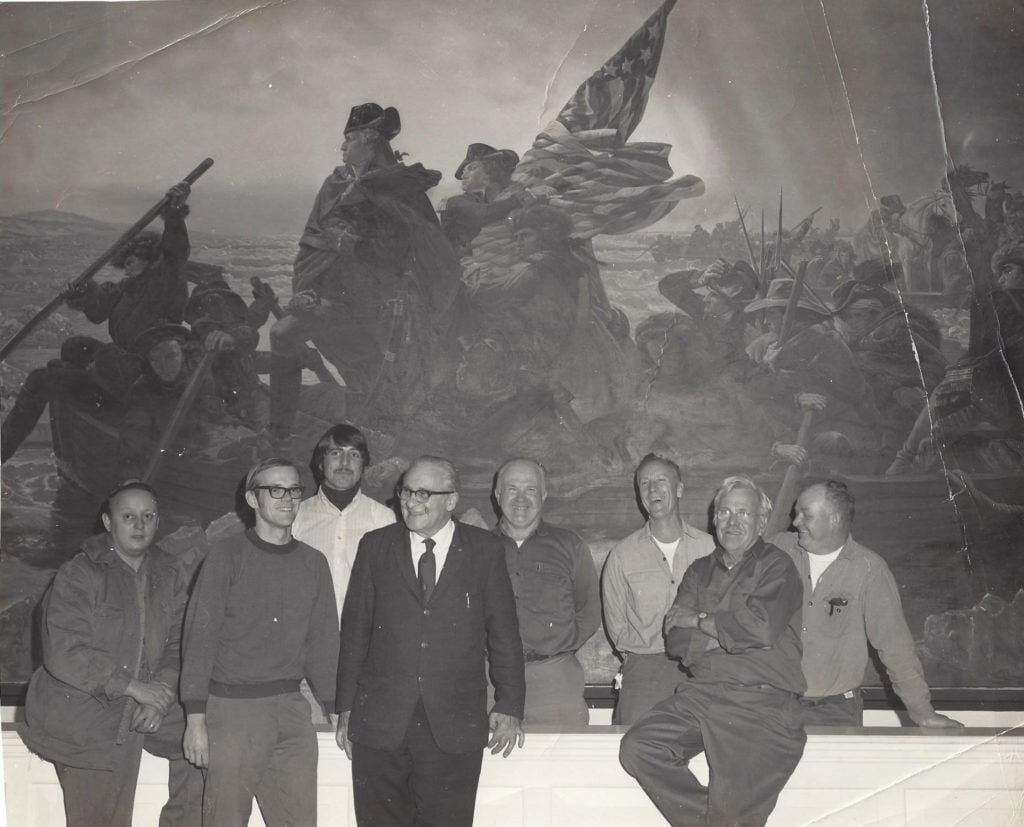
The book also moves into a moment of history when the actual “Washington Crossing the Delaware” painting by Leutze arrives for an extended stay at the site of the event.
As the writers note, the painting in the possession of the Metropolitan Museum of Art “fell out of favor with art historians and critics alike,” although it remained a favorite with the general population.
As the caption of one photo shows, “In 1950, the Metropolitan’s conservators prepare Washington Crossing the Delaware for loan to the Dallas Museum of Fine Arts for display at the Dallas State Fair. It was unstretched and rolled onto a drum for shipment. During just two weeks in October in Dallas, over 100,000 people came to view the painting. The much-publicized loan caught the attention of Pennsylvania’s Washington Crossing Park Commission, which set into motion almost two decades of loan negotiations, spearheaded by (park commissioner) Ann Hawkes Hutton, to keep the painting at the Pennsylvania Park.”
Another caption notes that “on the snowy day of Feb. 14, 1952, Emanuel Leutze’s painting arrived at the train station in Trenton, met by Anne Hawkes Hutton and Metropolitan Museum conservator Murray Pease. Hawkes Hutton worked tirelessly to secure a two-year loan from the museum, with options to renew, and arranged for the painting to be hung at the Washington Crossing Methodist Church until a proper exhibition gallery could be built. ‘It’s coming home,’ Hawkes Hutton remarked to a reporter from the New York Herald Tribune.”
Then “in the summer of 1959, (Leutze’s painting) was hung on the front wall of the auditorium of the new Washington Crossing Memorial Building. It was surrounded by maroon velvet curtains with another set that was opened and closed every half-hour for 16 showings per day. Hundreds of thousands of people came each year until 1969, when the Metropolitan denied another loan. But for the first time ever, it granted permission for a copy of one of its paintings to be made.”
A photo and caption present artist Robert Bruce Williams painting a recreation “in the memorial building’s auditorium, allowing everyone to watch as he recreated Leutze’s work stoke by stroke. Williams said of the crowds, ‘They help me relax and work quickly.’ Hawkes Hutton personally paid over $10,000 for the copy in honor of her late husband, John.
“Williams completed the copy on Christmas Day in 1969, the 193rd anniversary of the crossing. The original was rolled around a giant drum to be returned to the Metropolitan in January 1970. A few critics of Williams contended that the copy was painted haphazardly and he responded, ‘They don’t know what they are talking about.’ The painting was so well executed that most visitors believed they were seeing the original.”
Washington Crossing (Images of America) by Robert Sands Jr. and Patricia Millen is available at arcadiapublishing.com and on Amazon.com for $23.99.
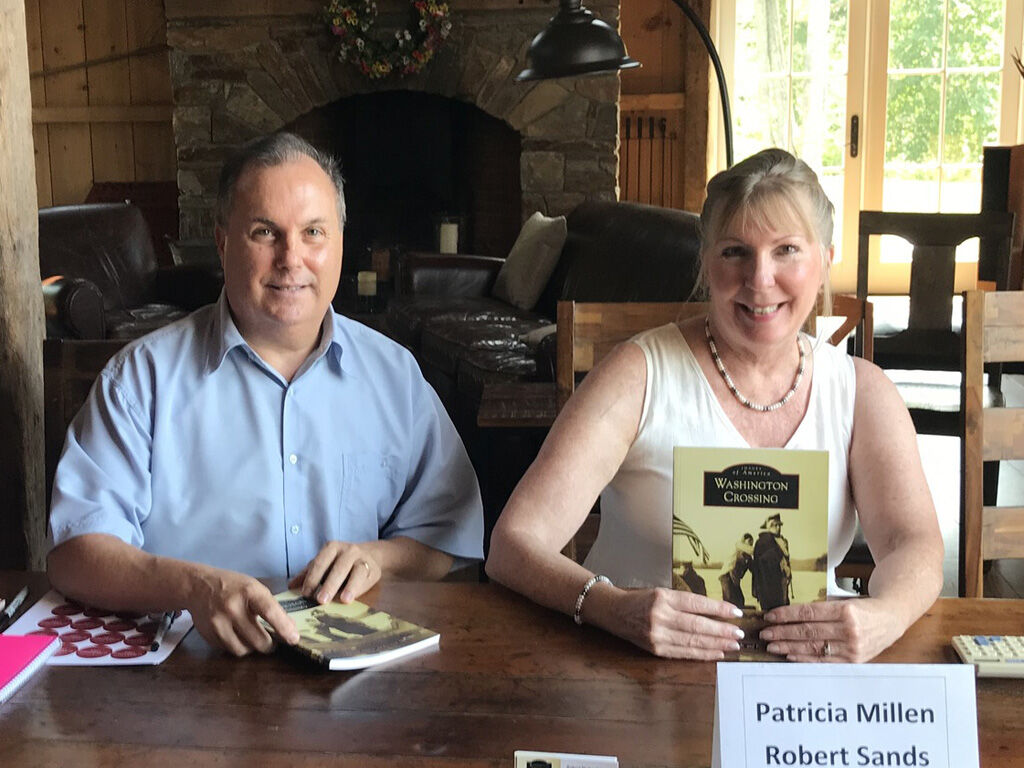
Ewing historians Robert Sands and Pat Millen at a signing for their book on Washington Crossing. The event was hosted by the Hopewell Valley Historical Society. (Facebook photo.),