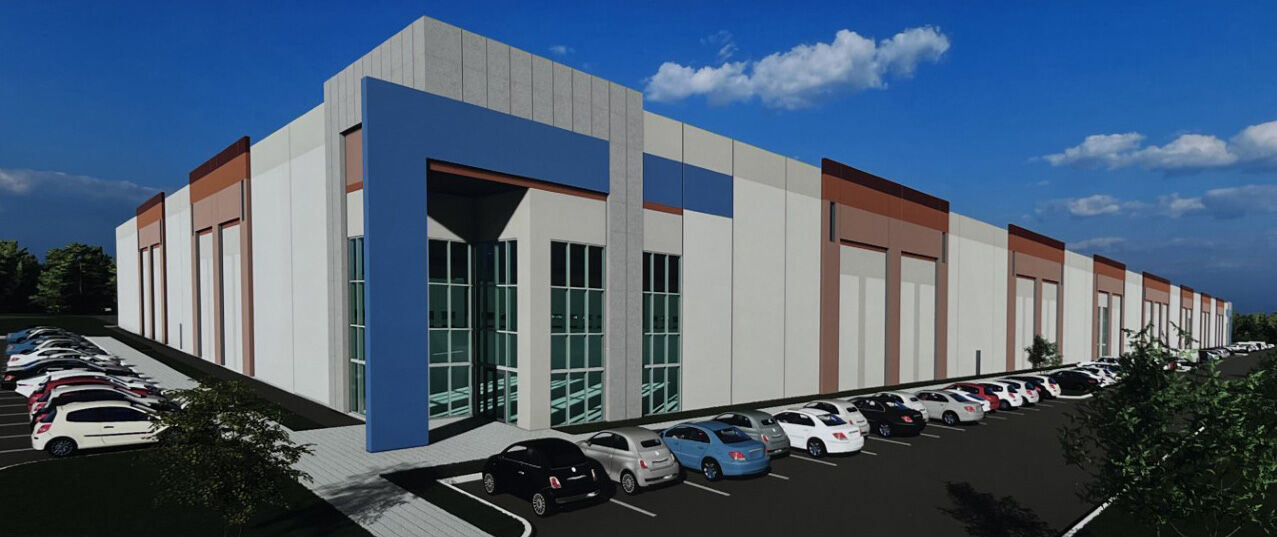
Ewing Township and developer KRE Group on April 22 officially kicked off the redevelopment of the decommissioned United States Naval Air Propulsion Center on Parkway Avenue.
Mayor Bert Steinmann, members of Township Council and other officials were on hand at a ceremony marking the commencement of the demolition of the old building, which has sat vacant on the site for decades.
Redeveloper KRE Group’s plans for the site call for construction of industrial and flex space. The redevelopment of the property is the second and final phase of the township’s Parkway Avenue Redevelopment Plan, which was first adopted in 2013. The project follows the transformation of the former General Motors factory into the Ewing Town Center, which offers a mix of retail and residential.
KRE Group’s redevelopment plans include four new buildings, featuring a 285,152-square-foot single-story warehouse, and three standalone flex space structures each measuring 20,000 square feet.
Planned site improvements include new stormwater management infrastructure, landscaping and lighting, a new N.J. Transit bus stop, surface parking, a landscaped walking trail, roadway improvements to Parkway Avenue, and the addition of a traffic circle at Parkway Avenue and Jack Stephan Way.
“Today’s demolition day is a long-awaited step in our redevelopment plan that promises to breathe new life into this historic property,” said Steinmann said, who operated the excavator that took the first swipe in the demolition of the building during the event.
“As the bricks begin to fall, we are at the crossroads of history and innovation, and I am excited about the future,” the mayor added.
In addition to Steinmann, also delivering remarks were: Ewing Council President Kevin Baxter; Jeffrey Persky, executive vice president, KRE Group; Helen Kull, local historian; Chuck Latini, executive director, Ewing Township Redevelopment Agency; Hal English, CEO, Princeton-Mercer Regional Chamber; and Lucylle Walter, Mercer County Commissioner.
Jonathan Kushner, president of KRE Group, expressed his excitement about the project. “We are thrilled to embark on this revitalization effort and are proud to be the ones capable of moving this important project forward after so many years of inactivity. This redevelopment initiative, long championed by Mayor Steinmann, will complement the progress already made within the redevelopment zone while laying the groundwork for an innovative future.”
Operated by the U.S. Navy as a jet engine test facility from 1951 until 1997, the Naval Air Propulsion Center played a crucial role in bolstering America’s military capabilities. The site’s narrative dates back even further, with the General Motors Inland Fisher Guide manufacturing plant on Parkway Avenue being requisitioned by the government during World War II in December 1941.
The plant swiftly transformed into Eastern Aircraft, a division of GM, retooling to produce the Avenger, the US Navy’s primary torpedo bomber. While the GM plant focused on aircraft production, the Navy utilized 1,000 acres across the street, which it had purchased from GM, for a different purpose—to build a testing facility for jet engines.
This strategic decision led to the establishment of the Naval Air Turbine Test Station (NATTS) in 1951, which became operational in 1956 and contributed greatly to advancing aviation technology.
TSpanning approximately 26.28 acres, the site is bordered by Mercer County Airport to the north, a Conrail railroad line to the east, Parkway Avenue to the south, and Jack Stephan Way to the west.
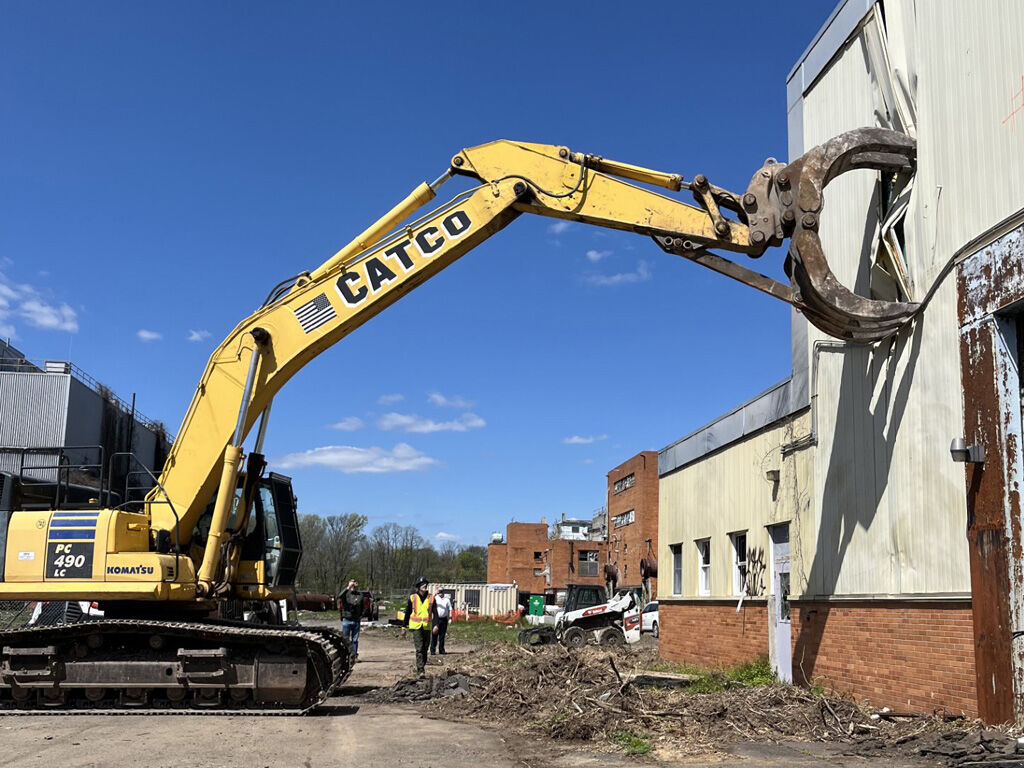
Ewing Mayor Bert Steinmann mans the excavator as it takes is first bite out of the structure at the soon-to-be demolished dilapidated Naval Air Warfare Center.,