By Chris Donnelly
Chris Donnelly, a 33-year-old resident of the Fleetwood Village section of Ewing, recently released his second book on the New York Yankees, “How the Yankees Explain New York,” published by Triumph Books. The book examines the parallels between the evolution of New York City over the years and that of the Yankees. His first book, “Baseball’s Greatest Series: Yankees, Mariners, and the 1995 Matchup That Changed History,” was released in 2010, published by Rivergate Books. A graduate of The College of New Jersey, Donnelly works as the press secretary for state Senate President Stephen Sweeney. Below, Donnelly shares some of his thoughts on his latest book, the Yankees and his love for the game. An excerpt from the book follows.
People often ask me if I hope that my daughters, Erin and Claire, will be Yankees’ fans when they grow up. My honest answers is that, while I think that would be great, all I can hope for is that they come to love baseball just as much as I do.
I can’t say why exactly I ended up being a New York Yankees’ fan. I was born and raised in Pompton Lakes, New Jersey, the son/grandson/nephew of nothing but Mets’ fans. My grandmother wouldn’t even let me watch the Yankees in her house when I was kid. Somehow, someway though, I ended up rooting for the Bronx Bombers.
Moreover, my family instilled in me a deep love of the game. While my love for the game far exceeded my ability to play it, I have always been hooked on baseball. I started following the Yankees when I was about 9 years old, a dark period in team’s history.
The first Yankee game I vividly remember is Andy Hawkins throwing a no-hitter against the White Sox — and losing the game! Despite these early struggles though, I never wavered. I followed every game, every hitter and pitcher, every statistic right up until the end of the season.
That love and appreciation for the Yankees and baseball has never wavered. Even now, having lived in Ewing for over a decade after attending The College of New Jersey, I still love few things more than taking in a baseball game. It’s what drove me to write my first book, Baseball’s Greatest Series: Yankees, Mariners and the 1995 Matchup That Changed History.
Having known nothing but losing my first few years watching the team (how many Yankees’ fans can say that?), seeing the Yankees finally make the postseason in 1995 was an amazing experience. It was especially rewarding for those of us, including myself, who were fans of first baseman Don Mattingly.
The outcome of that series, which saw the Yankees blow a one-run, 11th inning lead in the final game, was certainly heartbreaking. But I never forgot how amazingly exciting that entire series was. After many years of thinking about it, and with a little helpful prodding from my great wife, Jamie, I finally decided to sit down and write a book focused solely on just what those games meant to the Yankees, Mariners and baseball in general.
Last year, I was presented the opportunity to write about my two favorite subjects — the Yankees and history — when the idea for my newest book, “How The Yankees Explain New York,” came along. There have been many books written on both the Yankees and the history of New York City, but what makes this truly unique, I believe, is that it’s the first book to intertwine the two into a single story.
The similarities between the history of the Yankees and the city they call home is both fun and strikingly odd. They both underwent social and ethnic changes throughout the course of the 20th Century, adjusting to the changing times of the country. They both underwent a difficult — some might say horrific — period of turmoil during the 1980s, only to go through a resurgence during the 1990s.
They have had their share of characters, be it mayors, managers, owners, players, or those crafting a good publicity stunt. And the reaction of the city and the team to the events of 9-11 will remain etched in our memories for decades to come. It was a time when baseball, however trivial it may be in the grand scheme of things, worked to take our minds of the tragic events and provide some kind of solace, even if only for three hours a day.
“How The Yankees Explain New York” is also about more than just games played and listing historical events. It shows how the city and the team are both places where people go to either become a star, or to make their star shine brighter. It talks about New Year’s Eve in Times Square and Opening Day at Yankee Stadium both being about creating new opportunities and new hope. It examines how nowhere in the world is there the kind of media presence that exists in the Big Apple.
It’s something many people how have come to the city have been able to handle well, while others, not so much. And, of course, what book about New York would be complete without looking at the residents who bring the city and its sports teams their character.
One of the aspects I enjoyed most was speaking to the players and fans who helped craft the narrative of “How The Yankees Explain New York.” People like Wade Boggs, Al Downing, Buck Showalter, John Sterling, Joe Pepitone, Steve Schirripa, and Ari Fleischer, among many others, were all gracious enough to share their stories with me of what it was like playing or rooting for the Yankees. And I was greatly honored that Paul O’Neill — someone I grew up watching out in right field at the Stadium — was gracious enough to write the foreword for the book.
I could not have imagined when I graduated from TCNJ in 2003 that just 11 years later, I would have written two books on the team and gotten to speak and spend time with some of the players I watched as a kid; people like Don Mattingly, Paul O’Neill, Mike Stanley, Jim Leyritz and Buck Showalter. It is a tremendous honor and I hope that sense of excitement that I still feel when watching baseball comes across in these books. From “How the Yankees Explain New York”
In the 1980s the Yankees and New York City had one thing in common: they were very unpleasant to be around. Both still maintained mythical status — New York as the epicenter of the world and the Yankees as baseball’s most successful franchise. But the polish was wearing off both labels, and by the time the ’90s came around, no one wanted to go to New York — the city or the team.
The city itself had been in decline for some time. Manufacturing jobs had departed in droves after the 1960s. Riots had left neighborhoods in tatters. Buildings started going up in flames in record numbers. Many of the fires were being deliberately set. Some landlords were either stuck with high vacancy rates due to white flight or were tired of housing deadbeat tenants.
Others were set as a result of the ever escalating crime rates in the city. As building after building went up, which devalued the neighborhood, more people decided to torch their buildings and collect on the losses. The Son of Sam shootings in the summer of 1977 had terrified the entire city. A blackout that summer spurred looting on a scale never before seen in the city’s history. New York’s finances were in shambles. In order to cut costs, thousands of municipal employees were laid off, “creating a city in which almost nothing was maintained or repaired for a decade,” said author Jonathan Soffer.
Bronx, a substantial part of that borough, particularly the Grand Concourse, “had gone to the modern urban hell of drugs, gangs, arson, homelessness, abandoned children, violent crime, and other tragedies.” The south Bronx had become so run-down that parts of it were used for a film about the bombing of Dresden, Germany, during World War II.
Once the pride and joy of the city, Times Square had turned into a squalid hellhole of sex shops, hookers, pimps, and drugs. In 1977 Show World, a gigantic “multi-story sex arcade complete with video booths, live sex acts, and private rooms where naked women sat behind thin sheets of Plexiglas,” wrote Jonathan Mahler in Ladies and Gentlemen, the Bronx Is Burning, made it’s debut right in the heart of Times Square. These kinds of shops didn’t have to be hidden anymore, and thousands passed through its doors on a daily basis. At one point, according to Greg David’s Modern New York: The Life and Economics of a City, police set up “barriers on Eighth Avenue to separate the theatergoers from the prostitutes.”
Even the crowds at Yankee Stadium became more unruly and harder to deal with. Thousands stormed the field after Chris Chambliss’ series-clinching American League Championship Series home run in 1976 against the Kansas City Royals. When the Yankees won the World Series the following year, the same scene ensued. Rather than celebrate on the field with their teammates, most of the players simply ran for their lives in an effort to get to the dugout and clubhouse as soon as possible. Even when they remained in the stands, fights broke out. In 1977 writer Roger Angell noted that he no longer felt safe bringing his family to a game at the stadium. This occurred after he watched a Yankees-Red Sox game in which “a group of fans in the upper deck showered their fellow spectators with beer, hurled darts and bottles onto the field, and engaged in a near riot with the stadium police. There was nothing fresh or surprising about this,” Angell said. “It happened all the time this summer at Yankee Stadium.”
***
As the city seemed to crumble all around them, the New York Yankees were also in a state of free fall. The championship teams of the 1970s were built on smart trades and wise free-agent signings. Yes, the Yankees threw money out there that other teams couldn’t match, but they tended to spend wisely. Players like Reggie Jackson, Jim “Catfish” Hunter, and Rich “Goose” Gossage were vital cogs in the machine. There were some flops here and there, but for the most part, the deals made by the team worked out. Part of that was because Steinbrenner had smart baseball people around him and because The Boss, while constantly meddling, did allow his people to make important decisions.
But that all began to change dramatically, and it started when the Yankees lost the 1981 World Series. They had led the Los Angeles Dodgers two games to none but lost the next four, culminating in the Dodgers celebrating on the field at Yankee Stadium. Not long after the last out was made, Steinbrenner issued a public apology to the fans of New York for his team’s performance. That did not sit well with the players, who had tried their hardest and didn’t see what it was they had to be sorry for. The Boss’ apology wasn’t his only bizarre behavior during the Fall Classic. Steinbrenner claimed that after Game 5 he got into a fight with two Dodgers fans in an elevator in Dodger Stadium. No one has ever come forward to say they were involved in the fight, leaving many to wonder if Steinbrenner simply made the whole thing up.
In 1981 Steinbrenner had more or less taken over the reins of being general manager from Cedric Tallis, a savvy baseball man who had trouble dealing with the constant phone calls and angry rants. For the next nine years, The Boss would not relinquish those reins. During the offseason that followed the loss to the Dodgers, Steinbrenner took the team in a completely new direction. The Bronx Bombers were going to turn into the Bronx Burners, swapping out power for speed. Jackson was allowed to sign elsewhere, and in his place came guys like Dave Collins and Ken Griffey. “The team got to spring training, and he brought in his friend who had been in the 1940-something Olympics, Harrison Dillard,” sportswriter Moss Klein said. “He was an Olympic hurdler. The idea was he was going to teach the Yankees how to run, like you can teach speed. Several days a week, they would have the players go in the back of the field with Harrison Dillard and just have races. It became a farce. Everyone was laughing about it.”
The experiment was a spectacular failure. The team stole 69 bases all year only 22 more than they had stolen the previous, strike- shortened season. Bob Lemon lasted 14 games as manager before being fired. Gene Michael replaced him and didn’t even last the rest of the year. The team used three managers en route to a 79–83 finish. The losing was only made worse by the erratic behavior of Steinbrenner, who drove his managers crazy, publicly blasted his players, and pushed for bad trades.
It was a vicious cycle. The Boss didn’t feel his team was good enough to win, so he went out and got other ballplayers. But the players he got never worked out, making the team worse. But the worse the team got, the more he panicked and began searching for more players. On and on it went. He shipped out prospects Willie McGee and Fred McGriff for virtually nothing. He acquired aging slugger John Mayberry despite protests from his scouts, and Mayberry hit .209 during his year with the team. Steinbrenner traded for Butch Hobson, and Hobson hit .172. It was a pattern that would persist for the rest of the decade, and 1982 was just the start.
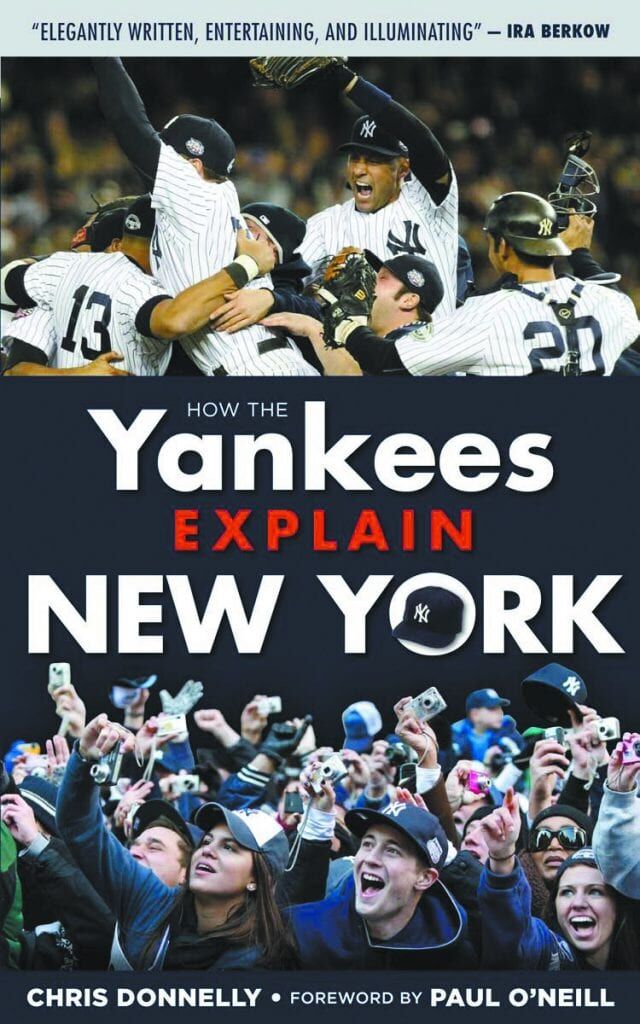
Ewing resident Chris Donnelly’s “How the Yankees Explain New York” features a foreword by Paul O’Neill.,

