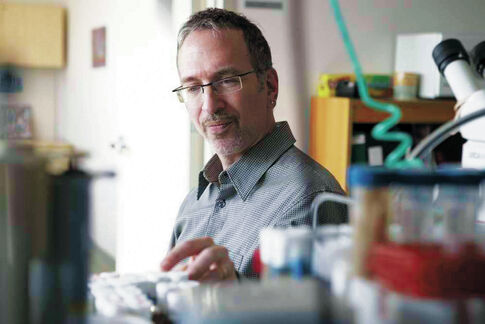
Fruit flies and robots may cure your cancer. Let’s just get that clear from the start. By the time you’re done learning about Ross Cagan, you’ll think twice about smacking those annoying little pepper flakes that show up at the very mention of ripe produce. Because they will, indeed already are, leading the march to eradicate cancer in all its forms.
So who is Ross Cagan? Before he became a leading cancer research scientist, Cagan was a Ewing boy, through and through. He attended Ewing public schools K-12, and along the way was inspired by a middle school science teacher named Mr. Williams, whose approach was “Do whatever you want, and write it down before you leave class,” Cagan said.
That freedom to try new things stuck with him as he entered the University of Chicago in 1978 — as a music major, because why not? He’d always wanted to be a scientist, but also always loved music.
He even had a band in Chicago that did well enough for him to switch majors to biology, he said. He still plays guitar when he can, but admits his life is getting busier these days, so there’s less of that happening now.
After Chicago, Cagan went to Princeton University for his doctorate in biology, which he earned in 1984. He met his wife, Yumi Kasai, a genomics professor, there and went to UCLA for his postdoctoral work. The couple now have two daughters in college, one who is leaning toward an artistic career and the other toward science.
Cagan’s first major job in science was at Washington University in St, Louis, where he spent 14 years. At first, the focus was on how the nervous system was assembled, but that focus changed to cancer research partway through his tenure. It was here that he began studying fruit flies in earnest.
In 2006 Cagan formed his own company, Medros, which he still owns, and which uses fruit flies for disease-based screens including cancer and diabetes. In 2013 he joined the Icahn School of Medicine at Mount Sinai Hospital in New York.
It was here that Cagan met a fellow Ewing resident, Frazer Tessema, who’s currently studying biology and genetics at Yale. Tessema recently attended a program that Cagan gave to help point middle schoolers towards the sciences. “He started with ‘Hi, my name is Ross,’” Tessema said. No ego, no bravado, just his first name, followed by “this is what science is.”
“I was so struck by the guy,” he said. “He was so down to earth. It makes me want to be like him.”
Tessema realizes he has a long way to go. Since joining Sinai, Cagan has added several layers to his resume. He is professor in the Department of Developmental and Regenerative Biology, associate dean for the Graduate School of Biomedical Sciences, director of the Center for Personalized Cancer Therapeutics, and editor-in-chief of the medical journal Disease Models and Mechanisms.
Before getting into exactly what Cagan does, let’s take a moment to clarify a couple things you’ll need to know to understand this all better. First, fruit flies have 44 percent of the same genes you have. In other words, every fruit fly is almost half human. Second, fruit flies, contrary to popular myth, don’t just live for one day. Typically, they live for about 30, though in controlled conditions they can live for up to three months.
These two facts are important to know because the research Cagan is conducting at Mount Sinai has managed to use those genetic similarities to research ways to treat cancers and other major degenerative diseases in people, and because that short lifespan allows Cagan and his crew to study the effects of inherited diseases over several generations without taking several years to do so. “The research is pinned on the idea of evolution,” Cagan said. “Fruit flies are quick, cheap, and easy to work with.”
Cagan’s team can grow flies and use robotics to do research screenings. “We have a computer that puts virtual drugs into virtual fruit flies,” he said. He refers to himself as “a fruit fly’s worst nightmare” because he and his team give the flies tumors and other cancer-related problems and then follow along, often for several generations, to see how exactly the body copes, and what science can do to stop the progression.
If there is a promising treatment, then Cagan and his staff move “up the chain” to higher animals until they have enough promise to try out a medicine on humans. His largest success against cancer so far is vandetanib, a drug for thyroid cancer that is now on the market and is proving rather effective. The lab’s research is also showing promise against diabetes, heart and kidney failure, and other genetic diseases, he said. “Any disease that can be modeled in a fly, we can develop a therapeutic.”
Cagan refers to his team’s approach as “disruptive thinking.” The idea of using flies to fix human medical problems and adding a hefty dose of robotics, computational chemistry and mathematics is a radical change from the relatively straightforward biological approach that carried cancer research for so long.
In business terms, this disruptive thinking would be labeled as innovation or creative problem solving. Call it what you want, it’s new, it’s bold and it shakes up the institutionalization and groupthink mentality that had gone into cancer research for decades. The old guard looked at the body of cancer research and kept trying traditional approaches, which showed promise and led to treatments, but as with anything, the field got a little too cozy for itself.
At the same time, genetics and biology research in general have made enormous progress, Cagan said. This is important because without knowing how the body works, you can’t understand how to deal with something that eats it away. Richard Nixon first formally declared a war on cancer in 1973, and it was generally assumed that science would find the answer by the 1980s, Cagan said. Money poured into cancer research throughout the 70s. And the 80s. And the 90s. And the 00s. And we still don’t have the answer we were supposed to have 35 or 40 years ago.
But the money that went into cancer research, Cagan said, also went into the very foundation of understanding the body. “The money was not spent just to cure cancer, but to learn how the body is assembled,” he said. “Cancer is the most fundamental disease of the body.”
This means that finding the cure is predicated on understanding all the fundamentals of genetics, DNA, how the body builds and regenerates itself, how immune systems and defenses work, and so on. Back in 1973, science didn’t know that it didn’t know to look at the genetic roadmap, Cagan said. The more scientists and cancer crusaders looked for the cure, the more complicated the answer grew to be.
Today, he said, that sustained effort to find out exactly how the body works is starting to work against cancer. All that knowledge has led to innovative approaches based on genetics and the understanding of how a multicell organism actually works in the machinery sense.
Even with that knowledge, though, cancer is a complex disease. For one, there are numerous different types of cancers; and like it is for us and fruit flies in the whole shared-genetics realm, different cancers share a lot of the same fundamentals. But not all. This makes trying to cure cancer a multilevel issue, because the answer to one type is not the full answer for another. What works for thyroid cancer, for example, will not work for liver cancer.
Still, the future is bright, which is probably not something you’d think to say in the same sentence with the C word. The 55-year-old Cagan believes he will see the cure for cancer in his lifetime. “I wouldn’t be in the field if I didn’t think it was curable,” he said.
What may come as a shock is that Cagan may not be the guy who ultimately finds the cure, even if his research is the groundwork. Cagan models himself, to a degree, on Seymour Benzer, a Cal Tech geneticist, biologist, and “old fly guy” whose research into fruit flies paved the way for understanding how diseases work. Benzer also had a saying that scientists should change fields every 10 years, and Cagan agrees with that philosophy.
He’s also right on schedule for a new shakeup, though he will not say where he is headed as a scientist, merely that he has “something in mind” for his next endeavor. “I’ve certainly changed fields pretty drastically,” he said. “It forces me to stop being so comfortable.”
A danger in scientific research, he said, is that scientists find something that works and then become staid in that position. They stop listening and stop being curious and stop trying new things from new perspectives. “It makes you risk-averse,” he said. And taking risks, like, say, applying robotic research to fruit flies in order to find cures for human diseases, is necessary for progress.
What Cagan is hoping for in terms of his research legacy at Sinai is that his lab’s approach turns out to be the right one, and one that future scientists can follow to the outer limits of their research.
“The onus is on us,” he said. “The next couple years will show whether our approach was better. We’ll see.”
,

