By Bill Sanservino
Work by Ewing artist featured in State Museum exhibition
Far too often, artists can get too comfortable in their own artistic skins — working within their own chosen guidelines and inspired by personal themes of their own choosing.
Often times it takes a challenge to do otherwise to help them think about and create their art in new ways, said Joy Barth, artist and long-time Ewing resident.
Margaret O’Reilly, curator of fine arts at the N.J. State Museum, offered just such a challenge when she asked artists to create works for an exhibition based on the theme “America.”
“She presented the challenge to the Princeton Artists Alliance, of which I am a member, and other selected artists in the area,” Barth said. “We had a year to dig deep into our own personal narratives and accept the challenge of interpreting them for a show.”
The resulting work by Barth, titled “The Beckoning,” is part of “America, through Artists’ Eyes,” an exhibition at the State Museum that features pieces by contemporary New Jersey artists who were asked to define and depict America in the a visual way they felt was most appropriate to their own personal ideology, style and convictions.
Originally set to close on April 5, the exhibition has been extended through August 16. Also for the show, the artists provided statements for each of their works and the relationship to the broad theme of “America.”
In her curator’s statement, O’Reilly said that her challenge to the artists raised many questions and apprehensions. “I came away feeling that America is a topic that can never be fully explored.”
“As the United States changes and evolves, as issues and ideologies emerge and recede, as societal mores shift and adapt, there will always be ideas to be examined through literature, dance, music and the visual arts,” O’Reilly said. “I know these artists, and I knew they would rise to the challenge.”
For Barth, and many of the other artists, it wasn’t easy.
“As an abstract painter, I felt uninspired,” she said. “So much of what I imagined was literal — either places, events, history,” she said. “For the most part, my paintings are an exploration on the moment and focus on non visual subject matter.”
“I wanted to explore an idea, and for nine months the idea evaded me,” she said. “The artists of the Princeton Artists Alliance — be they sculptors, printmakers, photographers or painters — all had our own personal struggle with how to address this complex and broad subject. I knew I was not alone in my frustration.”
Inspiration finally came from a quote on the plaque mounted on the Statue of Liberty: “Give me your tired, your poor, your huddled masses yearning to breathe free.”
“I imagined those words calling, echoing across seas, continents, desserts, finding a place in the imaginations and hearts of millions who have risked life to follow this voice from afar,” Barth said. “I had found my muse.”
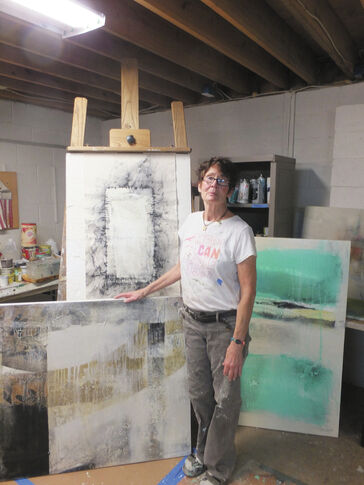
Barth created “The Beckoning” by drawing the words in paint, scrubbing them off, overlaying the words in graphite and then repeating the process, “to create a vaporous and dreamlike quality, as if the words were calling from afar.”
“The Beckoning” was painted in the back yard of Barth’s home on raw canvas. “I felt it spoke to the people themselves. Those who are also raw, the raw materials of which we are all a part, the melting pot of dreamers, America.”
For most of Barth’s artwork, water is an integral part of the process. She throws water at the painting and then hoses it off. “I can’t work without it being wet,” she said.
Barth, who was one of the Trenton Artist Workshop Association’s delegations to the Soviet Union in 1989, is also a poet and speaks in a poetic way about her work. “I’m the wind instead of having the wind outside myself — I make the movement.”
Her day begins with writing in her journal, drawing, watching backyard birds, and writing poetry — it is purely for personal expression, and she hasn’t published it. It’s all part of her process of taking something from inside and putting it outside.
When she gets into her studio, it’s all about experiencing pleasure — and the text finds its way to her canvas. She may use an old drawer with partitions to print from, then collage on top, scrub it off.
“I don’t have a standard way of doing this,” she said. “I may have a plan but then go in a different direction.”
Barth said she prefers not to choose content, but allows herself to submit to the work instead.
“The choice of material or technique, the use of collage, sand, relief surfaces, and pouring are simply means to an end, a spontaneous response to the work in progress.” The works are a meditation on the moment they happen, she said.
If it all sounds very Zen, that would make sense. Barth was once a lecturer on art as Zen at Brooklyn College. As director of the art department at the Titusville Academy, she worked for 30 years with a special needs population as an art therapist.
Barth grew up in Pittsburgh. Her father, a draftsman, drew and sculpted things like a carved stalk on a rifle he used for deer hunting. Barth was always interested in his tools, but her father discouraged that interest, just as he discouraged her mother from working outside the home.
When her father died, she went through his workbench and found her favorite of his tools, a file, with a note tied to it: “For Joy.”
From watching her father control her mother, Barth was determined that no one would ever stop her from doing what she wanted.
“I was always bucking my father’s ideas, climbing hills and getting on boats,” she said. “There were lots of rivers and lakes and wild hills, though no ocean.”
With her brother, Barth kayaked, canoed and went white water rafting. “I had a strong upper body, but in college I crushed a vertebra in a car accident. I didn’t let it stop me — I pushed myself because I wanted to get everything in.”
As a child, Barth’s first love was music. She studied piano, guitar, and flute. Her piano lessons were in a turreted convent, taught by a nun who told her to go home and tell her mother she was wasting her money, that Joy had no talent. “I thought she was crazy and missing the point, which was enjoying the music.”
So with encouragement from her mother, Barth knocked on the door of the pianist from the Pittsburgh Symphony and subsequently took lessons.
“Do we get our stubborn streak genetically, or does it evolve from childhood determination? As a teacher, I think how we’re affected by the environment, by people who suppress us,” she said. “Why do some thrive and others don’t?”
Barth earned a bachelor’s degree in art education from Indiana University of Pennsylvania in 1959 and took graduate courses in fine arts at Carnegie Mellon, then later at Rutgers.
She raised her children in Pittsburgh, and then the family moved to Belle Mead when Barth’s ex-husband started a software company in Princeton in the early 1970s. In Pittsburgh Barth painted in watercolor, but became more expressionist in New Jersey.
“The ’80s were a great time in this area: there was no end to exhibits, and I sold so much,” said Barth, who gradually became an abstract painter.
After retiring from the Titusville Academy in 2010, Barth thought she would devote herself to art full time, but realized she missed teaching. Now she works one day a week at Children’s Day School, also with special needs students.
From her work getting children to show their emotions, Barth has learned to open her own feelings that had been suppressed during her upbringing. Although she had begun writing poetry in high school, she made it a part of her daily practice while teaching. She also explored her own spirituality through yoga, Buddhism, Universalism, and Quaker meetings.
“As our lives change, marriages fail, children pass away, as we sail, every day we’re weaving a thread,” she said. Attending Buddhist sanghas has helped to turn those loose threads into a cloth, in her words.
Driving home that point is the fact that “America Through Artists’ Eyes” is dedicated to Nancy Kerns, a fellow member of the Princeton Artists Alliance , who passed away before the show opened in November 2014. Barth said that Kerns and O’Reilly were the ones who planted the seeds for the exhibition.
Barth said in the end, everyone was amazed when they saw the assembled collection of works hanging on the museum walls as the exhibition opened.
“There is such an exploration of ideas,” she said. “Some works explore the natural world, others to work with a personal narrative, political commentary, focus on historical events, social or political issues.
“This is a unique and thought provoking exhibition, full of different ways to look at the same broad subject. Each work in the exhibition has a statement from the artist, hung beside their work, a way for the viewer to step into the thought process of the artist and a way for the artist to speak not only through his or her art, but verbally too.”
Some information in this article is reprinted from a story by Ilene Dube in the Oct. 29, 2014 issue of U.S. 1 newspaper.
,

