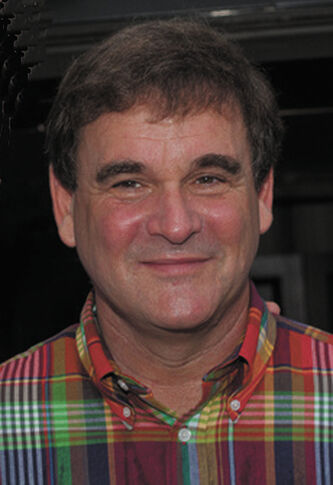
Laurence Fieber, director of the Center for Future Educators, who runs the Urban Teacher Academy at the College of New Jersey.
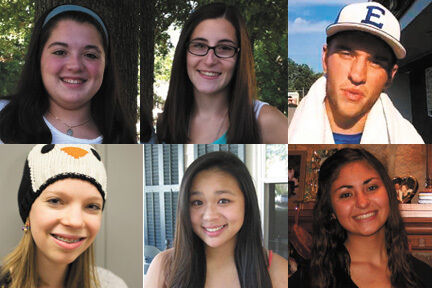
Mercer County students attended Urban Teacher Academy during the summer. Top: Robbinsville High seniors Erica Falk and Danya Goldstein and 2013 Ewing High graduate Evan Patrick. Bottom: Princeton High senior Harmony Kingsley and Hopewell Valley Central seniors Zoe Thompson and Elisa Mastroianni.
The College of New Jersey encourages future teachers to choose urban school districts
In a perfect world, every community would be staffed with have a world-class school to teach its children. Unfortunately that’s not the case — especially in many urban school districts.
“Some of our urban schools have a long way to go to be able to reach that standard,” said Laurence Fieber, director of the Center for Future Educators at the College of New Jersey.
Fieber runs and teaches the Urban Teacher Academy — an intensive two-week program designed to attract students to teaching in urban school districts. The program, which is held every summer at the College of New Jersey, hosted 54 students this year from 23 New Jersey High Schools, including Princeton, Robbinsville, Hopewell and Ewing.
The practices that go on in some of those [urban] schools are unacceptable in terms of how we’re preparing kids for the future” Fieber said. “Kids from districts like West Windsor-Plainsboro, Princeton and Hopewell have a certain educational environment. Our city kids have something completely different in terms of opportunities, facilities and the high attrition rate of teachers.”
Fieber, 63, knows first hand about the difference between and urban and suburban schools. After working for more than 20 years as a teacher and administrator in the West Windsor-Plainsboro School District, Fieber left, and for a decade was principal of Parkway Elementary in Ewing, an urban rim school located on the border of Trenton.
The UTA, which is run by the Center for Future Educators, began at TCNJ in 2006. The program was developed by Fieber and other education experts and officials through a federal grant awarded in the early 2000s for teacher recruitment in New Jersey.
“We took a look at what New Jersey was and was not doing in that area,” said Fieber. “We found that there was a need for teachers, particularly in high-poverty hard-to-staff schools.”
“We looked at a variety of different programs that were being offered in other parts of the U.S. and found that New Jersey did not have those programs in place,” Fieber said.
Fieber’s part in developing programs in the state involved creation of a website for urban schools to attract teachers, and defining a framework for an urban teacher academy.
When the grant ended, the Center for Future Educators was created to establish the programs developed through the work done under the grant. Originally, it was hoped that the state would fund the center, but money proved to be unavailable due to the economic downturn. Ultimately, the New Jersey Education Association stepped in and funded the program.
Since it’s inception, the UTA has “exploded,” said Fieber, adding that they have grown from the initial academy at TCNJ to a total of five academies, which are also held at Fairleigh Dickinson, Kean, Rider and Rowan universities. He estimates that 50 to 60 percent of the kids that are involved in the program go into teacher education.
“We attract kids who want to become teachers and encourage their application to state colleges and universities,” Fieber said. “Our hope is to have the kids go through our programs, be educated in New Jersey and then come back and teach in New Jersey schools. Who better to understand New Jersey than people who grew up here?”
He explained that under the program, the kids take several field trips to visit urban and suburban schools throughout the state. The attendees also have an opportunity to interact with college professors and see what life is like on a college campus.
The UTA culminates in a sort of mock classroom activity where more than 50 third to fifth graders from the Ewing Township summer camp program are brought in, and the UTA participants get to try their hand at teaching a “class.”
Not only is the program good for kids who want to be teachers, it can also help some decide that a career in teaching is not for them, said Fieber.
“It’s a virtue for kids to decide early on that, ‘I thought this is what I wanted to do but I had no idea that it would involve X,Y or Z, I want to do something else’,” Fieber said. “That’s a good thing because they had the opportunity to do some career exploration and learn that this is what they don’t want to do.”
That was not the case for Evan Patrick, a 2013 Ewing High graduate who attended the academy in summer 2012. He said the UTA was a “once in a lifetime” experience that reinforced his desire to become a teacher.
He started attending TCNJ this fall with a dual major in secondary education and history and would like to be a history teacher. “It really cemented what I want to do in college and beyond.”
Patrick also said he wouldn’t mind teaching in an urban school district given the opportunity. “I would also be interested in a coaching role,” he said. “I enjoy sports (baseball and soccer) and I would like to teach them as well.”
Patrick attended Parkway School when Fieber was principal there, and said that he was one of his inspirations.
“He was one of the main reasons I want to teach,” Patrick said. “It was amazing watching him interact with the kids every day. He engaged people, and he knew everyone’s name in entire school. I’m sure I look a lot different than I did when I went to Parkway, but he remembered who I was when I came to the academy last year.”
He added that he was also inspired by a lot of the teachers he had during his school years. “I remember being afraid on my first day of kindergarten and holding onto my mom’s leg because I didn’t want to go. My teacher, Ms. Hood was very nice and she laid the foundation for me to enjoy school throughout years.”
Erica Falk, a senior at Robbinsville High School, attended this year’s UTA. She plans on studying elementary and special education in college, with her top choice being Arcadia University.
“My experience at UTA made me want to pursue a career as a teacher even more,” she said. “I absolutely loved my experience and learned so much from the people I met and all of the guest speakers.”
Falk said that she wanted to attend the UTA because she knew it would address the differences between urban and suburban school districts. “I thought that maybe it would help me decide what type of district I would like to teach in.”
She said that although she wants to be a teacher, it probably won’t be in an urban district. “As much as I have thought about teaching in an urban school district, I don’t think it is the type of career that I am looking for. Sometimes I’m still undecided, though, and I start thinking about what a huge impact I could make in urban students’ lives, so it is not totally out of the question.”
Falk said one experience from UTA that made an impression was a field trip to the Joseph Capella School — a school for autistic and multiply disabled children.
“While I was observing a class of seven year old autistic children, I thought it was one of the best experiences I would ever have,” she said. “I loved watching how these children learned new skills. I even came home and told my mom that my dream job would be to work in an autistic school like Joseph Capella.”
In fact, Falk said one of the reasons she wants to attend Arcadia is because it also offers a certification in Autism education.
Robbinsville senior Danya Goldstein said she intends on attending a four-year college where she will study elementary education. She said that although she’s undecided about whether she wants to teach in an urban school, she wants to pursue a career as an educator.
“When I think of my teachers and mentors, I think of elementary school teachers that paved the path of education for me,” she said. “The UTA has definitely opened up my eyes to the many different areas of teaching and why it has always been my passion to teach. The program enhanced my understanding of the teaching profession immensely.”
“Every lesson confirmed my decision to become a teacher,” Goldstein said. “When we went on day trips and encountered students and campers, they all had such a desire to learn. It really did influence my thoughts on becoming a teacher.”
Hopewell Valley Central High School senior Elisa Mastroianni said she intends on pursuing a career in teaching, specifically as a high school math teacher.
She said she was inspired to go to the UTA by her older sister, Christina, who also participated in the program.
“I went to the orientation with her and met Mr. Fieber,” she said. “He spoke with such a passion for teaching and electrified the room with his stories. My sister could not stop talking about it each day she came home from the academy.”
She said the difference between urban and suburban school districts was driven home to her in the first day of the academy.
“We went on a field trip to WW-P High School North and took a tour of the school. The classrooms were updated and supplies seemed to be unlimited,” she said. “Next, we went to Trenton Central High School, which was a shock. The first thing I noticed was the beautiful architecture of the building. However, once we got inside, I saw that the school was falling apart. The ceilings needed to be repaired and there was no air circulation in the school.”
She said she’s undecided as to whether she would teach in an urban district, but she wouldn’t rule it out. “I learned that students in urban school districts are not as involuntary to learning as rumored. If I teach in an urban, rural, or suburban area, I know I will always put the student first and will strive to make a difference.”
Zoe Thompson, also a senior at Hopewell, echoes similar sentiments. “The UTA opened my eyes to being more open to teaching in an urban school district,” she said. “I had wanted to stay in a suburban setting because I grew up there, but during the academy we talked about the benefits and pros and cons of teaching in urban settings.”
Thompson said a field trip to the Trenton Area Soup Kitchen was eye-opening. “I realized that as a teacher you want to create an environment for kids so that they don’t wind up in a soup kitchen and brighten their future.”
Thompson recommended that anyone interested in teaching should get a job working with kids — such as working as a camp counselor, for example. Currently she works with children at Motion Gymnastics in Pennington, and worked last summer at Hopewell YMCA summer camp.
Liana Bloom, a 12th grader at Princeton High School said she attended the UTA because she was considering a career as an educator and thought the academy would be a good place to learn about the education field.
She said that although she’s still unsure whether she wants to be a teacher, if she doesn’t, she would like to teach in an urban district.
“As of right now, I’m looking at education programs in colleges, but who knows where my interests will be in a few months or years from now,” Bloom said.
“I would like to be a teacher in an urban school district, because after become aware of all of the different challenges teachers and students are faced with, it would be such a rewarding experience to try to make my small contribution.”
She said that an English teacher she met on their field trip to Trenton High made comments that resonated with her.
“She told us about what made her become a teacher and how it has changed her perspective,” Bloom said. “She always said that she taught, but was never a teacher. This resonated with me because I have always felt the same way.”
Harmony Kingsley, also a senior at Princeton, said the UTA convinced her that she wants to be a teacher. “I’ve always wanted to be a teacher, so I thought that the UTA would be a good experience in gaining some crucial teaching skills, and also getting a little taste of college life.
“At first, I thought that perhaps I would want to be a teacher in an urban school district, but through the program I discovered that urban teaching may not be for me,” she said. “I don’t think my personality is strong enough to be able to take on teaching a group of kids whom may be difficult to work with.”
Kingsley said she particularly enjoyed working with the campers from Ewing. “That was the best day out of the two weeks. We taught them how to build light circuits, and afterwards we put on a light show with a fun dance. The kids had such a good time and it felt nice knowing that they looked up to us. By the end of the day, one of the girls told me that she thought that I was “a great teacher.” That really meant a lot to me.”
The program means a lot to Fieber too. He said that the opportunity to give kids the opportunity to take field trips and for them to have their own opportunity to teach elementary kids is “magical.”
“We believe that every child is important and sacred,” Fieber said. “If you’re going to be a teacher you have to know how to do it in urban, suburban and rural communities, because your skill set should be reaching out to and connecting with kids.”
Fieber said that in addition to helping kids determine whether they want to be teachers, the UTA is all about finding the special people who can teach in urban schools. “They’re social entrepreneurs. They take a look at problems, they step outside their comfort zone, and they seek ways to solve those problems that exist in teaching in urban districts. We’re training kids to do that.”
“I tell the kids at the beginning of the academy, if I change your life in two weeks I’ve done my job,” said Fieber. “We don’t sugar coat anything, and we are very clear about what the challenges of good teaching are about.”
,