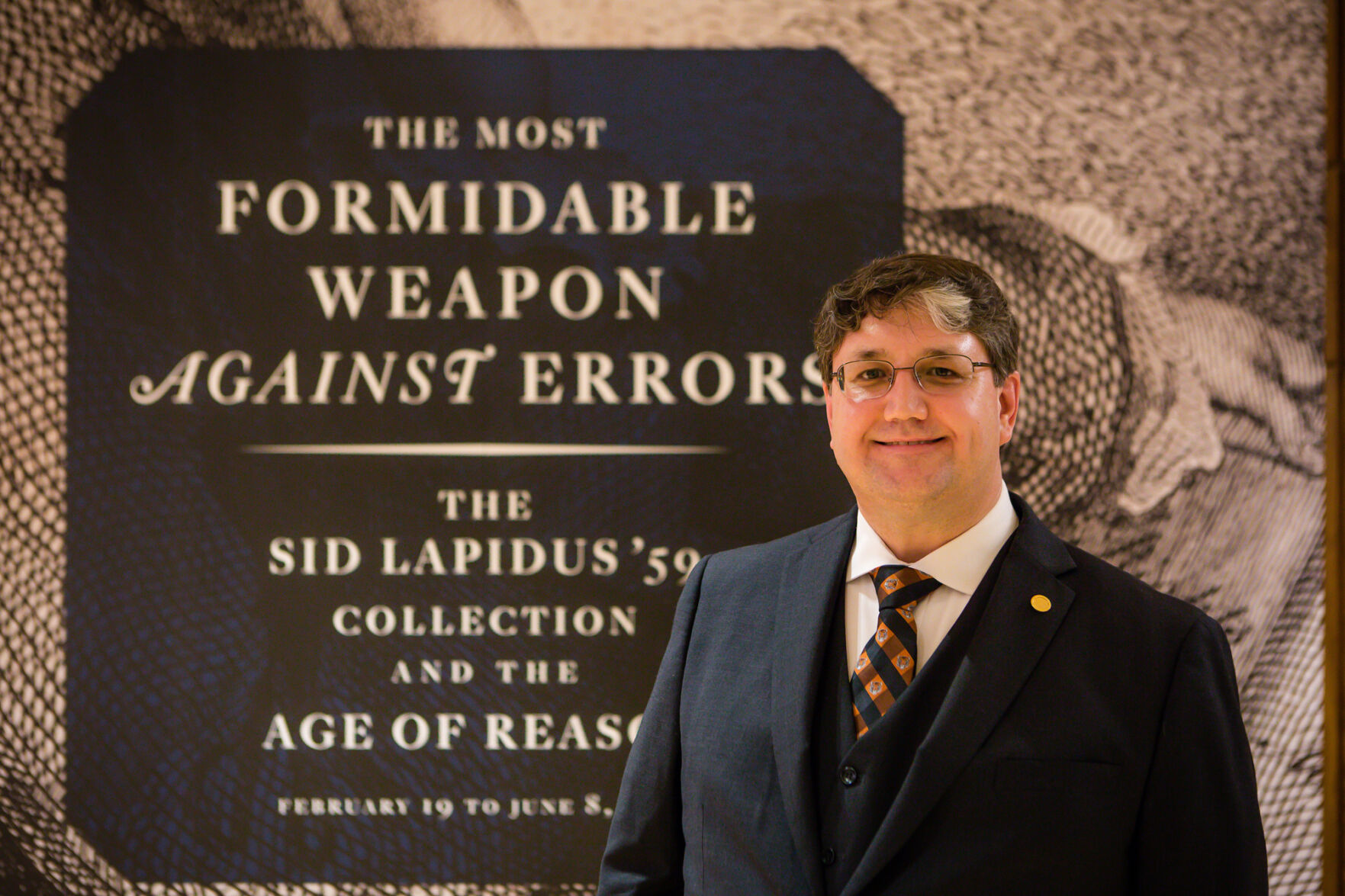
The Milberg Gallery at Firestone Library, a small room now brimming with big ideas about human liberty, political order, and scientific reason, is the location for the new exhibition “The Most Formidable Weapon Against Errors: The Sid Lapidus ’59 Collection & the Age of Reason” through June 8.
Even a 10-minute walk through this carefully designed exhibit will leave the visitor dazzled by powerful texts, images of oppression and freedom, and pithy quotations framed by arches that echo architecture reflecting both historical venues and Princeton University. “If the present generation, or any other, are disposed to be slaves, it does not lessen the right of the succeeding generation to be free (Thomas Paine, 1791)” and “There must be more equality established in society, or morality will never gain ground (Mary Wollstonecraft, 1792).”
The exhibition’s title is borrowed from Thomas Paine’s introduction to his 1794 book “Age of Reason.” After alluding to his criticisms of religion — which he subsequently offered in detail and which led ultimately to his trial for seditious libel and exile from England — Paine asks his readers to remember “that I have always strenuously supported the Right of every Man to his own opinion, however different that opinion might be to mine. He who denies to another this right, makes a slave of himself to his present opinion, because he precludes himself the right of changing it.”
What follows is a short paragraph, the source of the exhibition’s title. “The most formidable weapon against errors of every kind is Reason,” writes Paine. “I have never used any other, and I trust I never shall.”
The exhibition’s curator, Steven A. Knowlton, Librarian for History and African American Studies at Princeton University Library, defines the word “errors” in the Paine quotation as “misconceptions that people form about the nature of reality: what is true and what is not true.”
Thomas Paine ignited Sidney Lapidus’s interest in what grew into his now-3,000-book collection of texts addressing political philosophy, which began with a book by Paine. Growing up in New Rochelle, New York, Lapidus would pass Paine’s home, now the Thomas Paine Cottage Museum, every day as he walked to school. Then in 1959, when he found himself in London with five pounds to spare, Lapidus noticed and then bought a 1792 edition of Paine’s “Rights of Man.” Lapidus has said that “the principal theme of my collection” was embedded in this book’s title.
According to Knowlton, Lapidus continued to gather works that address the question “What rights does a person have that must be respected by their government and their fellow human beings?” The works in the collection are mostly from the 1600s to the early 1800s.
Lapidus donated 2,700 of them to his alma mater of Princeton in 2023 and the rest to the American Antiquarian Society, the Wolf Law Library at William & Mary Law School, the Schomburg Center for Research in Black Culture, the Center for Jewish History, the New York Historical, and the New York University Health Sciences Library. To put together this exhibit, Knowlton had to choose 70 out of Lapidus’ multitude of texts.
The texts are supplemented by graphics and other items, sometimes blown up on the walls for easy viewing. “We wanted to demonstrate that these people weren’t writing in a vacuum, exchanging intellectual ideas; they were living in an active world and were exposed to these concerns,” Knowlton says. Similar ideas are expressed in other media, including satirical prints, illustrations of contemporaneous events, and even tools used by artisans in different trades.
Enlightenment thought touched on many issues raised in this exhibit. One important one was how we know things? During most of European history, the accepted answer to this question could be traced back to the Bible or Aristotle. David Hume and others had a different approach: using introspection to create knowledge in our minds. The process begins with observation — we see things happen. But reasoning is necessary to determine, say, whether sequential events are connected or whether their proximity is merely circumstantial. “When people fail to scrupulously exercise the power of reason,” Knowlton observes, “many erroneous thoughts arise.”
Another important aspect of Enlightenment thought was that of “natural rights.” Knowlton observes, “The notion that everybody is entitled to their ‘natural rights’ has come to be a cornerstone of our politics and our jurisprudence.” These natural rights include the right to life (freedom from arbitrary execution by the government without due process), to liberty (freedom to do what one wishes with our bodies, but also having liberty of conscience to express, within the bounds of law, both political and religious opinions and to work with likeminded people to achieve our ends), and the pursuit of happiness (traditionally meant as the right to be an economic actor, to own property, and to engage in trade). Knowlton traces “every advance in civil rights” to these natural rights as they are enshrined in the 14th Amendment.
“A corollary that follows is that if you have the right of liberty of conscience, you probably ought to have a say in how you are governed,” Knowlton says. “That’s the philosophical principle behind democratic politics.”
Just to be able to talk about this idea, Knowlton explains, was an intellectual innovation that came with the Age of Enlightenment. Before that, he adds, “there wasn’t anywhere in the world where you were thought to be entitled to share in how you are governed — whoever had the biggest sword had the biggest say.”
Edmund Burke argued against Paine, claiming, Knowlton says, “that whereas all people may be alike in dignity, they are not all alike in resources and capacity, and hence equality is not the only standard by which a government should be measured.”
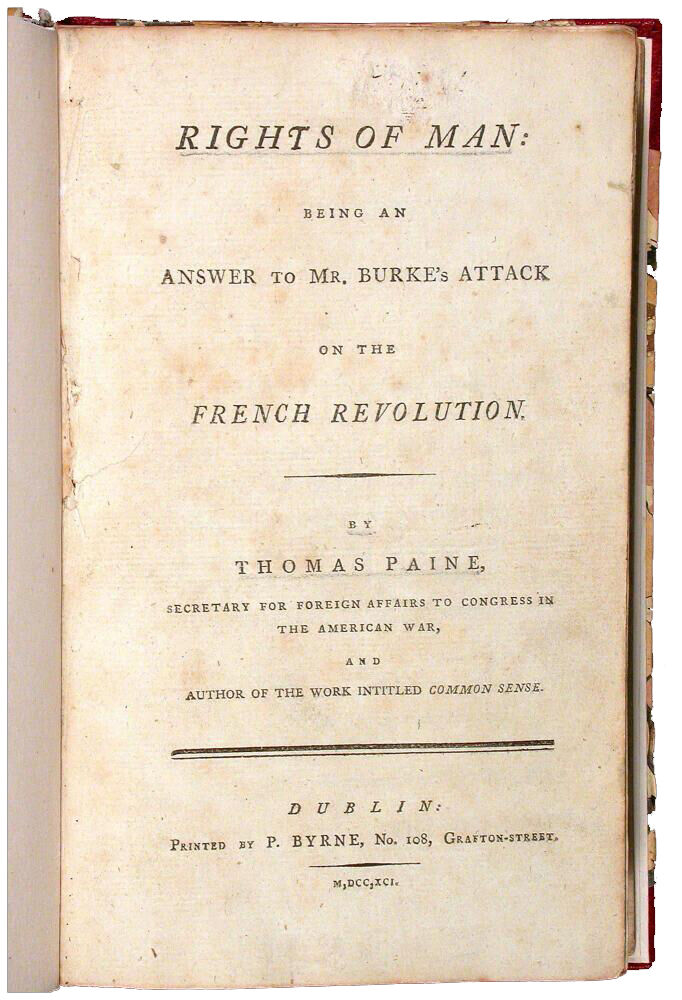
The goal of the seven segments of this exhibition is to show the diversity of Lapidus’ collection. To introduce Thomas Paine, Knowlton chose his book “Rights of Man: Being an Answer to Mr. Burke’s Attack on the French Revolution (1791).” Its main theme, Knowlton says, is that it is antidemocratic to argue for maintaining traditional structures without scrutinizing them “because [then] we are giving the dead a say over the living.”
To represent the Stamp Act, one choice of Knowlton’s was James Otis’ book “The Rights of the British Colonies Asserted and Proved (1791),” which, although it predates the Stamp Act, argues that taxation of unrepresented colonists is a violation of their natural rights. As graphics relating to the Stamp Act, Knowlton chose one where colonists were rebelling against tax collectors by tar and feathering them and another where colonists were celebrating the act’s repeal.
To represent abolition, one choice of Knowlton’s was one of the latest books in Lapidus’ collection, Frederick Douglass’ “Lectures on American Slavery (1851).” The first lecture explored why slavery was wrong, maintaining that it was a sin against Christianity. In the second Douglass attributes the wrongness of slavery to its violation of the natural rights of enslaved people, focusing in particular, Knowlton says, on the “right to liberty” at a time when “slave owners could kill a slave with impunity.”
Because the abolitionists also communicated their ideas through visual media, the exhibit includes “Description of a Slave Ship,” a cross-section of a ship used in the Middle Passage showing just how tightly the slaves were packed. Its publication in 1789, Knowlton says, was “the first time the public at large was made aware of what brutality occurred in the Middle Passage.” The exhibit also includes small medallions with images portraying abolitionist sentiments, for example, a kneeling man with manacles and the words “Am I Not a Man and a Brother?” People would sew these medallions on their clothes or pass then hand to hand.
In the exhibition section titled Emancipation of Jews in England, Francis Henry Goldsmid, a Jew, in his “Reply to the Arguments Advanced against the Removal of the Remaining Disabilities of the Jews (1848),” makes the case, Knowlton says, “that those who share the burthens of a state, ought in justice … to share its honors also.” Those honors, for Goldsmid, included holding office.
In 1290 the entire 3,000-person Jewish population had been expelled from England, but during the 17th century discussions began over whether Jews should be allowed to return. Even in the 19th century, however, Jews remained barred from Parliament, because its members swore a Christian oath. Between 1848 and 1858, several bills were advanced to reform this practice, and, Knowlton says, “the final barrier fell and the first Jewish member of Parliament, Lionel de Rothschild, took his seat.”
Talking about the Medicine section, Knowlton ties Noah Webster’s work on the causes of the yellow fever epidemic to reason. “Known as lexicographer, Webster was a Renaissance man and a big wheel in the Federalist party. He was also the first person to begin a systematic study of epidemiology in United States, using reason.” Webster collected reports from doctors throughout the country and tried to figure out what the various outbreaks of yellow fever had in common. He deduced that “stagnant water” was the cause, but did not have access to the technological advances necessary to tie the stagnant water to the mosquitoes that actually carried the virus.
The section on Atomic Bombs also fits into the overall conceptual ideas of the exhibition. “The connection we are making is that this practice of observation, reason, and improved tools leads to these incredible scientific advances; like it or not, it is a remarkable achievement to learn how to split an atom and release energy,” Knowlton says. In fact, use of the scientific method to understand nature was just beginning in the period that the exhibition covers.
At the end of 2022, when Knowlton was asked to create an exhibit displaying the breadth of a huge and somewhat diverse collection of texts, where did he start? “I got the title list of everything he owned and looked for themes,” he says. Once he decided on which books to include, Knowlton wrote for each one a “tombstone,” a “bare-bones” label that “orients the reader to who the author is, what they are addressing, other books they are in conversation with, and the gist of their argument — all in 70 words!”
Knowlton grew up in Mount Pleasant, Michigan, a town of 25,000 an hour north of Lansing, whose big industry was Central Michigan University. His father was his eighth-grade history teacher, and his mother ended her career as an insurance agent.
“I have never not been interested in history. Most people enjoy things they are good at, and I am blessed with the kind of brain that remembers facts, and what happens before and after,” Knowlton recalls.
Knowlton majored in history at the University of Michigan, and his strongest interest lay in 20th-century American history: “It’s close enough to my own time that I basically understand the mindset and the technology. Also, it’s so well documented. The mid-20th-century newspaper is a thing of wonder.”
After graduating from college in 1994, he spent some time as a secretary, but as he was about to turn 30 and sitting in the medical library at the University of Michigan, he says, “Inspiration struck: this is my favorite place in the world; I should be a librarian.” The librarian told him about library schools, and he enrolled at Wayne State University in Detroit, focusing on cataloguing.
After earning his master’s in 2003 and stepping out into the real world, he realized that he was pursuing a tough field and spent five years at Proquest, a publishing house that largely sells to libraries. Although he survived three reorganizations there, his wife agreed they could leave Michigan if necessary for him to find a library job. In response to the hundred resumes he sent out in the wake of the 2008 recession, he got only two calls. But one was from the University of Memphis Libraries, where he was hired in 2010 in collection development.
At the university, librarians were considered as faculty, eligible to earn tenure. One requirement for him to move beyond his assistant professor rank was to get a second master’s degree. “Since it was free, I enrolled in the history master’s program at the University of Memphis. Since I thought I would be spending the rest of my career in Memphis, I decided to learn as much as I could about the history of Memphis,” Knowlton says.
He studied African American and Southern history, along with some independent study. The topic of his master’s thesis grew out of his discovery that sit-ins against racial segregation in Memphis began March 19, 1960, with 41 students in the Memphis Public Libraries. The title of his thesis, submitted in 2015, was “Memphis Public Library Service to African Americans: A History of Its Inauguration, Progress, and Desegregation.”
Knowlton shares a couple of take-homes from his research. “What is really striking if you look at the history of segregated cities in the South is the robustness of institutions people had to build because they were excluded.” Another significant point, he continues, “is something I think gets glossed over in the way the civil rights movement has been treated in most of American history. The Civil Rights Act and the Voting Rights Act allowed the courts to intervene when the plaintiff brought a suit. Every single institution had to be desegregated separately with a lawsuit or a protest campaign. … The intransigence of the white power structure was deeper than most people realize these days.”
Knowlton has also been fascinated by flags since childhood and has written several academic papers about them. When his kindergarten teacher was teaching about Ghana and showed her students its flag, he recalls, “that was the first time I realized there was more than one flag in the world.” So of course he memorized all the flags in the world. And when as a professional librarian he was expected to publish, he discovered the single periodical devoted to flags, “Raven,” so named because the first flag flown in America, by the Vikings, had a raven on it. His earlier papers on flags looked at the symbols on them and later ones focused more on flags as an expression of historical phenomena, for example, the flags of the black nationalist movement.
In 2006, when an immigration reform bill was being proposed that would make enforcement of immigration law stricter, there were massive protests in Los Angeles and Chicago where immigrants were flying flags of their home countries. As the conservative media were labeling them as disloyal, Knowlton was investigating an article about what the people were thinking when they flew these flags.
His next career move came as a bit of a surprise. The same month that he finished his master’s degree, the job at Princeton was posted on a listserv, and he thought, why not apply, “the worst that I’ll do is waste an evening putting my resume together, the best thing is that I would get a free trip to Princeton.” In 2016, the same week that he earned tenure at the University of Memphis, he got the job offer from Princeton to work as Librarian for History and African American Studies.
Because the circumstances of every historical moment are unique, Knowlton does not believe we can “learn from history.” However, he observes, “If you look at the debates we are having over how our government should be organized and function, they are all within the bounds of the notions of governance that came about through the period of the Age of Enlightenment: how should the will of the majority be implemented versus how the rights of minorities should be protected.”
The Most Formidable Weapon Against Errors: The Sid Lapidus ’59 Collection & the Age of Reason, Milberg Gallery, Firestone Library, Princeton University. The gallery is free and open to the public weekdays, 10 a.m. to 6 p.m., and weekends, 11 a.m. to 6 p.m. Guided tours of the exhibit are offered Saturday and Sunday, April 5 and 6, from 1 to 1:45 p.m., and Tuesday, April 15, from 12:30 to 1 p.m. Check online for additional future dates. On view through June 8. library.princeton.edu/lapidus2025.