We are a society constantly on the move. Every day we are committed to errands. Products that we order are delivered to us by box trucks that carry an array of large and small parcels. Commercial trucks are loaded with items destined for retail stores and businesses across the country and beyond.
Not a day goes by that we don’t see any of these trucks traveling along the highways. Most of the time we don’t care about what these trucks carry as long as they make their destination. For that matter, we don’t care how they are delivered. All we know is that on most occasions these products are wrapped and secured with corrugated cardboard for safe transport. But who came up with the concept that a versatile item like corrugated cardboard would make our lives easier? Yep. A Bordentown resident.
George W. Swift, Jr. (1867-1942) was born in Philadelphia to George W. Swift (1842-1914) and Mary Jane Nesbit Swift (1841-1914). Both of his parents were English immigrants that settled in America during the late 1850s. His mother arrived in 1857 and his father arrived in 1859.
He served in the U.S. Navy as a waterman before obtaining the rank of captain. The family consisted of at least two sons and three daughters.
As a child, young George and his family visited the Centennial Exposition in Fairmount Park, which was considered the first successful world’s fair. Opening in May 1876, it celebrated a century of discovery since the Declaration of Independence.
One of the most fascinating structures was Machinery Hall. Covering an area of almost 560,000 square feet, this architectural marvel in its simplicity resembled an enormous greenhouse with thousands of operable windows.
Well received by the public for its design and striking light-blue appearance, upon entering one of eight entrances, the interior housed many machines from nations across the globe. Featured exhibits included a Corliss steam engine, a Baldwin locomotive engine, a 56-ton flywheel, an early internal combustion engine, an Otis elevator, an ammonia compressor for refrigeration and ice making, a massive Seth Thomas clock, and Alexander Graham Bell’s Telegraphic Receiver. Symbolically, the building represented the power and strength that technological development had to offer.
Awestruck by the complexity of the machinery, young George and many like him walked away with a sense of pride that they too could make strides in our nation’s industrialization with great will and determination.
When the family moved to Bordentown several years later, George learned a machinist’s trade and worked in a factory along the Delaware River in nearby Fieldsboro. At the age of 21, he moved back to Philadelphia for a while, becoming engaged with a business partnership for a machine press as well as lovely woman by the name of Stella Saylor (1870-1966).
By this time, the Philadelphia area was already rated as one of the largest saw manufacturing centers in the world. Companies like Disston dominated the majority of the country’s lumber industry by producing millions of hand saws, circular saws, band saws and files every year. This boom included smaller companies such as the American Saw Company in Trenton, which employed fifty workers. Ceasing on its success, George moved his operations from Philadelphia to the factory site in Trenton.
In 1901, George was presented with the opportunity to purchase the Bordentown Rug Factory on Park Street in Bordentown. In doing so, he and his wife also bought a magnificent Italianate home on Prince Street that was formerly the residence of Robert Schuyler Van Rensselaer (1808-1877), a descendent of a wealthy family from Amsterdam that settled in upstate New York and an important figure in his own right as superintendent of the Camden and Amboy Railroad.
While decorating their new home, George graced the property with an elegant gazebo and Victorian era embellishments such as an iron stag and large garden urns that were cast at a foundry. Overlooking the Crosswicks Creek, the home had a prominent belvedere with windows that afforded scenic views in every direction.
However, since the staircase posed an extracurricular workout to reach this hypnotic destination, an Otis elevator was installed between the first two floors for convenience. It was also a necessity when his elderly parents lived with him.
In the factory on Park Street, Swift hired specialists to design and build special machinery that would significantly improve time and labor costs involving businesses and homeowners. With over 100 patents to his name, he manufactured machines that revolutionized the paper industry. Starting with corrugated cardboard, he discovered that the material “provides a plurality of corrugated webs having their corrugations intermeshed and connected with each other at their crests…so that they are capable of relative movement and are not crushed together by strains which would collapse a single web of their aggregate thickness.”
Therefore, the cushioning of corrugated cardboard prevented products from damage during shipping and packaging. In addition, the machines created folds and slits for easier assemblage of container boxes.
As if this wasn’t miraculous enough, the factory stored a vast array of machines that manufactured paper cups, bottle caps, paper bags, tickets and baggage tags, printing paper, and even some of the first commercially successful pre-gummed envelopes in the country. But before the age of Styrofoam, it was the creation of cardboard egg case partitions that carefully cradled the soft shells from breakage during transport. Suffice to say, George received a patent for that as well.
By 1916, his business was known as George W. Swift, Jr., Inc. with George rightfully serving as president. Through the years, his machinery was sold to numerous countries including Canada, England, France, Germany, Italy, Sweden, South Africa, and Australia. At the height of its success, the company in Bordentown employed almost 300 workers.
Yet success doesn’t always equate prosperity. A critical housing shortage made life problematic for employees and their families to reside in the city. Addressing the situation, the company bought a large tract of land three years later which extended from Union Street through to Chestnut Street for the sole purpose of constructing 120 modern dwellings.
This was the catalyst that prodded other building enterprises to unfold for the first time in the history of the town. Despite efforts from an outside firm to make this dream a reality, unfortunately it foundered under the breadth of bureaucracy, an economic depression, and war before a formal ground-breaking ceremony actually happened three decades later.
Built by the 20th Century Construction Company of Camden for $750,000, the development site was known as the 96-unit Bordentown Manor Apartments. Today it is recognized as the Chestnut Village Apartments.
As civic minded individuals, George and his wife enjoyed their status as philanthropists in giving back to the local community. Noticing the deteriorated condition of the abandoned one-room schoolhouse in which Clara Barton taught before she founded the American Red Cross, the Swifts acquired the structure at a Sheriff’s Sale for $300 and sold it to the New Jersey State Board of Education for $1.
With the sale came the understanding that it would be restored and preserved as a memorial to her humanitarianism as the centennial of her birth approached in 1921. On the day of its dedication, many school children, their teachers, and state dignitaries, including New Jersey Governor, Edward Edwards, came to celebrate.
The schoolhouse wasn’t the only project of educational value and learning that the couple found worthy of funding. Their generosity, along with other individuals, helped lay the foundation for a community library on East Union Street. Dedicated in 1941, the occasion was met with exuberance amid fanfare. Today it is a branch of the Burlington County Library System. In the lobby stands a bronze plaque forever memorializing their names and the selflessness that they embodied.
In 1942, this pragmatic community leader died in his home. In addition to being an inventor and industrialist, he faithfully served as a member of the Masonic Lodge, a member of the Yapewi Yacht Club, a volunteer fireman, and a director of the Bordentown Banking Company.
He was buried in the Bordentown Cemetery where his wife would join him 24 years later. In 1964, his company shut its doors.
Although the name of George W. Swift, Jr. is not recognized in history books, you can honestly say that he was the person who thought outside of an actual box.
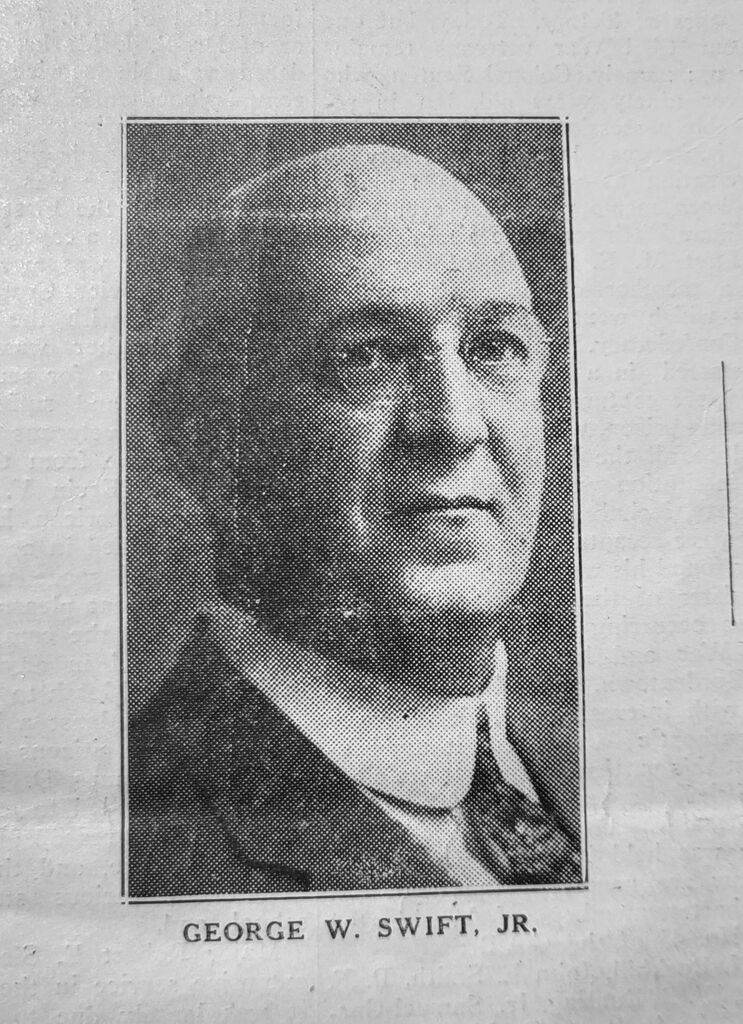
George W. Swift, Jr. (Photo courtesy of the Bordentown Historical Society.),

