Princeton University awarded Bordentown Regional High School seniors Ifeoma Eleazu and Chimkasimma “Kasi” Oguonu with a 2018 Princeton Prize in Race Relations for programs they founded to support difference, expand opportunities for diverse populations, and respond to the institutional racism they see around them. Eleazu founded Cultivate Culture, “a diversity acceptance group,” and Oguonu created STEM For Kids and Bordentown College Tours.
Cultivate Culture gives minorities a voice and a place to hold discussions of “all things involving and considering minorities,” Eleazu, president of the club, says. During the biweekly afterschool meetings, “we have a safe space for people who experience things like we experience to speak out on it—not just to empathize personally, but to figure out ideas about how we as individuals and groups can come together to find that common ground and combat society’s problems that oppress the minority.”
From her experience with Cultivate Culture, which also hosted a multicultural night this spring, Eleazu says, “I’ve learned that to only look at what involves you is extremely selfish. Not only are we going through a lot personally and consciously, so are other people, and there are different sides to everybody’s story.”
During her sophomore year, Oguonu, secretary of Cultivate Culture, noticed that many of her minority peers were not looking at four-year colleges, “not because they didn’t have the criteria to attend, but because they felt they weren’t smart enough or capable enough to survive in that sort of sphere.” She decided that school-sponsored tours to schools instate and out of state might ameliorate this problem. Her goal, she says, was “to welcome inclusivity into the college process and to show all these kids that they are capable of going to these four-year universities.”
Some evidence suggests that the tours have made a difference in people’s lives, because in the past year, Obuonu says, “more minority students are attending a four-year university.”
This year Oguonu started a second program, STEM for Kids, after realizing there were few afterschool activities targeted to people interested in science, technology, engineering, and mathematics. Her idea was that high school students would teach STEM topics to students at MacFarland Intermediate School and Bordentown Regional Middle School “through a more experiment-based way of learning.”
The high school students create a STEM lesson that incorporates activities and experiments that help the younger students learn more about a particular topic. Their lessons always include an innovator of the day who is purposely a person of color or a woman (or both) who has revolutionized the STEM topic they are exploring, she says, “to show white and black kids that people who look like me are capable of making these great changes in STEM.” Examples are Ada Lovelace, Marie Curie, George Washington Carver, Mae Jamison, and Carlos Juan Finlay. Following the presentation, the high school students help the younger ones as they work on an experiment.
Eleazu and Oguonu’s activism grew out of their own struggles as “outsiders” who had to reconcile multiple identities.
Eleazu talks about growing up in a family of recent immigrants. “It was hard because there was a form of double consciousness that I had to grow into; within my house, I was surrounded by a culture directly linked to Nigeria; it was a different lifestyle than when I was in school assimilating to American culture and learning American culture.”
Oguonu, also a first-generation Nigerian American, adds, “Our households are so vastly different from American culture; I consider my house is like a portal to Nigeria… and I’m in that always when I’m home and American culture doesn’t permeate into that sphere. I am around Nigerian food, clothing, language [Ibo], mannerisms.”
‘Many people try to ignore [race] as a whole because it doesn’t affect them, because they are privileged by their race. It is deeper than just the color of your skin.’
There are also positives to having a strong African identity, Oguonu suggests. “I know exactly where we came from and have that direct connection to Nigeria and our culture and can openly celebrate that culture and appreciate certain aspects of that culture.” This, she adds, is not true for many African Americans, “who can’t necessarily pinpoint what country they came from—it is a plethora of different countries.”
Another struggle the young women have is being at “the intersection of being too African for the black kids and too black for the American [white] kids,” Eleazu says.
The two young women’s understanding of race in America has propelled much of their activism. Eleazu says, “Many people try to ignore [race] as a whole because it doesn’t affect them, because they are privileged by their race. It is deeper than just the color of your skin; it is institutionalized in ways that we can’t see for ourselves. People should be aware of it because it’s harmful.”
Oguonu adds, “It’s based in these institutions that were established in the start of America. America has racism inherent in the fabric of our society. By acknowledging that and working to uproot those structures that have enforced that kind of rhetoric, we should come together as a society to break those ties to racism.”
Eleazu distinguishes between two types of racism directed at African Americans. “There is blatant racism, where it is easily punished and pointed out.” But more prominent are microaggressions, which Eleazu describes as “little comments … that are targeted and have some connection to race that are offensive.”
The young women offer a laundry list of microaggressions they have experienced. People have touched Eleazu’s hair without asking, or called her hair “nappy” or talked to her about “good versus bad hair.” Or people use the terms “ghetto” or “ratchet” (slang for “wretched”) based on the assumption that “a ghetto is always black or dirt poor,” Eleazu says. “Calling something ghetto or ratchet means it has a connection to urban or black America, implying it is gross or bad, and not doing something to fix it.”
Other microaggressions, Oguonu says, refer to a person as an exception to her race, for example, “You’re pretty for a black girl.”
When confronted with a microaggression, Oguonu says, “Some people believe it is meaningless because it is not as blatant as using racial slurs, like the n word.”
Eleazu explains that people are “not used to thinking outside what is normal for them” and will say things like “I miss the old days when no one was called out for this.” Or, Oguonu says, people will ask black students, “Why are you so sensitive? Why do you take it to heart?”
“When we call them out, because we are aware that talking like this is toxic, they get defensive,” Oguonu says.
‘They’ve made the effort to start change in a positive manner, and I think their peers respect them for that.’
Eleazu says she has also been made fun of and socially ostracized because of her skin color. For example, she says, if kids “drew on you with a purple marker and it didn’t show up, then you were too dark.” Or, Oguonu adds, kids would “shut off the lights and try to find me in the darkness.” Both young women also got called names referring to their African heritage, like Kunta Kinte, the slave in Alex Haley’s “Roots.”
Eleazu’s father was a chemical engineer working for Exxon Mobil in Nigeria; today he is a realtor. Her mother, who died in 2014 of lymphoma, was a midwife in Nigeria and fulfilled her dream of becoming a registered nurse in the United States. Eleazu has two older sisters, 25 and 23, who grew up in Nigeria, and a younger brother who is 14.
Oguonu’s family won the visa lottery and immigrated to America in 1996, before she and her siblings were born. Her father earned a degree in civil engineering in Nigeria. Her mother studied teaching and business management in Nigeria, but studied nursing here and is now a nurse practitioner.
Oguonu plans to study electrical and computer engineering at Rutgers University, and Eleazu will study government and politics at the University of Maryland.
Amy Rabenda, Eleazu’s counselor, spoke to Eleazu’s and Obuonu’s accomplishments. “They didn’t do it for the recognition but it is awesome that they were acknowledged for it. It is an opportunity for our younger kids to see their leadership and what they did, and to be inspired by them.”
She herself left the awards ceremony inspired by their willingness to take action against a problem rather than just complaining about it, and remembers thinking, “What am I going to do?”
Michelle Leusner, Oguono’s counselor, says, “Kasi is always on the ball, an overall great kid, and a go getter. If she sees a problem, she wants to find a solution.”
Rob Walder, principal of Bordentown Regional High School, says of Eleazu and Oguonu, “In my years of experience those two, Kasi and Ifeoma, are probably two of the most driven and passionate students I’ve had the pleasure to work with. They are mature beyond their years, and intent on making the most of their experiences.”
“They’ve made the effort to start change in a positive manner, and I think their peers respect them for that. They’ve created programs that will last after they go.”
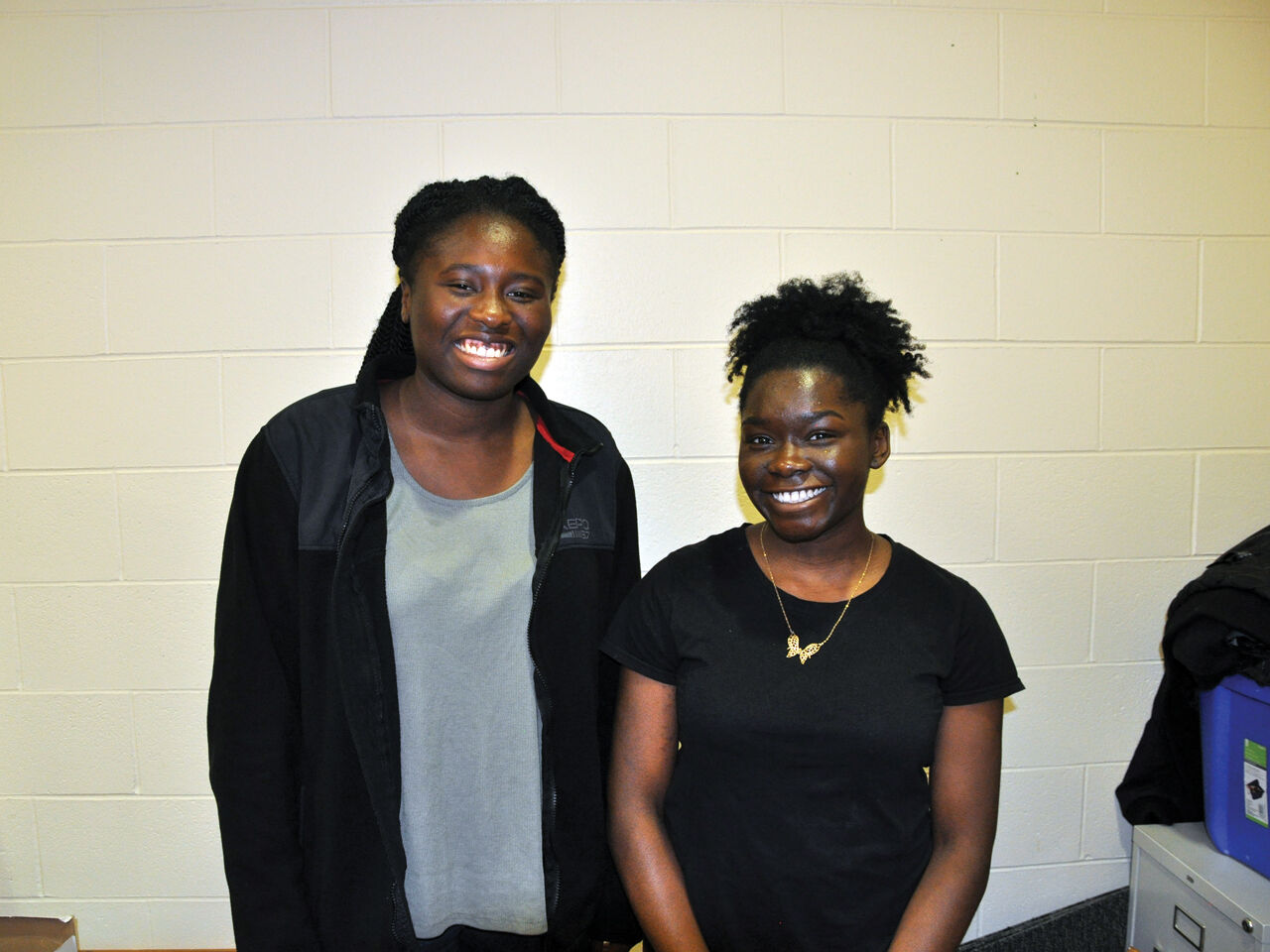
Bordentown Regional High School students Kasi Oguonu (left) and Ifeoma Eleazu were recognized by the Princeton Prize for Race Relations committee last month. (Photo by Michele Alperin.),

