In January 1776, a pamphlet titled “Common Sense” was published in Philadelphia by an anonymous author. Its effect was almost immediate. Two weeks after its first publication, Gen. Charles Lee, writing to General George Washington, stated, “Have you seen the pamphlet Common Sense? I never saw such a masterly irresistible performance—it will if I mistake not, in concurrence with the transcendent folly and wickedness of the Ministry give the coup de grace to G. Britain—in short I own myself convinced by the arguments of the necessity of separation.”
Washington called it a “sound Doctrine, and unanswerable reasoning” laid out within its contents. Within weeks, it would be republished in newspapers throughout the colonies. By April, the colonies were increasingly coming around to the idea that declaring independence was not only possible but desirable. The author of the pamphlet, Thomas Paine, was soon to become a household name throughout North America and Britain.
Well before he called Bordentown home in the mid-1780s, Paine was born in England in 1737. His life before arriving in America was one of struggle and heartbreak. He was educated, but drifting between professions, when his first wife, Mary, died during childbirth. He remarried in 1771 to a woman named Elizabeth and the two took over her father’s tobacco shop.
The marriage was tumultuous with evidence of spousal abuse; the business soon failed. It was during this time that Paine began writing political pamphlets. After separating from his wife, he traveled to London and met Benjamin Franklin, who in turn recommended he relocate to America. With a letter of introduction, Paine arrived in Philadelphia in November 1774. Within six months, he had become editor of the Pennsylvania Magazine and penned several political works, including one that challenged slavery.
Paine was serving as a volunteer aide to Gen. Nathanael Greene in November 1776. After the disastrous defeat at Fort Washington on Nov. 16, the Americans were forced to abandon Fort Lee four days later. In all, the Continental army lost 2,900 soldiers and tens of thousands of muskets, cartridges, tents and other irreplaceable equipage.
It was during this march south through New Jersey that Paine began writing “The American Crisis,” famously begun with “These are the times that try men’s souls….” So impressed by its summary of what was at stake, Washington had the pamphlet read to the troops as he planned his attack on Trenton.
In the ensuing years, Paine would serve as a secretary to the Committee of Foreign Affairs, travel to France on diplomatic terms before spending a long period in Revolutionary France that nearly lost him his head. He died in New York City in poverty, alone and largely forgotten in 1809.
How could this be? Newspapers acknowledged his contributions to the Revolution but also pointed out how far he’d fallen out of favor with many he once called friends. Chief among them was George Washington.
One of Paine’s worst characteristics was his vanity, and his propensity for accusing others of slights he perceived to wound his reputation. Many of these were unfounded and invented by Paine when things did not go his way. The pattern began in his years prior to emigrating to America. As a prisoner during the French Revolution, he assumed his status and American citizenship would grant him immediate parole. The French radicals, however, viewed him as an Englishman. He was incarcerated for 11 months until finally being freed in November 1794.
Feeling betrayed by the Washington administration and its neutrality amid growing Britain-France hostilities, Paine wrote a rambling letter to Washington in July 1796 blaming him for his imprisonment and attacking the president’s character and his role in the Revolution. Paine wrote: “I was now at no loss to understand Mr. Washington and his new fangled faction, and that their policy, was silently to leave me to fall in France.” In addition to his resentment over being imprisoned, Paine opposed the creation of the Executive in the Constitution, along with the Senate, and declared: “If I live to return to America I will use all my endeavors to have them altered.” Paine went on. “The character, which Mr. Washington has attempted to act in the world, is a sort of non-describable, chameleon-colored thing, called prudence. It is, in many cases, a substitute for principle, and is so nearly allied to hypocrisy, that it easily slides into it.”
But the most damning, according to Paine, was Washington’s role in the Revolution. “In the first place, as to the political part, he had no share in it….There remains then only the military part, and it would have been prudent in Mr. Washington not to have awakened enquiry upon that subject. Fame then was cheap; he enjoyed it cheaply; and nobody was disposed to take away the laurels, that, whether they were acquired or not, had been given.” Paine then said Washington had nothing to do with Gen. Horatio Gates’s victory at Saratoga or Gen. Greene’s successes in the Southern Theater; that the French Alliance and its navy were the real reasons for the war’s success, and that Washington’s acceptance of receiving all the credit proved he was just in it for himself.
The letter, as one might expect, did not go over well in America. The Jay Treaty and its neutrality had wounded Washington in the public eye for the first time in his long career. Many, particularly in Philadelphia, felt the Americans owed the French for their support in the Revolution. Paine’s broadside found traction within the Jefferson-aligned Anti-Federalists, but the public largely rejected its tenor that Washington was a tyrant, unworthy of the laurels he had received. Even if what Paine had written held elements of truth, combining it with personal vitriol undermined whatever validity his other points had. John Adams, then vice president, wrote to his wife Abigail: “I think, of all Paine’s productions it is the weakest and at the same time the most malicious.—The man appears to me to be mad—not drunk—he has the vanity of the lunatic who believed himself to be Jupiter the father of gods & men.” Many came to Washington’s defense, stating Paine’s letter attempting to tarnish the president’s legacy actually tarnished his own.
He quietly returned to the United States during the first term of Jefferson’s presidency. His views on religion, slavery and government made him enemies in all circles, and his career as a political firebrand was over. Despite his enormous contributions to the American Revolution and the Enlightenment, it would be his “Letter to Washington,” one penned out of misguided resentment, that would be the end of Thomas Paine.
Adam Zielinski is president of the Rev War Alliance of Burlington County.
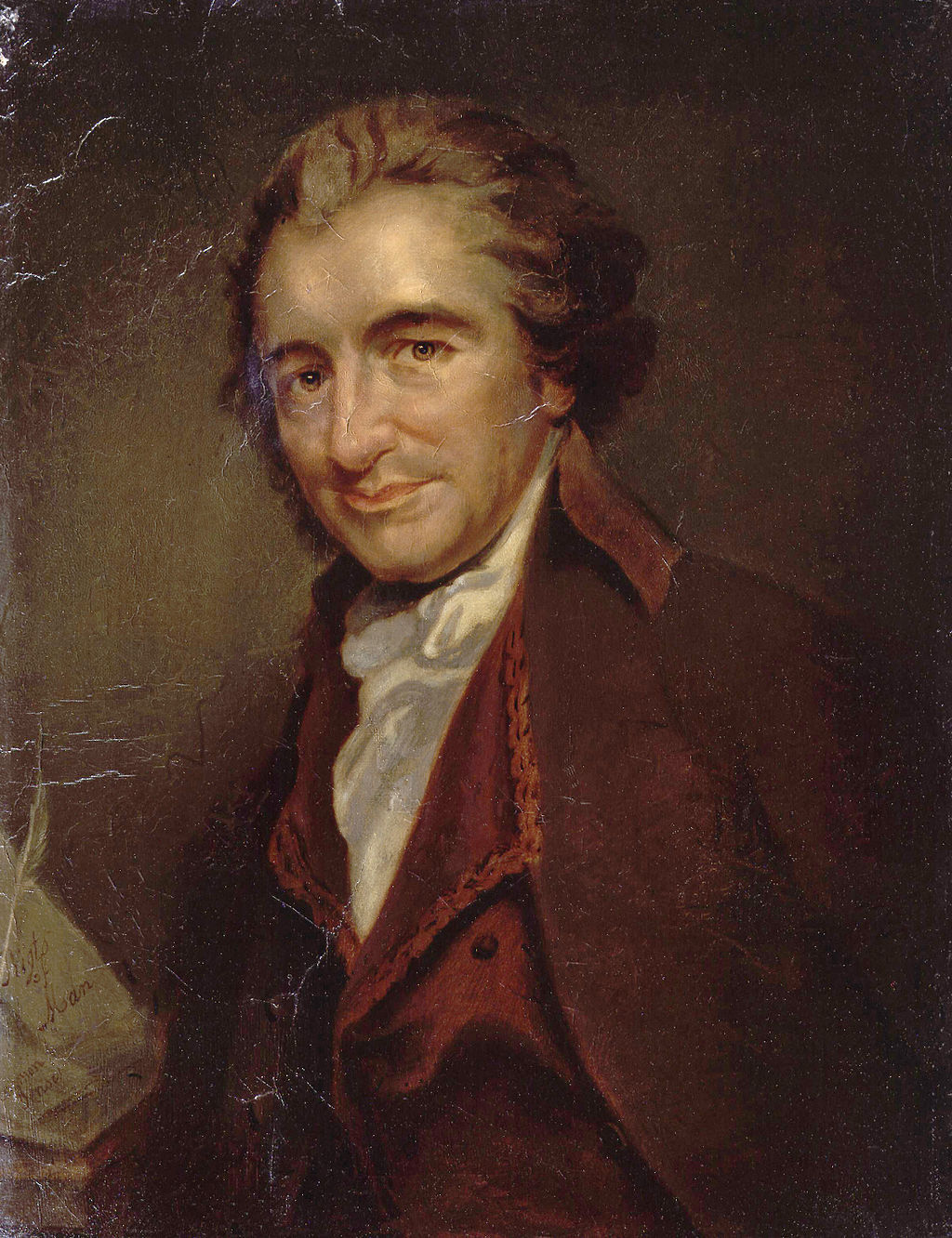
Thomas Paine, painted by Auguste Millière, 1880.,

