While Emperor Napoleon I sat on the throne of France from 1803 to 1815, he installed several of his brothers and sisters on other thrones across Europe. This included installing his older brother, Joseph, first as King of Naples (1806-1808) and then as King of Spain (1808-1813).
After Napoleon’s defeat at the Battle of Waterloo on June 18, 1815, Joseph escaped to the United States. After spending time in Philadelphia, in 1816 Joseph purchased land and built an elaborate estate called Point Breeze in Bordentown, New Jersey. His lavish chateau was furnished with the finest Empire-style mahogany furniture as well as over 200 paintings by European masters such as Rembrandt, Rubens, David, Titian and Vandyke.
His chateau also contained the largest library in America, with over 8,000 volumes. This was at the time when the Library of Congress in Washington had only 6,500 volumes.
Since Joseph was educated as a lawyer at the University of Pisa in Italy, many of his books were related to legal topics and government. He also had numerous books by the three famous Enlightenment-era French philosophes: Voltaire, Rousseau and Montesquieu.
He owned two copies of the famous French novel Paul et Virginie by Jacques-Henri Bernardin de Saint-Pierre. First published in 1788, this work tells the tragic love story about two youths who are marooned on the island of Mauritius. (The novel is the basis for the 1980 Brooke Shields movie The Blue Lagoon.) Joseph named certain sections of his Point Breeze estate after places referenced in Paul et Virginie.
Also on view at the Joseph Bonaparte Exhibition is a two-volume copy of La Gerusalemme liberata (Jerusalem Delivered) by the Italian poet Torquato Tasso. Originally published in 1581, this epic recounts the First Crusade and its climactic battle for Jerusalem. Tasso was a prominent Italian poet of the late Renaissance, and this work helped shape the literary landscape of 16th-century Europe.
Another highlight of the Joseph Bonaparte Exhibition is his travel library, consisting of miniature copies of many French classics. In 1808, Napoleon ordered his first travel library so he would have access to these written works when he was on campaigns in Russia and Prussia. These portable libraries were stored in mahogany cases for ease of transport. The miniature library on view in Bordentown was given to Joseph by his younger brother — Napoleon.
In 1845, Joseph Bonaparte’s grandson, Joseph Lucien Bonaparte (the first prince ever born in the U.S.A.), inherited the estate and auctioned off the property, artwork, and library in two spectacular auctions: one in 1845 and the other in 1847. A copy of the 1845 auction of the Bonaparte library, along with other books mentioned, can be seen at the Joseph Bonaparte Exhibition at the Bordentown Historical Society.
For information about the Joseph Bonaparte Exhibit at the Bordentown Historical Society, contact BHS by phone (609) 298-1740 or email bordentownhistoricalsociety@gmail.com.
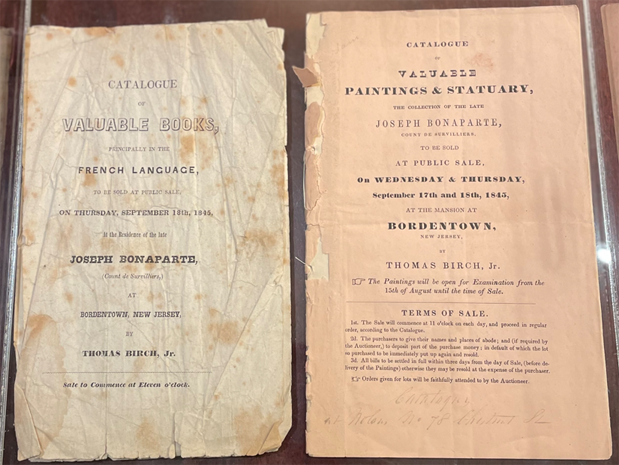
A book from the Joseph Bonaparte library collection.,

