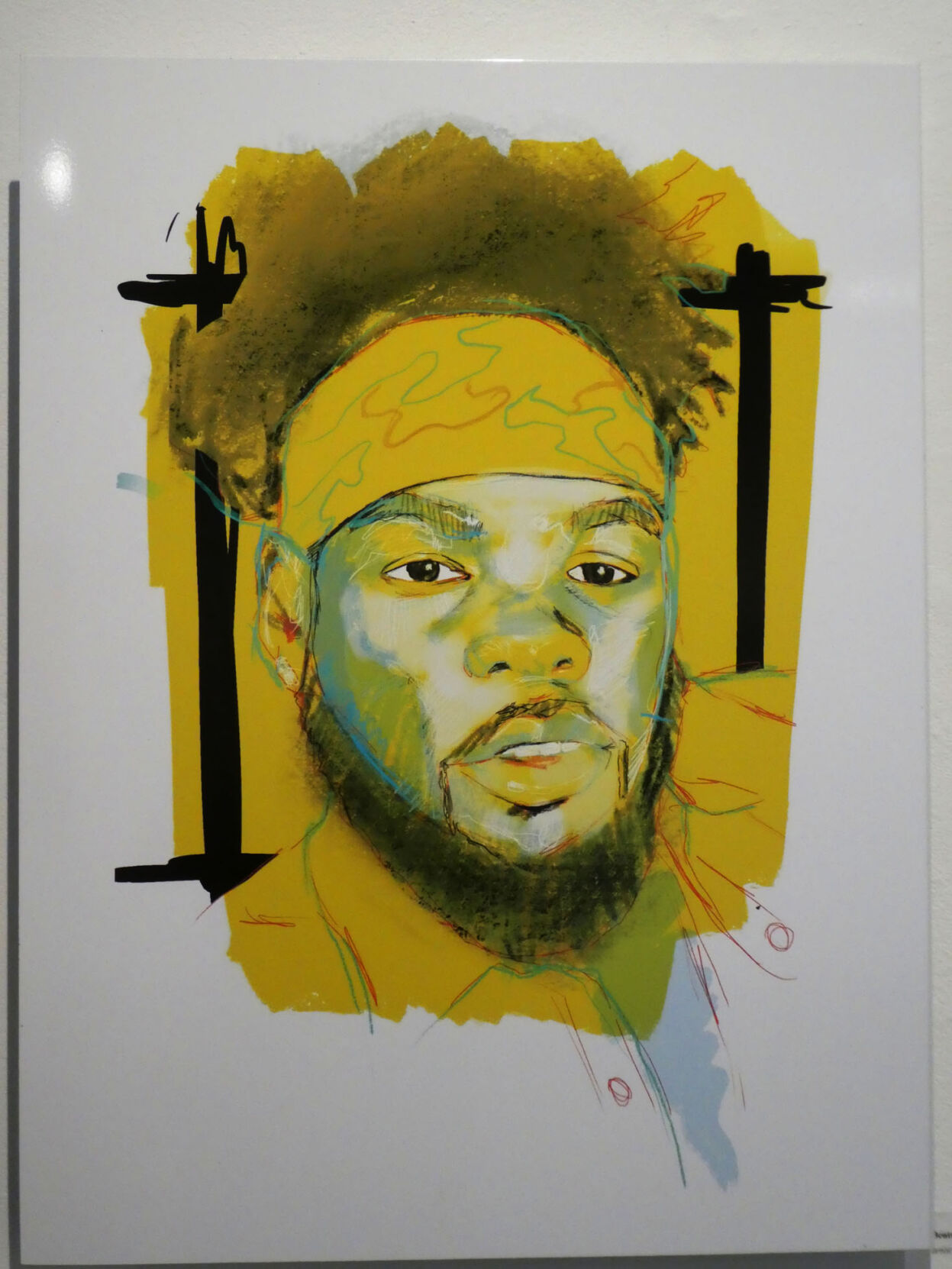
The “Potential Project: 21 Stories of Trenton” at Artworks Trenton features mainly mixed-media portraits loosely set on a unifying series of black frames set against a gold-yellow background.
That the images of individuals of African heritage are finely rendered is evident. In fact, the simple grouping in the main gallery could pass as the exhibition’s end product.
Yet, the artistry deepens when one follows the entrance posting that invites visitors to download a cellphone app that generates digital images and sounds connected to specific works.
Then there’s the subject matter: the exhibition uses the faces of Trenton residents who experienced gun violence.
The exhibit then leads the viewer into pondering what may have happened to the potentials of those who lost their lives.
It also brings home that the survivors are attempting to sort out the potentials that are unfolding.
That includes the exhibition’s lead artist, Bentrice Jusu.
During a recent interview in her studio at Artworks Trenton, the 30-year-old Trenton multi-media artist, teacher, activist, and member of the City of Trenton Fire Department reflects on the experiences that turned her into a survivor.
She also talks about the choices that can make one person a shooter — or as she puts it, “a monster” — and another a healer.
At one instance, Jusu moves across her studio to a poster-sized board covered with photos of the faces of people who were victims of gun violence in Trenton.
She points to one face and says he was the “gentleman” who was shot by police during the gunfight at the 2018 Art All Night festival.
While not excusing him for bringing a gun to the festival, Jusu says she learned the young man had a history of incarceration and solitary confinement that started when he was a juvenile.
“Imagine the psychological warfare in his head,” she says. “He’s hurting. There is no re-integration” from prison to society.
Jusu stares at the board and says, “Those are things that are happening in our city.”
But why stop there?
As indicated by the news, shootings have been happening across the nation for some time.
That includes one on June 12, 2016, in Orlando, Florida.
That’s when and where that a vacationing Jusu decided to attend Latin Night at the Pulse nightclub.
So did a 29-year-old-man who chose to pull out an assault rifle and handgun, kill 49 people, and wound at least 53 others.
It was called the deadliest mass shooting in the United States, until a year later, when 58 people were shot at a Las Vegas country music festival.
Jusu says she was numb when she came back to Trenton after the shooting, “Sometimes I detached myself because of survivor guilt.”
The founder of Both Hands, an independent Trenton arts education initiative for teens, and a teaching artist for the College of New Jersey, Jusu found herself additionally affected on September 10, 2016.
That when 16-year-old Jahday Twisdale, one of Jusu’s students, was shot in Trenton.
Sensing that the boy was killed while making videos, Jusu sought out the camera, viewed the footage, and began to wonder.
“I thought about the potentials,” she says. “What could have happened if I didn’t make it out of that club that night? What comes of Jahday’s never-to-be-finished poetry and film projects?”
The Trenton Central High School and Wake Forest University graduate — whose interest in filmmaking and photography was aided by her Liberian-born father’s filming events for other Liberians — says she started making choices that it turn started the project.
One, she says, was realizing that “someone has to live to tell the stories.” That led to her decision to make notes and drawings and collect data — all with the idea of remembering victims and looking for solutions.
She also began posting the images on the photo board, which in turn attracted the interest of another Trenton community activist, Iana Dikidjieva.
The former acting director of the Trenton Downtown Association and the coordinator for Isles’ Trenton Neighborhood Restoration Campaign Program was intrigued by its potential to address various social needs.
After Dikidjieva joined the Trenton Health Team as the director of grants and development, she and Jusu successfully applied to the Kresge Foundation for a grant to realize a THT project that could “change the discourse around violence, trauma, mental health, and healing in Trenton.”
For the reasons already mentioned, Artworks Trenton became the obvious venue for the exhibition.
Jusu says the choice to limit the exhibition to only 21 pieces — or stories — was inspired by Trenton’s tallest building, the 20-story Kingsbury Towers.
“If you go to the top, you see all of Trenton,” she says.
The 21st story is a mirror where visitors realize that their potential to make choices is also part of the story.
She says those who people the exhibition were selected through a variety of means, including personal connections, students, or stories suggested by participating artists or mothers of victims.
Then there was the choice of collaborating regional artists: hip-hop artist Big Ooh, poet and soundscape designer Hana Sabree, poet Terra Applegate, and dancer and choreographer Jennet Jusu.
“I chose them because of what I saw in the work and their potential too,” says Jusu. “I wanted a vastness. I’m a mixed media artist, poet, painter, and rapper. I wanted to have mixed medium. I wanted a vastness. I wanted to have that expressed in the exhibition, for it all to flow like the town and its potential.”
She says other contributing artists include Wills Kinsley and Dean Innocenzi (aka Ras), whose painting of 9-year-old shooting victim Se’Quoya Bacon-Jones is the only gallery image not made by Jusu.
Overall, she says, she depended on “Egoless collaboration” and “working with artists and engineers to talk out the vision, which included virtual reality.
“I wanted virtual reality in it. It’s a whole world that’s super cool but so complicated, and I’m learning as I go. It added another depth. It is about potential. It’s the pull.”
Reflecting on seeing the exhibition, Jusu shares mixed responses. “When you see (the exhibition) come to life, it’s exhilarating. Art is the life of life. That is how we love, and that’s how the souls talk, through art.”
Yet there is also “the emotional weight. I try to make beauty out of someone’s tragedy. It’s quite the responsibility. And I remember feeling, ‘Am I doing the right thing?’”
However, since more shootings have been happening lately, she says she feels “more empowered” to talk about gun violence and that she’s become a gun violence and mental health advocate.
Arguing that many people are in denial about why they’re struggling, she says “it’s not okay, we’re hurting” and says the Potential Project website has a “clever map” that lists mental heath resources with a reference as to whether they “work or don’t work.”
She also says the exhibition is designed to show the faces of victims and provide a sense of accountability for citizens to join together and stop this “solvable” problem that stops individuals and communities reaching their full, healthy potentials.
“Everyone is affected and infected by the problem,” she says.
In a statement, Jusu notes the Potential Project will grow after the current exhibit with additional stories and physical installations in the community. “Additional phases of the project will include installations around the city where specific stories can be viewed, and community conversations around healing, mental health services, and community-based trauma response efforts.”
The Potential Project, Artworks Trenton, 19 Everett Alley. Through July 16. For hours and more information, visit www.artworkstrenton.org.
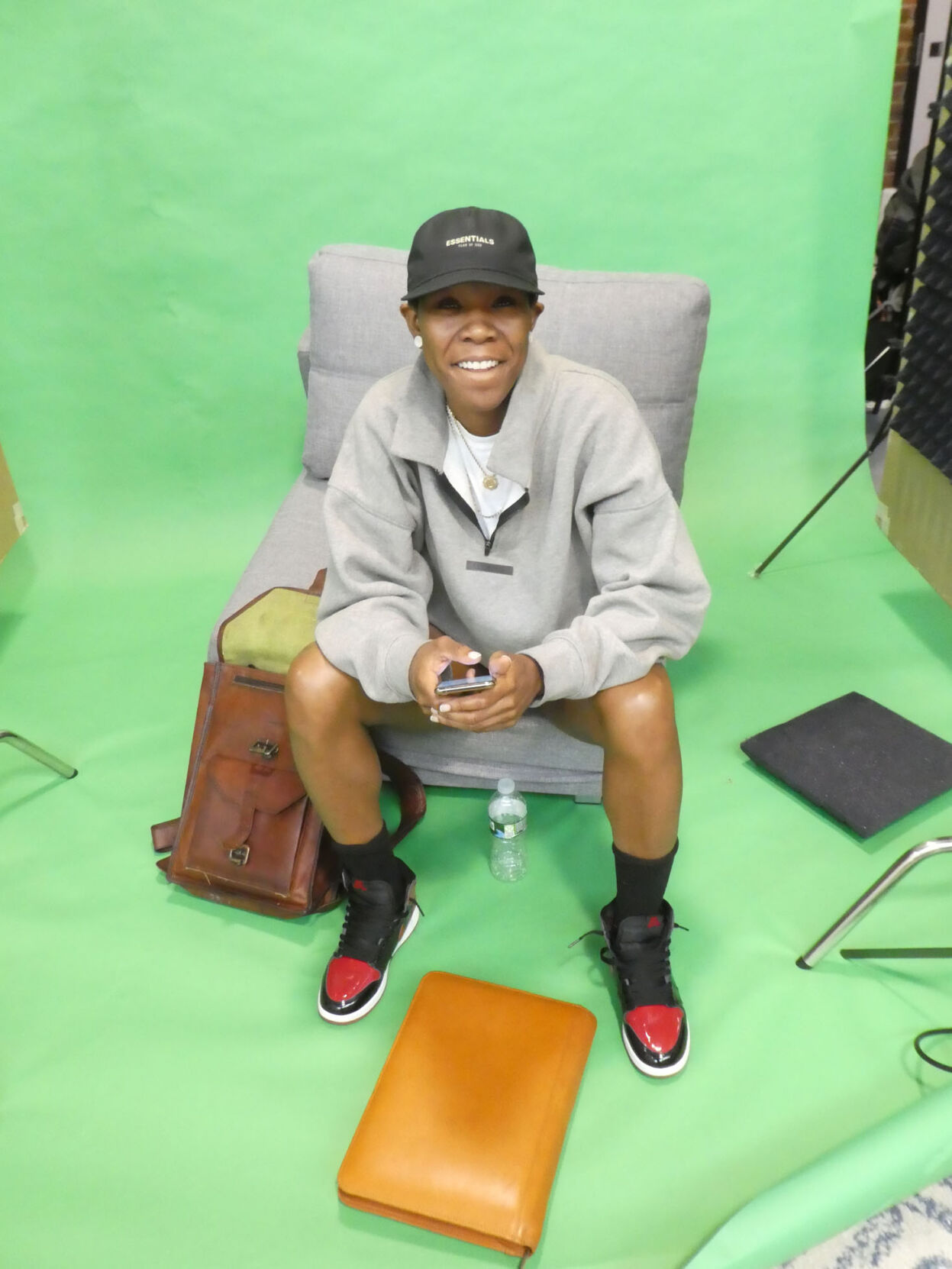
Artist and activist Bentrice Jusu conceived and created the Potential Project, on view at Artworks Trenton through July 16. ,