“Emergency,” Daniel Beaty’s 2006 play at Princeton Summer Theater through August 3, examines reality by positing a fantasy that allows several characters to express individual points of view, the range of which shows the breadth of Black attitudes and experience and demonstrates how that range defies categorization or stereotype.
Take, for instance, the controversial subject of reparations for American slavery. One character played, as all Beaty’s characters are, by the versatile Destine Harrison-Williams, offers an intellectual reason why reparations are warranted while another, a successful businessman, regards them as an insult, a fashionable suggestion that borders on indulgence.
Throughout “Emergency,” Beaty explores the yin and yang of opinion within a large community whose thoughts are often, and incorrectly, interpreted as being unanimous when they are varied and random and all over the map.
Whose idea is right? Beaty doesn’t tell you. He has his characters toss their ideas to the audience and lets each member of that audience decide for him- or herself.
While the Black community is Beaty’s focus, his play sheds light on all ethnic and cultural groups that might be thought to be monolithic but have the same wide gamut as society in general.
Hearing the different perspectives, positions, and sentiments of the two dozen or so people Harrison-Williams portrays, some recurring, some in single takes, is what keeps “Emergency” interesting.
It treads little new ground, but it covers vast ground. It addresses enough subjects, sometimes cloaked in cliche or the expected, sometimes shattering the expected to smithereens, to hold attention and keep you listening.
No matter what the comment or argument, Beaty will have someone articulate a viewpoint, then have another present the alternative.
This is the best feature of “Emergency,” which tends to meander between instances when distinct thoughts are expressed and countered.
A lot of the meandering emanates from the fantasy Beaty builds to establish his play.
“Emergency” begins with a news update from a reporter on the scene at the Statue of Liberty, where a slave ship of the kind that sailed from Gorée Island to foreign ports in the 17th to 19th centuries has appeared. In Layla J. Williams’ straightforward production, modern-day wonderers, gawkers, and concerned folks all come to Liberty Island to marvel at the ship and record it on their 21st-century mobile phone cameras.
The ship, though palpably visible and the impetus from news crews and spectators to gather at Liberty’s base, is a metaphor.
Someone who boards the vessel describes seeing skeletal remains in chains and feeling the oppression and negativity emanating from its holds. For those ashore, it is a curiosity that triggers the comments that compose much of Beaty’s play.
To give the slave ship and its presence some urgency beyond the metaphor, Beaty offers a real-time plot involving the father of two men, one of whom is about to compete as a finalist on a TV program called “America’s Next Top Poet,” the other of whom leads a more prosaic life, more on the lookout for Mr. Right than the perfect image or word for a poem.
The father, a Shakespearean scholar who lost his intellectual compass when his wife died, is the person who boards the not-so-phantom but not completely genuine slave slip. His sons plead to let them entice their father off the craft before authorities haul him off and, perhaps, take him somewhere for observation, or worse, institutionalization.
Concern about the father, and the sons’ quest to rescue him, provides a handy leitmotif to generate and get relief from the general bewilderment about the slave ship, how it got to Liberty Island, and what it all means.
Some passages in “Emergency” resonate and rate more attention than others. The play can be uneven and wander into territory that is not as compelling as in other sequences. Scenes on the set of the “Poet” show are an example of that. Neither they, nor the poem that emerges, grab as much as much as the contrapuntal points of view of the fascinated gathered on Liberty Island.
In fact, the sequences in the TV studio seem a tad naive and self-conscious.
The way Beaty’s script shifts characters, mixes quick vignettes with extended scenes about the ostensible lead, Rodney, touches on so many topics, and transfers from the scene of the slave ship to other less fanciful settings, requires a fluid production that can handle all the pivots and make them distinct and related.
Layla J. Williams’ staging is more low-key than dynamic. It makes you come to it rather than enticing or dazzling you. Beaty’s plot, points, and juxtapositions are clear, but the tone is more declarative or conversational than it is dramatic. Emotions aren’t wrung, and passions are not excited. The approach is more intellectual and thought-provoking. Beaty, via Williams, makes you consider a panoply of ideas, some of which contradict one another, some of which are more political or polemical than verifiable as fact, some of which are a bit old hat, but all of which add up to a broad picture.
“Emergency,” at the Princeton Summer Theater, makes you listen, just to hear the differences among people who are frequently regarded as thinking alike, more than it moves or affects one’s feelings.
Destine Harrison-Williams’ performance is in keeping with this subdued tone. It may actually set it.
Harrison-Williams is engaging. He moves deftly from one character to another, establishing gestures or vocal cues that help identify one recurring figure from another and endowing each with a unique personality and traits.
His transitions, though fast, are clear.
They are also quiet. Harrison-Williams is a mellow performer. He knows his characters and their telling attributes. He can slide into voices and attitudes, but he rarely projects or uses his voice for emphasis or to gain extra attention.
The problem is one of volume. Accents, pitches, timbres, and vocal effects ranging from gravelly to falsetto are easily navigated, but always at a level that doesn’t sound as if it’s coming from a theater stage.
His calm style of speech keeps much in “Emergency” matter-of-fact. Nothing seems more important than anything else. Harrison-Williams may endow his TV reporter with more energy than say, a hanger-on who just likes to be where something curious is happening, but he rarely reaches a vocal level that goes beyond everyday speech. His approach is always pleasant, and you always feel as if what his characters are saying is directed towards you, but it tends to keep all that occurs, even the bizarre, fearsome, and controversial on a single level.
Keeping track of a few dozen characters is daunting, and Harrison-Williams manages to get through his catalog of portrayals without repetition. He also makes you care about Rodney and if he can come to his father’s aid before officials can swoop in and impose measures that might be harmful and contrary to the wishes of a family.
What “Emergency” does best is show how common facets of history do not affect all people in the same way, and one cannot afford to take a cookie-cutter view of any group in spite of the current proclivity to generalize.
Designers Yoshi Tanokura (sets) and Bex Jones (costumes) keep things basic. Harrison-Williams wears one outfit throughout, using dance, gesture, and facial expression to separate characters, and Tanokura suggests various locales, the TV station with “Applause” signs being the only one that is specific. Alex Swisher has more leeway with lighting, and Alyssa Gil-Pujols provides some tricks with sound, enhancing Harrison-Williams’ voice at times for effect.
“Emergency,” Princeton Summer Theater, Hamilton Murray Theater, Princeton University. Though Saturday, August 3. Thursday and Friday, 8 p.m.; Saturday 2 and 8 p.m. Saturday. $30 to $35. www.princetonsummertheater.org.
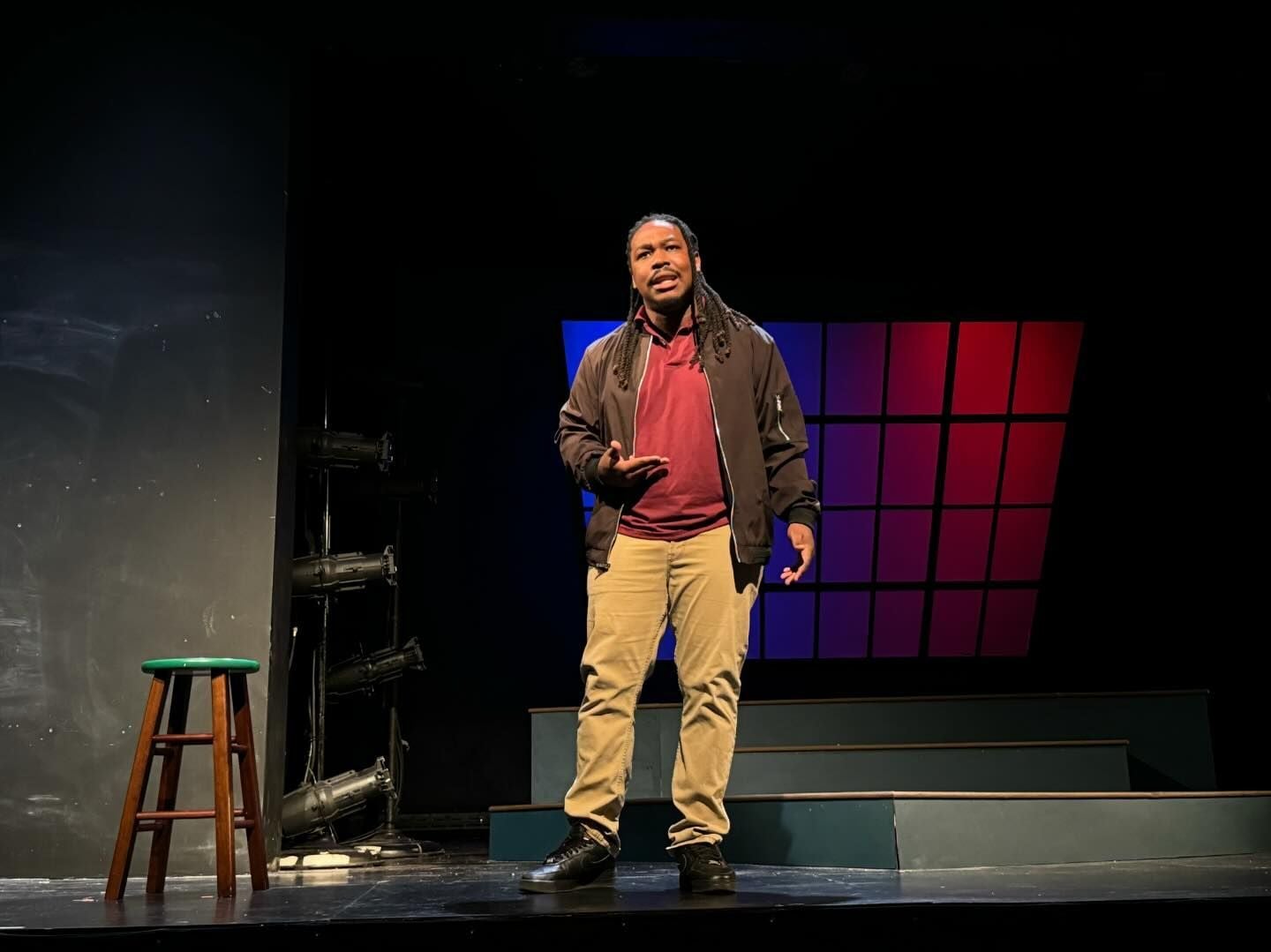
Destine Harrison-Williams in "Emergency" at Princeton Summer Theater.,

