Politics, artistic and financial, and how they affect collaboration among friends, and friendship itself, are the crux of David Robson’s “Muleheaded, or Zora and Langston Write a Play,” a world premiere at Trenton’s Passage Theatre through Sunday, February 15.
The Zora and Langston cited are Zora Neale Hurston and Langston Hughes, two of the leading lights of the Harlem Renaissance, which flooded the cultural world with music, literature, poetry, and essays at the time of the Great Depression.
Robson’s play deals with creativity and relationships, but the politics I mention intervene and compromise both when Hurston and Hughes are paired to write a play, unnamed and without subject, plot, or character when they begin their collaboration at Hughes’ Westfield, New Jersey, home in 1930.
In the course of “Muleheaded,” artistic arguments, including who wrote which line or conceived which scene, lead to strategic moves, countermoves, and legal entanglements between the authors. Robson depicts how these disputes and maneuvers threaten to scuttle everything Hurston and Hughes are working towards, including their close friendship, enhanced by both of them living in Westfield, both being known for their talent, and both being under the patronage of Charlotte Osgood Mason, a wealthy woman who gives stipends and commissions to Black artists of the Renaissance.
Mason, called only “Godmother” in Robson’s script, wields her generosity in ways that keep artists receiving her largesse competitive, including in their shows of devotion and gratitude to her.
She is in a way the catalyst for Hurston and Hughes working together. She agrees to back Hughes as he writes a play, and he invites Hurston to join him in the effort. Robson uses the opportunity to take Zora and Langston beyond the page and present them as people, at first as friends and willing artistic partners, then as adversaries fighting for what they see as their literary rights and artistic integrity. As he does, you see the different levels of ambition, sensibility, personal grit, and ability to handle “Godmother” each contains.
“Muleheaded” is an interesting piece because it shows Hurston and Hughes in a variety of ways. It also shows the importance of patronage, the control of the patron, and how an optimistic beginning can go so wrong when personalities that mesh as friends do not gibe neatly as collaborators.
Brishen Miller’s production for Passage is also interesting because it makes the surging conflict and its consequences clear. You see how the natures of the main characters will lead to trouble and impasse. Hurston (Constance Thompson) is a firebrand who knows exactly what she wants to do and how she wants to do it from the start. Hughes (Anthony Vaughn Merchant) is more uncertain and more passive. He is open to feeling his way to a play, building it as ideas come, then honing it, while Hurston has her plot and dialog all mapped out and ready to go.
The fading relationship between the writers, and the troubles that lead to it, are evident but often play as matter-of-fact. The effect is more like a game of dominoes, in which each piece falls in a predictable sequence, rather than a jigsaw puzzle in which the next move involves thought and may come as a surprise.
Miller’s production is straightforward. It holds attention but lacks some dramatic edge because it is so neat. Texture comes more from clever between-scene interludes in which characters mime their everyday life or music, big band sounds and ballads from the Harlem Renaissance, sets tone.
The directness doesn’t mar the power of Miller’s production. It packs its punch and keeps you involved in how things, even historically known things, will turn out, but there’s some tension, built ironically from subtlety, that’s missing. Everything is plainly in front of you. There doesn’t seem to be much happening behind the scenes, even though there has to be.
In listening to the play, I heard line readings, mostly by Thompson, that would have added more humor and personal intention to Robson’s text had a different word in the line been emphasized.
In general, Miller and his cast, which includes Unissa Cruse as a secretary hired to type Hurston and Hughes’ script, do a fine job showing the deterioration of Zora and Langston’s relationship, the business aspects of creating art, and why the play in contention, “Mule Bone,” was not produced in either of the authors’ lifetime. (It didn’t come to the stage until Lincoln Center produced it in the early ’90s. That production, also, was more important as history than it was as theater.)
Robson and Miller also do well at depicting the energy of the Harlem Renaissance, which not only produced Hurston and Hughes, whose works are read today and continue to influence writers — Lorraine Hansberry took her title for “A Raisin in the Sun” from a Hughes poem. The time, with some help from Godmother’s money, was rife. The musical moments Miller adds, via a record player and between-scene passages, speaks of a time that included Duke Ellington, Billy Strayhorn, Countee Cullen, Gwendolyn Bennett, Arthur Huff Fauset, and others.
In the long run, Robson’s title seems to refer mostly to Zora Neale Hurston (someone who for obvious reasons became a fascination the first time I heard of her in my freshman year of high school). In “Muleheaded,” you see her commandeer the alleged shared play from the beginning. She comes up with the plot, she created dialog from the top of her head and brings more for the secretary to type, she eventually finesses Godmother to keep financing “Mule Bone” and Hughes, she makes the first move in disturbing her collaboration with Hughes, and she cites business and money, as much as artistic verity, as her reason.
Hughes is shown as more docile and easygoing. He is a poet and more unsure about how to guide a plot or keep a narrative going than Hurston. He allows the commandeering and seems willing to lose arguments about how much dialog should match the speaking patterns of people from Eatonville, Florida, where “Mule Bone” is set and important plot twists (even if he does comes up with one crucial bit that markedly changes “Mule Bone”).
Anthony Vaughn Merchant is gentlemanly and cordial as Hughes. He tries to present his ideas calmly, even as Zora rails at Langston over one point or another.
Hughes has already had some success and recognition by the outset of “Muleheaded,” and Merchant lets you see Hughes’ refinement, even in the way he serves coffee and manipulates Godmother.
His poetry had earned him something but not enough to abandon Godmother, as Zora can do, but doesn’t, out of sheer pride, so Hughes is in the middle period between acclaim and success, i.e. independence. A play, especially as desired by Godmother, could take him to his goal. Merchant plays that situation well. His capitulations to Zora are because she has ideas and written pages and Langston doesn’t.
Constance Thompson is a formidable Zora, determined and unflappable.
Thompson is outspoken, direct, and given to nip anything she sees as a problem or obstacle in the bud.
She neatly dominates the more successful and popular Langston. She proves how honey can combine with vinegar in manipulating Godmother. She makes sure the secretary is aware she’s a secretary. She stands her ground when she realizes the division of labor that went into “Mule Bone.”
Thompson comes on stage, and you know there’s going to be some kind of reckoning and who’s going to come out ahead. Thompson’s Zora becomes a shrewd portrait of a woman who wants to maintain her personal traits while mastering the world of art and being paid for it.
Unissa Cruse is excellent as Louise, Godmother’s assistant sent to be a typist for Hurston and Hughes’ script.
Her Louise is the most roundly human character on Miller’s stage. There’s reality in everything Cruse does, the sense of a woman with a head on her shoulders who knows how to get ahead but keep from drawing attention that might impede her.
Louise does draw Zora’s attention, and Langston’s. Robson hints at a relationship between Louise and Langston and also Zora’s designs in a similar direction.
One small cavil concerns something that might only happen in the performance I saw but is a pet peeve. Merchant throws something towards a wastebasket and misses. Instead of picking it up and placing it in the receptacle, he leaves it on the floor. That seems unnatural, especially since the tossed object is a paper he’s used to stanch blood. Thompson does better when Zora fails to get a manuscript page into the trash on the first go.
Also, the setting of Westfield and Eatonville being Zora’s hometown could be clearer.
Jaelyn Alston-Frye’s set is simple but tasteful in a way that seems right for Hughes, whose house we’re seeing. Choices of props, like the coffee set, and art, are perfect.
Tiffany Bacon’s costumes, especially her dresses for Louise, are true to character and period. Another small cavil is Hughes spending half the play in his sleeveless undershirt. He is at home, but the look seems too informal and wrong for a gentleman among two married women. Ava Weintzweig’s sound and music choices gave texture to Miller’s production.
Muleheaded, Passage Theatre, Mill Hill Playhouse, 205 East Front Street, Trenton. Through Sunday, February 15. Showtimes are 7 p.m. Thursday and Friday and 2 p.m. Wednesday, Saturday, and Sunday. Tickets are $35, with some discounts available. www.passagetheatre.org or 609-392-0766.
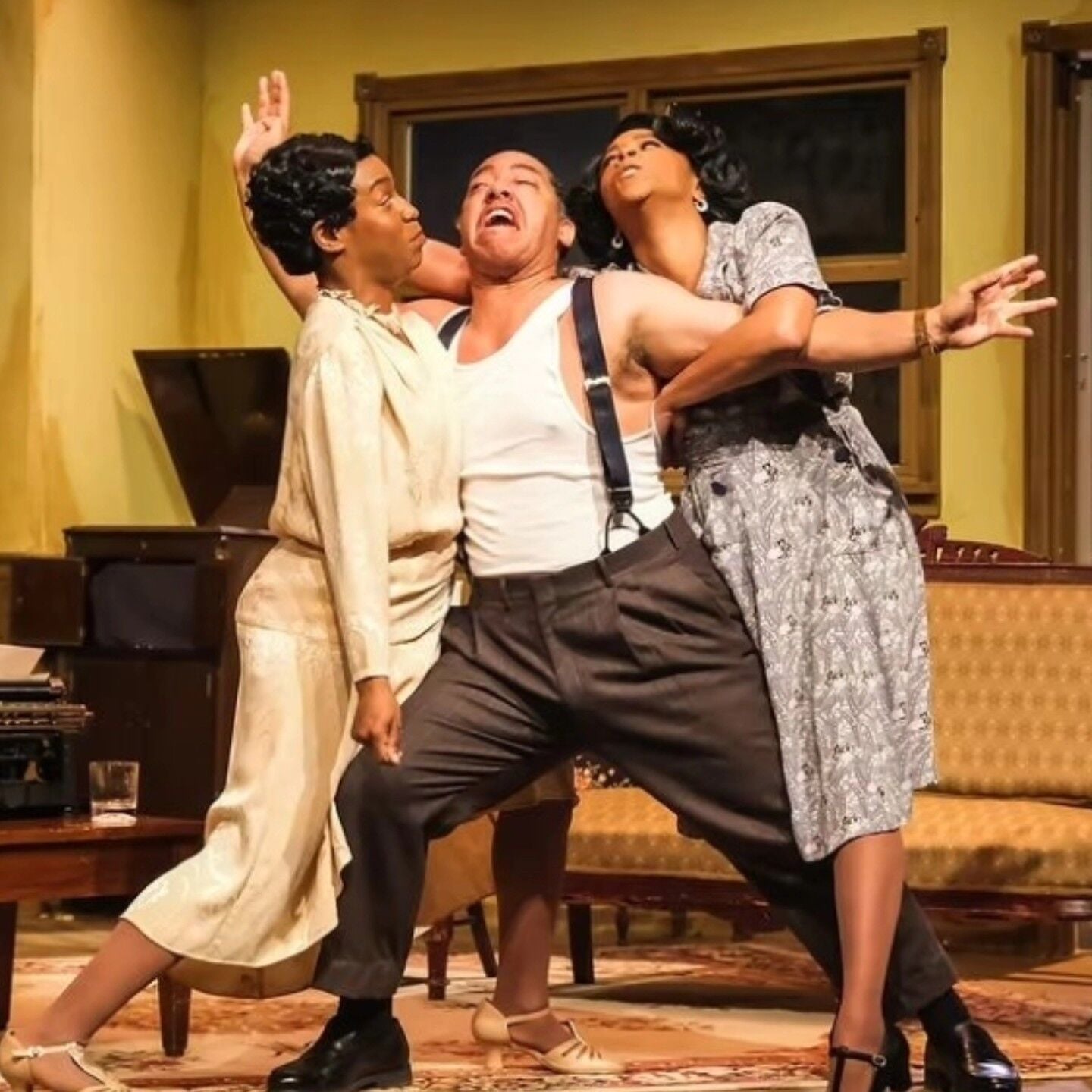
Constance Thompson, left, Anthony Merchant, and Unissa Cruse in ‘Muleheaded,’ at Passage Theatre through Sunday, February 15. Photo by Habiyb Shu’Aib.,

