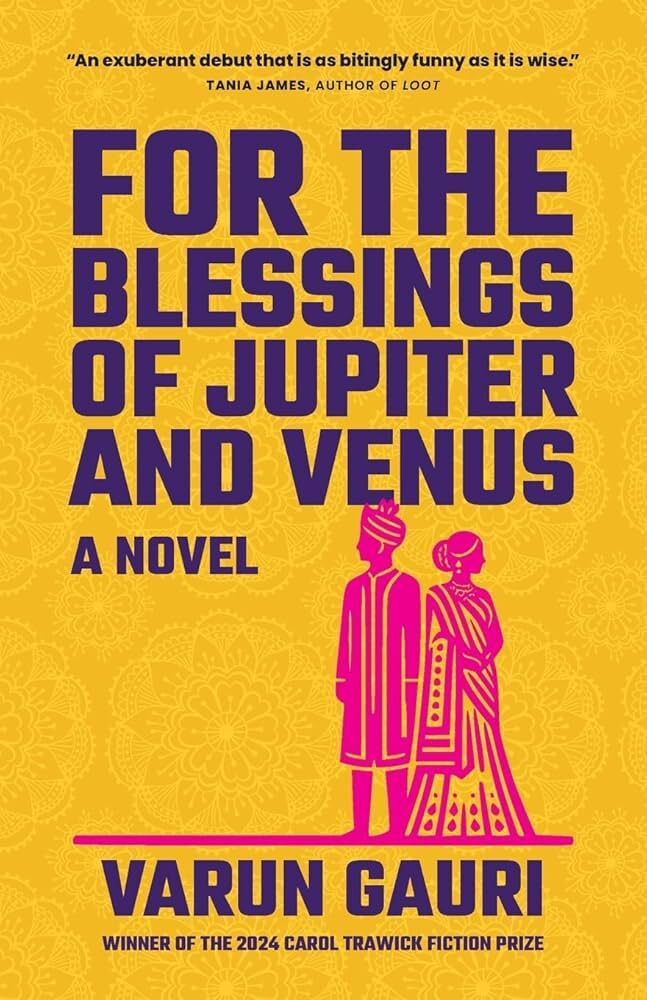
“Economist” and “award-winning novelist” are not usually descriptors used for the same person, but Varun Gauri is an exception to that rule. The Princeton University lecturer in public and international affairs published his first novel, “For the Blessings of Jupiter and Venus,” on October 8. He discusses his book in conversation with novelist Laura Spence-Ash at Princeton Public Library on Tuesday, October 29, at 7 p.m.
Gauri’s novel is the winner of the 2024 Carol Trawick Fiction Award, a prize given annually by the Washington Writers’ Publishing House, which published the novel.
The novel tells the story of Meena, a cosmopolitan globe-trotting business consultant-turned-educator, and Avi, a lawyer trying his hand at small town politics in Southgate, Ohio, where his network of Punjabi family and friends holds significant sway over the town’s Indian immigrant population.
Avi and Meena come together through an arranged marriage — Avi, due to his parents’ commitment to cultural traditions; and Meena, disillusioned with modern romance and despite skepticism from her more modern mother and sister.
The opening paragraphs of the novel set the scene at their wedding and previews themes around evolving traditions, mixing cultures, and the meaning of love and marriage that drive the plot:
“Meena pushed aside her veil. The gold bangles, heavy on her wrists, slid and clinked. She feared the audience would find the gestures graceless, clumsy, but she had to see his eyes. She would in moments be the wife of this man in the groom’s headdress. Maybe she already was his wife. The Vedic ceremony, hours of venerable ritual, had no vows, no exchange of rings, no single moment when choice, her will, exercised its prerogatives.
“Perhaps sensing her nervousness, Avi caught her eye and motioned across the temple ballroom. He was offering the wedding finery for reassurance. He pointed up at the beautiful mandap, adorned with white and pink carnations, yellow marigolds, and fragrant red roses. He was smiling warmly, and his expression seemed to say, These old, magnificent powers guard over you. The betel nuts and the bowls of oranges, apples, and coconuts. The sandalwood incense. The ancient incantations of the priest, now pouring ghee into a bowl. The sacred fire burning at their feet. The expectant faces of all the lovely women in the audience, sharp-tongued aunties in embroidered sarees. The silly, sweet nonsense uncles, Avi’s father’s friends. The communal pride. The coming feast, with buttery spinach and tandoori kabobs.
“He was saying their wedding conjured every Bollywood movie ever made, every Indian story ever told. And her husband-to-be was right. Every year, millions of people married in this way and went on to have fulfilling relationships and meaningful lives. Or anyway, one had to assume they were fulfilling.
“She and Avi hadn’t spoken in days, though she had almost called him that morning. Waking up alone in the nondescript hotel, like any of the hundreds of interchangeable rooms she’d passed through for work, had been disorienting. She nearly headed to the gym to run on the treadmill, her habit before board presentations. But this was no business trip. She decided not to call him because she didn’t know yet if Avi consoled well, or if talking to him would make her more nervous. Instead, she made herself coffee in the room. She convinced herself that arranged marriage wasn’t strange. After all, could any woman say, years later, that on her wedding day she’d really known the man she was marrying?”
But the novel is not just a love story. Avi’s political campaign becomes mired in racist attacks from a white high school classmate and former friend whose family also wields substantial influence in the town. Meena questions her choice, and whether Avi is more committed to her or his political career. And drama that plays out in the relationships of supporting characters shows that love, however it comes about, is never that simple.
Gauri, who previously worked as an economist in the World Bank’s research department, does work on behavioral economics, human rights, and social policy in developing countries. Born in India and raised in the American Midwest, he now lives with his family in Bethesda, Maryland.
Laura Spence-Ash is a New Jersey-based writer whose short fiction has appeared in One Story, New England Review, Crazyhorse, and elsewhere. Her debut novel, “Beyond That, the Sea,” was released in March, 2023.
Varun Gauri in Conversation with Laura Spence-Ash, Princeton Public Library, 65 Witherspoon Street, Princeton. Tuesday, October 29, 7 to 8 p.m. Free. www.princetonlibrary.org.
For the Blessings of Jupiter and Venus, Washington Writers Publishing House, October, 2024. 217 pages. $18.95.
,