Simplicity has the potential to become charming or even poignant on a stage.
What appears to be ingenuous or disarmingly innocent can take on depth if the right dramatic, emotional, or enhancing elements are added to it, contrast to it, or illustrate constancy when circumstances insist on change.
That kind of development is among the basic building blocks of theater.
“Primary Trust,” a Pulitzer Prize-winning play at Princeton’s McCarter Theatre, seems to aim squarely at showing the simplest of characters, a man without guile who is content to do the same things in the same order every day, grow into a fuller, more aware being. Playwright Eboni Booth throws curves in his routine, forcing some adaptation, some need to make a decision or venture to wider ground. Booth provides new experiences, subtle enlightenment, even some disillusion and loss that could lead to small revelations or an expanded menu of comforts.
In Timothy Douglas’ production on the McCarter stage, none of that seems to come to much avail. Neither the lead character, Kenneth (DeShawn Harold Mitchell) nor “Primary Trust” ever gains any sophistication. I waited for depth or poignancy, and they never showed up. Kenneth, though he finds occasional guidance, is taken to different settings, and has some encouragement to blossom, remains the simple sad sack he is when we see him talking to his lone friend, Bert (Shane Taylor), near the top of the show.
I sense potential for more. Except for one major instance of being out of control and emotionally lost to a dangerous point, Mitchell, as Kenneth, never responds in an adult or evolving way to situations that normally alter a person’s perception — a new job, attention from an attractive woman, introduction to restaurants and cuisines different from Wally’s, his habitual haunt. Mitchell’s Kenneth seems to bounce from one complication to another without being affected or edified by it.
There’s no movement, not even a budge. Kenneth’s rarely surrendered sameness in Douglas’ production makes “Primary Trust” frustrating and tedious. Booth creates obstacles to Kenneth being so regulated. She provides problems, disappointments, regrets, and even moments of hope, but Kenneth, at the McCarter, doesn’t rise to them.
Yes, he is confused and taken aback when a woman who befriends him chooses to continue a relationship she had before she met Kenneth. Yes, Kenneth suffers mightily when he doesn’t hear from Bert, his mainstay and anchor for so much of his life. Yes, there are truly comic moments, as when Kenneth tastes a martini or margarita after decades of mai-tais. But so little rocks Douglas’ production from its simplistic tone, nothing dramatic seems genuine. All becomes another plot device that leads to nothing, not even sympathy for Kenneth or concern for his mental health.
Worse, moments that could be moving remain as inert of most of Douglas’ production.
We learn, for instance, that Kenneth is an orphan who remembers his mother but from a young age was sent to foster homes. At McCarter, that information comes nonchalantly. It never invites a reaction or signals anything that might make us understand Kenneth better.
It just lies there.
The character of Bert also becomes problematic. The more we learn about Bert, from what Kenneth tells us directly and from a memory that is triggered when Kenneth is asked how he met Bert, the less Bert’s seeming abandonment of Kenneth makes sense.
Of course, it’s meant to be a symbol, something that tells the audience of advancement Kenneth may be experiencing but which, at McCarter, is not established firmly enough. Given Bert’s main characteristic, one that makes him summonable by Kenneth at any time, this important development in Booth’s play makes little sense. It becomes one of many plot twists that remain dormant rather than building to something of depth.
These come in legion, involving employment, kindness misread as romance, Bert’s reason for absconding, Kenneth drinking an inordinate number of mai-tais, but they never create interest.
Then there are things about Kenneth that remain mysteries even as so much appears to be revealed. “Primary Trust” takes us to two places Kenneth works, a book store and a bank, but we never have a sense of where he lives, what his apartment looks like, or what he does between going to work and drinking but ordering significant food, fries and such, at Wally’s. (Walking through his small town is suggested.)
At McCarter, Mitchell makes Kenneth pleasant enough but he demonstrates no skills for getting through life. The reason for Kenneth’s success in business is another mystery. It’s clear he isn’t doing anything learned or intentional. A generally sunny disposition and penchant for chattiness doesn’t explain it.
“Primary Trust” seems to have more holes than it has substance. Parts of Douglas’ production are entertaining, such as the parade of servers who make the same speech but have different names at Wally’s and the size Peter Bisgaier gives to both of Kenneth’s bosses and a maitre d’ at a fancy French restaurant, but for most of its 90 minutes, it’s a non-stop squirmer.
Even the beginning is weak. Booth has Kenneth make an opening speech describing his life and routine rather than having Mitchell and the other performers act it out. What Kenneth says sound more like a novel or direct storytelling instead of theater, where showing should supersede telling.
Oddly, I’d like to see a different production of “Primary Trust” to gauge whether the problem is Timothy Douglas’ mild and childlike approach to Booth’s material or if something substantial can be mined from all Booth provides.
While I think there’s more to the character of Kenneth than Deshawn Harold Mitchell is giving him, Mitchell deserves applause for being consistent and unwavering in the way he chooses to play the role.
In addition to simplicity, Mitchell conveys Kenneth’s innocence and an idea that he had no one to teach or train him in the ways of the world.
Mitchell’s Kenneth is a happy, amiable soul who only reacts badly to situations he doesn’t fully grasp or have the capability to understand.
There are a number of scenes in which Bert instructs Kenneth to count backwards from 10 to calm some small emotional upheaval. Mitchell makes the most of the one time Bert is not there to quell Kenneth’s anxiety or neutralize his tantrum. (Bert’s absence is the cause of the uproar.)
So we know Kenneth can lose control and possibly harm himself. For the most part, Mitchell holds a strict line that has Kenneth seeming slow and unable to judge what is really happening around him. The only place he seems in charge of himself is during cocktail hour at Wally’s. Mitchell adeptly makes you like Kenneth. The character’s seeming inability to grow makes you lose interest in him.
Shane Taylor is a stalwart Bert, always reasonable and always willing to go with whatever Kenneth says, even if it’s inane. Taylor’s Bert provides reason and becomes the strongest character in Booth’s play.
Lilian Oben looks as if she’s been relegated to play the brigade of servers, female and male, that inveigh Kenneth and others to order mai-tais and daily specials at Wally’s.
Oben bursts from that shell with a sensitive performance as Corrina, a Wally’s waitress and Primary Trust bank customer who advises Kenneth and gives him the closest semblance he has to a social life. The careful way Oben enunciates her lines as Corrina is impressive.
Peter Bisgaier brings some life to Douglas’ proceedings as a book seller who speaks his mind plainly, a bank manager who is aggressively friendly and the ultimate salesman, and as a funny, if stereotypical, host and waiter at a French boîte.
Tony Cisek’s set is minimalist; buildings projected on a back wall giving the only sense we get of the town in which Kenneth lives. Cisek is most creative in designing the lavishly garish set for Wally’s and is clever at bringing a bank, book store, and office front and center.
Trevor Bowen’s costumes for Oben’s fleet of characters, Bisgaier’s authority figures, and Bert, are fine, but more variety was needed for Kenneth’s wardrobe, which doesn’t always fit with occasions like job interviews and visits to restaurants better than Wally’s.
Primary Trust, Berlind Theatre at McCarter, 91 University Place, Princeton. Through Sunday, May 25. Wednesday through Saturday, 7:30 p.m.; Saturday, Sunday, and Thursday, May 15, 2 p.m. $43 to $73. www.mccarter.org or 609-258-2787.
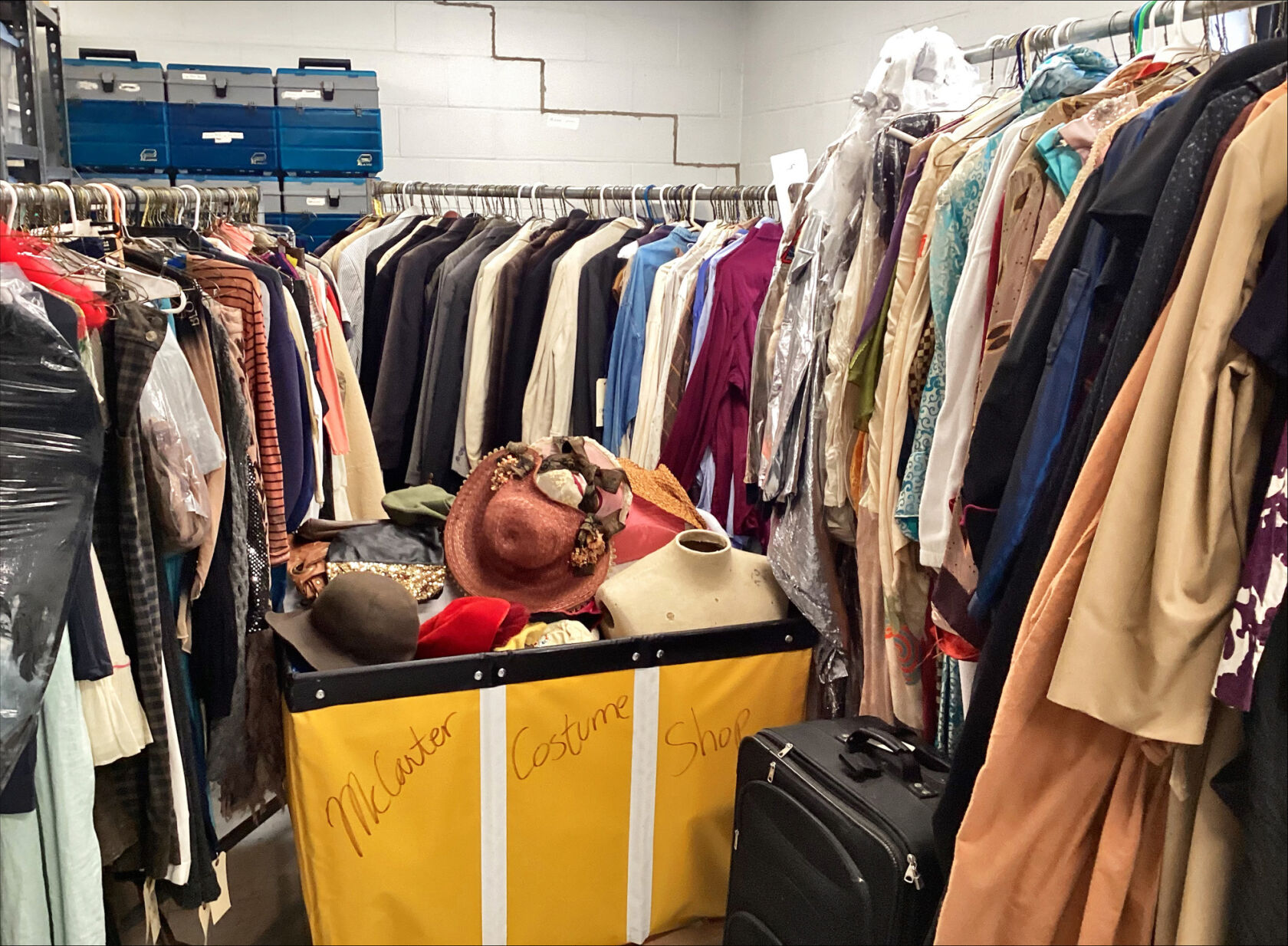
McCarter Theatre Announces Costume Sale
From beautifully crafted period pieces to whimsical fantasy looks, McCarter Theatre Center’s Costume Sale offers the public an opportunity to own a piece of theatrical history. Running Friday through Sunday, May 16 through 18, from 10 a.m. to 6 p.m. daily, the sale will take place at 755 Alexander Road in Princeton.
Costumes, shoes, and accessories featured in McCarter productions — ranging from new to heavily distressed — will be available for purchase, with all items priced at $25 or less. Payment will be accepted by cash, check, or credit card. As a special bonus, on the final day of the sale (Saturday, May 18), educators may purchase costumes by the bagful for just $5 per bag. Quantities are limited.
Please use the “auto entrance” and enter through the double doors at the back of the parking lot. For more information, visit mccarter.org.

DeShawn Harold Mitchell, left, and Shane Taylor in ‘Primary Trust.’ Photo by Mikki Schaffner.,