Ins Choi’s “Kim’s Convenience” is a compact sitcom that packs two seasons of plot lines, comedy, and drama in one neat 90-minute play.
Warm and congenial, yet touching on genuine family conundrums and filled with personality, Choi’s piece, at Princeton’s McCarter Theatre through Sunday, February 15, comprises a romance, an estrangement, parental interference, parental secrecy, personal obsessions, strategic use of martial arts, expressions of feelings, a business proposition, and a keen knowledge of who is and isn’t likely to steal in a way that moves flowingly from one beat to another, always holding interest and always entertaining.
The sitcom nature of Choi’s play must have resonated with Canadian television producers because three years after “Kim’s Convenience” landed on the stage, it was turned into a TV series that aired first in Canada and later internationally via Netflix.
The play’s Canadian roots show in the same subtle way they inform the popular musical about travelers being transported to Newfoundland on September 11, 2001, “Come From Away.” It has taste and a knack for making palpable points without the overstated drama or excesses that plague so many American works. (I call that knack “Canadian assurance.”)
“Kim’s Convenience” is a slice of life set in a variety store owned for years by Mr. Kim, a Korean immigrant who was a teacher but couldn’t manage English well enough to be certified in Canada. To support his family, he opens a variety store in a busy Toronto residential neighborhood, one that is about to change from single homes to massive apartment complexes and shopping centers, including a Wal-Mart that causes Mr. Kim some concern.
He has built a life he likes in his store. He often tells his children and the audience his “story” and how much his business is part of it. He also emphasizes how much of a staple Kim’s Convenience has been to the neighborhood it serves.
Choi’s play depicts activity in the store while revealing aspects of the Kim family’s personal lives. Their daughter works at the store and lives with the family at age 30 while trying to gain traction as a photographer. Their son had addiction problems, including stints in rehab, and left home at 16. Mrs. Kim, called Umma for mother as Mr. Kim is called Appa for father, is religious and has a nice middle class life while forging a different relationship with her children from her more sarcastic, more temperamental husband.
All of this come across matter-of-factly while to being potent enough to engage both the attention and emotions of the audience. Choi and the McCarter cast directed by Weyni Mengesha aim for the real while allowing themselves human traits, including anger and aikido to make points. Choi, Mengesha, and company are masters at setting, then changing tones and levels, to provide depth that goes beyond the everyday veneer of “Kim’s Convenience.” Humor prevails, but there is authentic sentiment behind much of it, giving “Kim’s Convenience” texture as it gives the welcome impression of breezing along.
Common familial and commercial happenstance and circumstance arise while providing glimpses of how well-defined characters deal with them as well as of Korean culture and the close relationship Mr. Kim has with his family and community.
Among the scenes I found particularly amusing are ones that involve separate uses of aikido to exact a confession of shoplifting and a marriage proposal, a history test the ex-teacher uses to gauge the fitness of a job applicant he wants to pass, Appa’s lingering disdain for anything Japanese based on a 1904 invasion of Korea, and the proper tying of a garbage bag. Among those I found moving were both Appa’s and Umma’s relationship with their children, tenuous at times with Umma being maternal in a way that differentiates between daughter, dutiful or not, and son, troubled or not, and Appa being more caustic and showing more authority (for all it gets him, children being children however grown).
There is also Appa’s “story,” by which he means his personal history, told several times with a twist that pertains to the situation at hand, but always telling as it chronicles the life of an immigrant who didn’t always do what he wanted but made sure he did what was necessary to keep his family thriving.
Choi and Mengesha are abetted by a cast that exudes the Canadian assurance I spoke of, always sincere and real even while playing a sequence of total comedy and dealing with an intense moment.
The show’s creator, Ins Choi, is a lovable, though wily and cantankerous Appa, who clearly shows every paternal and general emotion while remaining a complete and realistic character.
Choi wrote good lines, and he’s excellent at delivering them, creating a complex man who knows not only how to run a store but the dozen telltale ways to spot a likely shoplifter, who rags at his daughter while showing pride and having her best interest at heart, and who may have driven his teenage, drug afflicted son from home but who never stops thinking about him and expecting his return.
Choi’s timing as actor and author is exceptional. He anchors his play while generously giving others, especially Kelly Seo as his daughter (Janet), Brandon McKnight in a quartet of roles ranging from cop on the beat to suitor to Janet, and Ryan Jinn as his son and recent father (Jung).
One measure of how well “Kim’s Convenience” communicates is occasional sequences in which Appa and Umma speak to each other in Korean, usually about their children or their eventual retirement, dreaded by one, yearned for by the other. Those who speak Korean laughed at times, but even if Korean is unknown beyond a few food names and phrases from TV series, Choi and Esther Chung makes make their meaning and intention known.
Chung is pert and recognizable as a woman who helps run the family business but enjoys the profits it derives and likes to shop. She is also involved with her church, both for the tradition and the gossip.
Umma is also in touch with her estranged son, and Chung knows how to be firm but giving and grateful when they meet, unbeknownst to Appa, in the sanctuary of the church.
Kelly Seo is as versatile as Ins Choi in conveying the variety found in Janet, who knows her family customs and helps maintain the store but is Canadian enough and modern woman enough to want some independence and the opportunity to forge her own way.
Of course, her parents in their own way allow for that, no matter how sarcastic Appa can be, but Janet is particular in the career she prefers and the kind of man she wants to marry, and Seo flawlessly handles both the assertiveness and respect Janet feels. (That Canadian assurance again!) She is also deft in revealing the intrinsic irony of her character.
Brandon McKnight is a veritable chameleon. You know the same actor is playing a thief, a policeman, a real estate mogul, and a family friend, but McKnight finds different postures and attitudes that distinctly differentiate his various, varying roles.
One great sequence involves a turnabout when McKnight’s police officer, Alex, eludes an aikido grip from Mr. Kim and applies one of his own, exacting a similar pledge to one Appa had him recite when he was immobilized by Appa’s control of his pressure points.
Ryan Jinn has in ways the most difficult role as he plays the son who has been on the scrounge and in rehab for part of his young life but now wants to acquaint his parents with a new situation that involves a grandchild and Jung’s realization of responsibility and need to change.
Jinn shows Jung’s transition while giving signs of his past. Scenes with Choi and Chung, never on stage with Jinn at the same time, define how one child, now adult and a father himself, finds different modes to relate to different parents.
Joanna Yu’s set makes you want to go shopping (especially on the evening before a looming snowstorm that threatens to make going out difficult). I felt inclined more than once to grab some Cheerios and a few Gatorades (sugar-free, thank you) before heading down the road to Tim Horton’s for a supply of donuts and a cup of coffee.
Ming Wong’s costumes are equally authentic, Appa dressed in almost a uniform for a variety store owner, Umma showing some fashion sense as she prepares to go to church, Janet and Jung looking smartly contemporary, and McKnight’s police uniform as crisp and neat as a Canadian would have it.
Weng-Ling Yeo’s lighting conveys the brash glare of a convenience store while being kind to the audience’s eyes. Fan Zhang’s music conveyed the sitcom feel of “Kim’s Convenience” while her sound design appropriately brought Toronto sounds to Appa’s story.
Kim’s Convenience, McCarter Theatre’s Berlind Theatre, 91 University Place, Princeton. Through Sunday, February 15. Show times are 7:30 p.m. Tuesday through Saturday and 2 p.m. Saturday and Sunday with a 2 p.m. performance on Thursday, January 29. $36 to $92. www.mccarter.org or 609-258-2787.
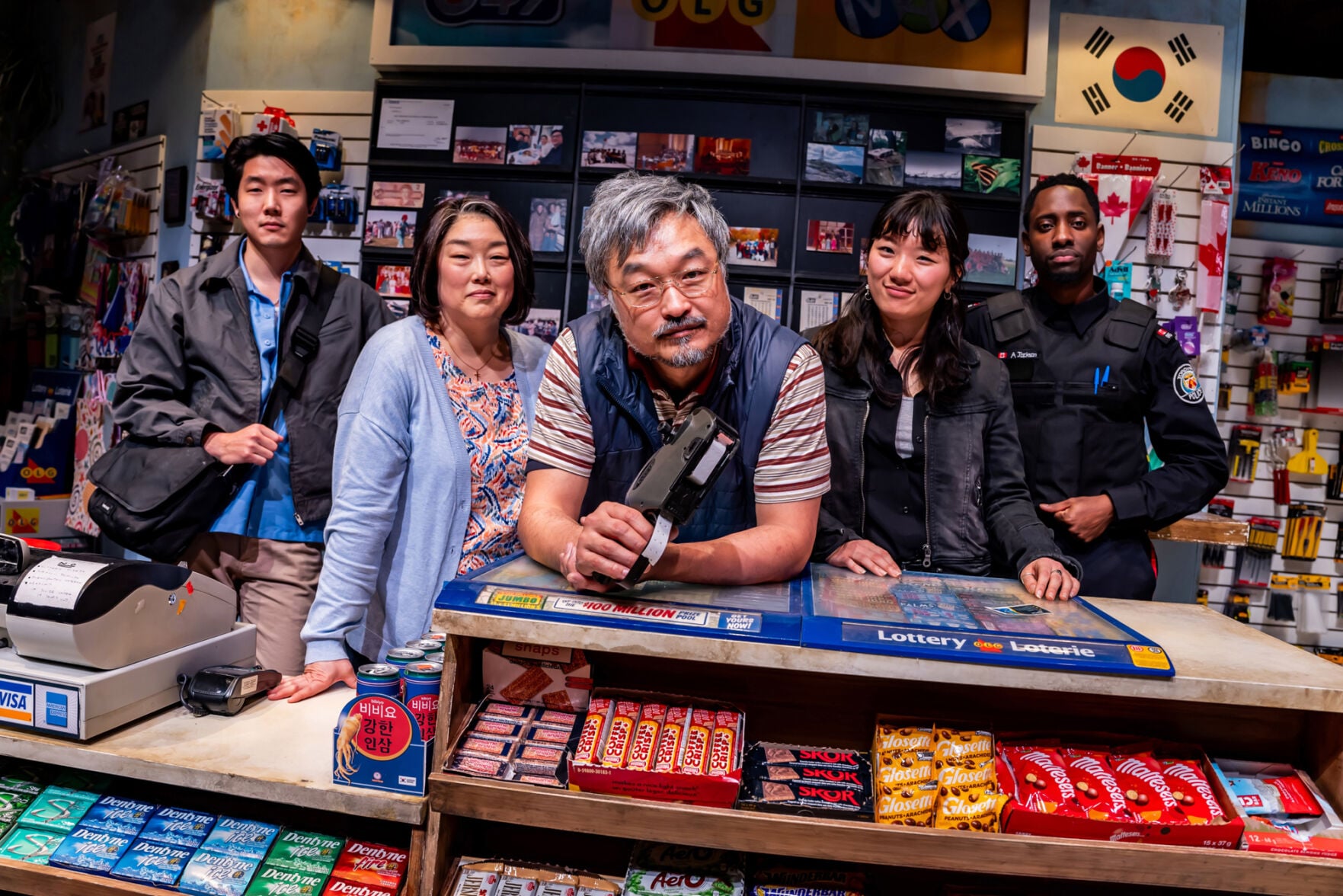
Ryan Jinn, left, Esther Chung, Ins Choi, Kelly Seo, and Brandon McKnight in ‘Kim’s Convenience’ at McCarter Theatre through Sunday, February 15.,

