Trenton resident and former Lawrence High School principal Donald Proffit has written a memoir of his experiences as a conscientious objector assigned to alternative service in Alaska during the Vietnam War.
As he notes in the preface for “Hardship Alaska,” “This book began as a collection of vignettes written while on airplanes over the last fifteen years or so, each one written in the time it would take to fly from point A to point B. It was a way to remember people and places I had come to know while a conscientious objector during the Vietnam War. These memories had been captured in photographs, each snapshot a sacred object to hold and gaze upon during the ritual of remembering. The photos, soiled and scarred by a Delaware River flood, now lie decomposing in some landfill in New Jersey. With the loss of these photos, writing then became a way to remember, a way to hold on to these images as they gradually wash away from my memory.”
Early in his account, the then-Westminster Choir College student recreates the historic night of December 1, 1969, when the U.S. government conducted a lottery that would determine which young American men would be drafted into the U.S. military — and most likely sent to Vietnam.
Proffit’s excerpted account also recreates a time in Princeton’s not too distant past:
We pulled the door open and descended the flight of stairs into the sheltered warmth of The Annex, a popular subterranean restaurant frequented by Princeton students, academics, and locals. It was also a place where discrete Westminster male students could temporarily become Ivy Leaguers, if only for a few hours, while eating a reasonably priced, big-portioned meal in the dark oak wainscoted dining room, or maybe having a burger and a few beers in the more intimate bar.
We grabbed a table, ordered a couple of beers and burgers. Tonight, the place seemed more populated with Princeton students than was typical for a Monday night. A handful of Tigers came over to our table.
“Boys,” one of the men addressed us, “do you mind if we join you?”
Herb and I were at a table that could snuggly hold six, and as the bar was quickly filling up, we looked at each other to make sure we agreed.
“Sure, I think we can make this work. Please have a seat.” We did a round of introductions over a round of beers.
It was a rare occasion to have University and Choir College men in such close proximity to each other. Princeton men tended to keep their distance from us, as there was a sustained rumor that most men from Westminster were queers, which may or may not have been true. I remember sitting at the very same table with four or five other Westminster students a year or so earlier. Someone at the table had gotten a hold of a copy of Bob Damron’s “Address Book,” a pocket-sized compendium of purported gay bars, bathhouses, highway rest stops and other unsavory haunts that catered to or were frequented by homosexuals at a time when socializing as a gay person meant going underground to stay safe.
To our surprise, he had read that The Annex was listed as a non-AYOR (At Your Own Risk) establishment where homosexuals might be present. With that newly discovered information, we increased our visits from the occasional to weekly for food and drink.
On this night, however, there were no barriers between us and the Princeton students. No worries that we might flirt with one of the boys and be ridiculed for it. Rumors and differences no longer seemed important. What mattered tonight was that the first draft lottery in nearly three decades would determine who among us of a certain age would be the first to be called up to the U.S. military by the Selective Service.
I can’t remember whether we watched the broadcast on a small black and white television set up on the bar — CBS News was airing the event live from the Selective Service headquarters in Washington — or on a portable radio tuned to the university’s student run FM station, WPRB. Either way, we sat together, drank beer, and listened intently as the birth dates of all U.S. males, aged 19 to 26, were randomly drawn.
This was not a lottery that you wanted to win, not when the grand prize included an all-inclusive two-year tour of duty slogging through Vietnamese jungles and facing possible death in a war that made no sense to me.
What was I going to do? I knew in my heart that I was incapable of killing another person should I be drafted and sent off to war. I wasn’t someone who ever thought of causing harm to any living thing for that matter, even those who had harmed me.
One of the Princeton boys bought another round of beers for the table as the sequence of assigned numbers climbed into the fifties. I was still grabbing bites of my burger between talk of war, politics, campus life, and birthdays when it happened. The rolled piece of paper holding my birthdate, January 19, was pulled from its hiding place among the hundreds of others waiting in the cylindrical glass container. Number 58.
Time stopped. I looked over at Herbie, both of us realizing that at that moment everything had changed for me, for us, and would never be the same. Those around the table put down their mugs of beer, burgers, and fries, all of us strangers until tonight, and looked at me with sympathetic eyes, the first at the table to be called.
“I’m so sorry, Buzzy,” Herbie was the first to speak. The rest at the table took turns offering their condolences to me.
“Return to Alaska,” Donald Proffit, 268 pages, $16.95, Epicenter Press.
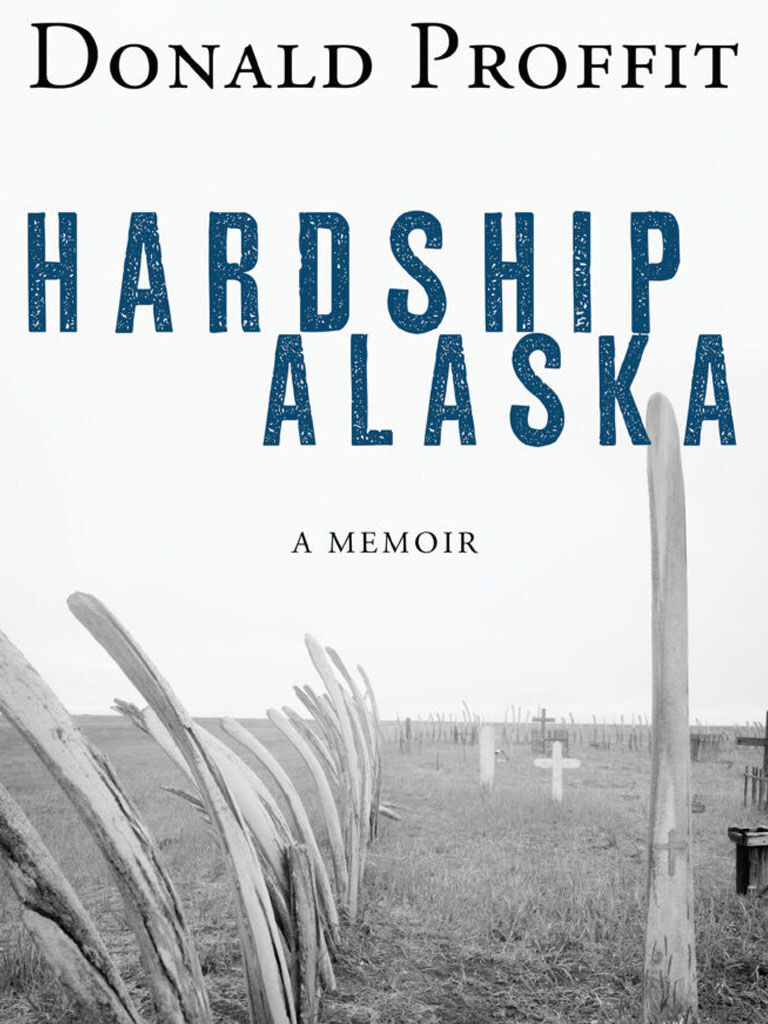
'Hardship Alaska' by Donald Proffit.,

