It’s a recent sunny Saturday morning, temperatures in the teens. Even though it’s been cold, the noted Trenton-based rustic woodworker David Robinson and I have decided this is the best day for our day-trip.
When I pull into the lot behind his shop at 2 Pearl Street in Trenton, where he has worked for about 30 years, Robinson gives me a hand-warmer pack, I grab my hot tea thermos, and we’re off to see his creations in multiple outdoor places in Mercer County.
Although I’ve read articles about Robinson and seen a few samples of his work, I ask him to tell me how he views his artisanship.
“I call myself a woodworker, working in one of the world’s oldest professions, wood-gathering and building,” he says. “I am a 21st century rustic woodworker, carrying on a tradition of building furniture and garden structures.”
His love for woodworking began in boyhood, when he followed around Mr. White, the carpenter hired to renovate his family’s house in New Hampshire. Robinson also established Robbie’s Fix-it Shop for go-carts owned by his neighborhood friends.
After a year at the University of New Hampshire, he followed his sister’s footsteps to San Francisco. Robinson apprenticed himself to the Dutch sculptor Jacques Overhoff to build architectural-scale precast concrete sculpture for public plazas throughout the city.
“When the studio finally settled into an old factory building, I moved into a loft above the studio where I was surrounded by dozens of other young artists — painters, sculptors, dancers, writers, designers. During this time, Abby Jaroslow, another young art student, joined us on a number of jobs, including a monument restoration in Golden Gate Park. She later became my wife, and I followed her to New York, where she was to study historic preservation in architecture and landscapes at Columbia University’s School of Architecture and City Planning.”
In New York, Robinson landed a job as director of the newly formed restoration crew for Central Park. “I had no idea how much that experience would change the course of my life,” he says. Robinson spent 10 years in that position before deciding to start his own business.
We hop into Robinson’s red Ford pickup truck, with his logo, Natural Edge, on the door, and drive just a few minutes away — to the South River Walk Park above the Route 29 tunnel. We walk through a series of five half-circle arches, 12 feet tall and 14 feet wide, each one representing 100 years in Trenton’s history. Proceeding from each arch we walk on a chain of engraved plaques depicting milestones of that century.
Robinson’s is the 17th century arch, made out of white oak he found locally. He points to the joinery, where the angles dovetail with each other and wooden dowels pull the angles tight together. “The wood is starting to weather. It’s had little maintenance in the last 20 years. At the minimum it needs to be painted with sealer, but some of it needs to be reinforced for the next 20 years,” he notes.
Our second stop is Trenton’s Old Barracks Museum, where Robinson has built two structures, also made of white oak. One is a shed for protection when the reenactors assemble and for storage of wood to repair the fence and gates. Robinson notices that squirrels are chewing on the wood of the rafters and that one gate is in disrepair. He says he’d be willing to volunteer or accept less remuneration to make necessary repairs. His second, smaller shed houses a bread oven. He also made boxes in which to knead the dough.
On our way out of the property, Robinson spots a tree with an enormous trunk: “It would be a lot of fun to build a treehouse up there,” he muses. As a child, he loved to build treehouses and birdhouses. He still does. We exit through the sturdy Barracks’ main gate, which he also constructed. “I’ve made hundreds of gates, so I have the system down,” he says.
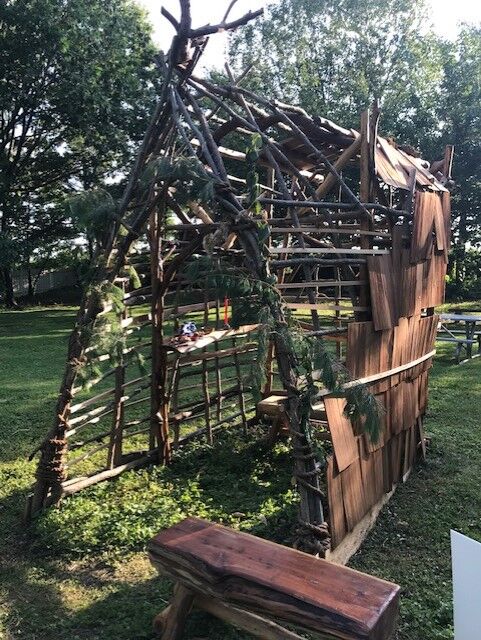
At another backyard property, the 1719 William Trent House Museum, Robinson says that two years ago there was an exhibition with the theme of immigration to the Trenton area. It was his suggestion to build a Lenape hut, which stands there now, representing the Indigenous Americans who inhabited Trenton originally. “I used miscellaneous wood that I could bend to create the curves in the hut,” he says.
He adds that the Native American huts here and at Hershey Park Gardens in Pennsylvania, along with natural human-sized walk-in bird nests created for parks in Philadelphia and Memphis, thematically reflect his approach.
Now Robinson points to a chair in the yard, which he made out of apple wood. “There are 10 to 15 different varieties of apple trees growing in this yard,” he says. “And I made four ‘angry trees’ for the Angry Orchard Cider House” in Walden, New York.
Now driving through Cadwalader Park, we approach Ellarslie, the Trenton City Museum. At the entrance we walk through a trellis with two benches made of cedar and Osage orange wood capped with a distinctive finial that curves with the wood from which it’s made, a characteristic Robinson touch.
“I was figuring I’d come back and add another rafter or two to reinforce it,” he says. “But it seems pretty solid.” As we enter the museum store, the proprietor says she’d like to buy one of his birdhouses on display, the one with a woodpecker that also serves as a doorknocker. Robinson guarantees that “birds build nests in 95 percent of my birdhouses.” In one of the galleries, the wintry sun shines through a window where one of his benches sit, a combination of cedar, Osage, and locust.
We then take off to Rat’s Restaurant in Hamilton, adjacent to the Grounds For Sculpture, founded by the late Seward Johnson. Toward the back patio we walk through another one of Robinson’s curved arches, about 12 years old, beside a lily pond.
“It’s as strong as it can be just as it is,” he says before sitting on the bench inside a curved shelter he built, a few feet away from two life-like bronze sculptures of Seward Johnson painting en plein air. Robinson notices some weathering pieces in the shelter; he’d like to replace them and put some sealer on it. “Now would be the best time to do it, to get it ready for the spring.” He tells me he’ll suggest the repairs to the restaurant establishment.
Once we get to Princeton, Robinson has two surprises in store for me. One is a small shelter, a square gazebo with benches, made of cedar and about 10 years old, commissioned by the owners of the private home it faces. I notice that some of the posts are curved branches, as are the backs of the benches — a Robinson trademark.
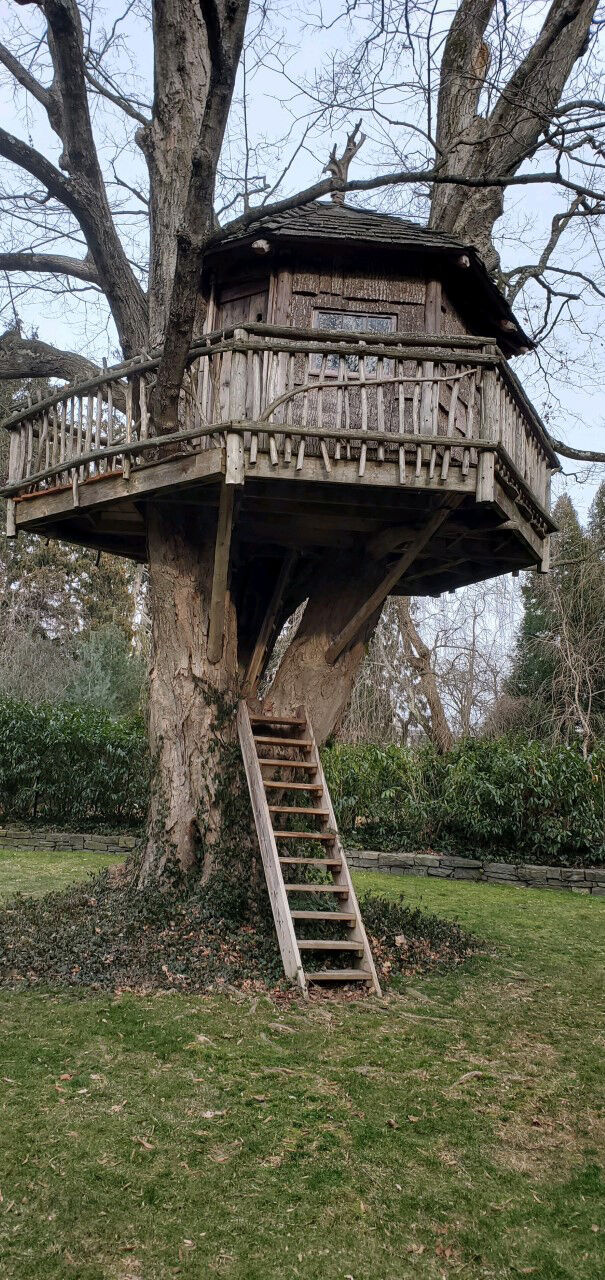
The real feast for the eyes is a magical treehouse that surrounds a gigantic maple tree in the front yard of a second home a few feet away. This wasn’t its original location. First Robinson built it on the other side of a swimming pool. “We had it all framed out and ready to go, but then the inspector came and told us it was too close to the pool. So we dismantled it and built it up in the tree.”
Robinson notices that the owners had found somebody to replace the flooring. “They definitely picked up the gist of how I do (it). I like to make flooring curvy and irregular rather than just straight across. That’s where I take the jigsaw and go [Robinson vocalizes the sound of a jigsaw]. And it’s so much easier, because if you have to cut it even, you have to measure everything and do all that.”
“When I do the flooring, I just lay it all down, let it overhang, and then I can go back with the jigsaw and weave the cut in and out, make it irregular, and it’s more fitting to the flooring and the structure that we work with. That’s the way we do it.” He calls it “the Robinson touch: laziness. No, you don’t have to measure it, just do it.”
Next we travel to the D&R Greenway Land Trust, specifically the Scott and Hella McVay Poetry Trail in Greenway Meadows Park. We walk toward the Edward T. Cone Grove near the entrance. Five of Robinson’s Adirondack chairs plus a bench allow a visitor to pause for a moment of meditation, or one can follow the concentric circular labyrinth of stones.
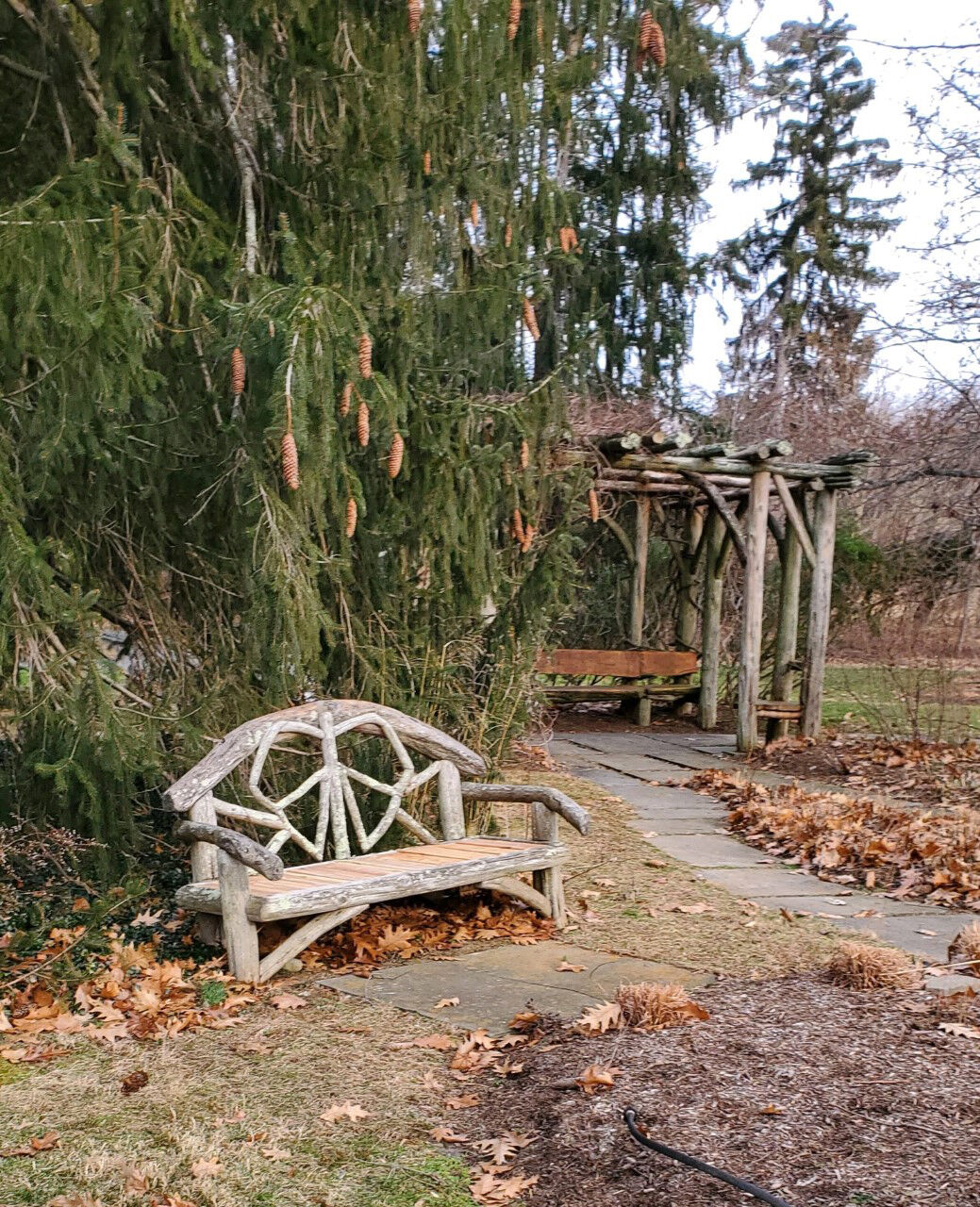
We approach a trellis with two benches, encased with spiraling vines above, that leads you to a perfect view of a tree sculpture with green metallic butterflies suspended from its branches. Three of David’s benches — these with the shape of a butterfly forming their backs — provide a place to rest and view the meadows. This area is known as “Meredith’s Garden for Inspiration: A butterfly lights beside us like a sunbeam.” Robinson tells me he also built butterfly benches for the Bronx Botanical Gardens. Along the Poetry Trail, 10 of David’s benches are strategically placed near the plaques upon which you can read poems related to nature.
While woodworking is his livelihood, Robinson has a passion for teaching his trade to children. We stop at Johnson Park Elementary School in Princeton, where Robinson assisted students in building an archway that led to a nature trail, as well as a boardwalk over a swampy area that often floods due to a nearby stream.
Our final destination takes us along a row of Osage orange trees, also on land preserved by the D&R Greenway Land Trust. “I like working with Osage wood because it has curves and is durable,” says Robinson. We’re at St. Michael’s Farm Preserve in Hopewell and walking on a rutted trail to view a rectangular gazebo Robinson built a year ago to memorialize the life of a young man.
Facing the sun as it sets, the gazebo overlooks an expanse of milkweed grasses, punctuated by three martin birdhouses. A plaque tells us it’s Jackson’s Place — “Breathe easy, think slowly, dream focused,” (lyrics from a song by the band Umphrey’s McGee).
“I wanted to use wood that is indigenous to this location,” says Robinson, adding that he uses a bandsaw to make the curved slats of the benches and then goes “back and round the corners and edges to make them smooth. It takes extra time and energy to finish them like that.”
Robinson tells me he finds a good portion of his wood in Whitehouse, New Jersey. “Choosing, harvesting, and gathering wood is the most creative and important part of building rustic structures and furniture. Not just any old piece of wood or branch will do. I primarily look for wood that is suitable for outdoor use: cedar, juniper. Other durable materials I use which have interesting and inspiring branch shapes are mulberry, Osage, locust, walnut, fruit trees — apple and pear — and some shrubs, such as lilac, rhododendron, and mountain laurel.”
It’s late in the afternoon, and 21 degrees is the warmest it’s gotten. Robinson and I head to Panera to warm up. Amid sandwiches, coffee, and chocolate croissants, he proudly shows me an album packed with photographs of children learning the art of woodworking from him.
One photograph is of two little girls on a bench. The one on the left is his daughter, Leah, who at age 3 sustained a brain injury. Now in her 30s, she lives in a house on a farm campus in upstate New York, where she is able to receive the support she needs. Robinson and Jaroslow normally visit Leah twice a month, but because of COVID, they haven’t seen her in over a year. He says they also have a 30-year-old son, Daniel, who has his own photography studio.
He then shows the next photograph of a young boy and girl with hammers in hand, wearing hardhats and he smiles — satisfied with inspiring the next generation of rustic woodworkers.
For more on David Robinson, go to www.naturaledgerustic.com.
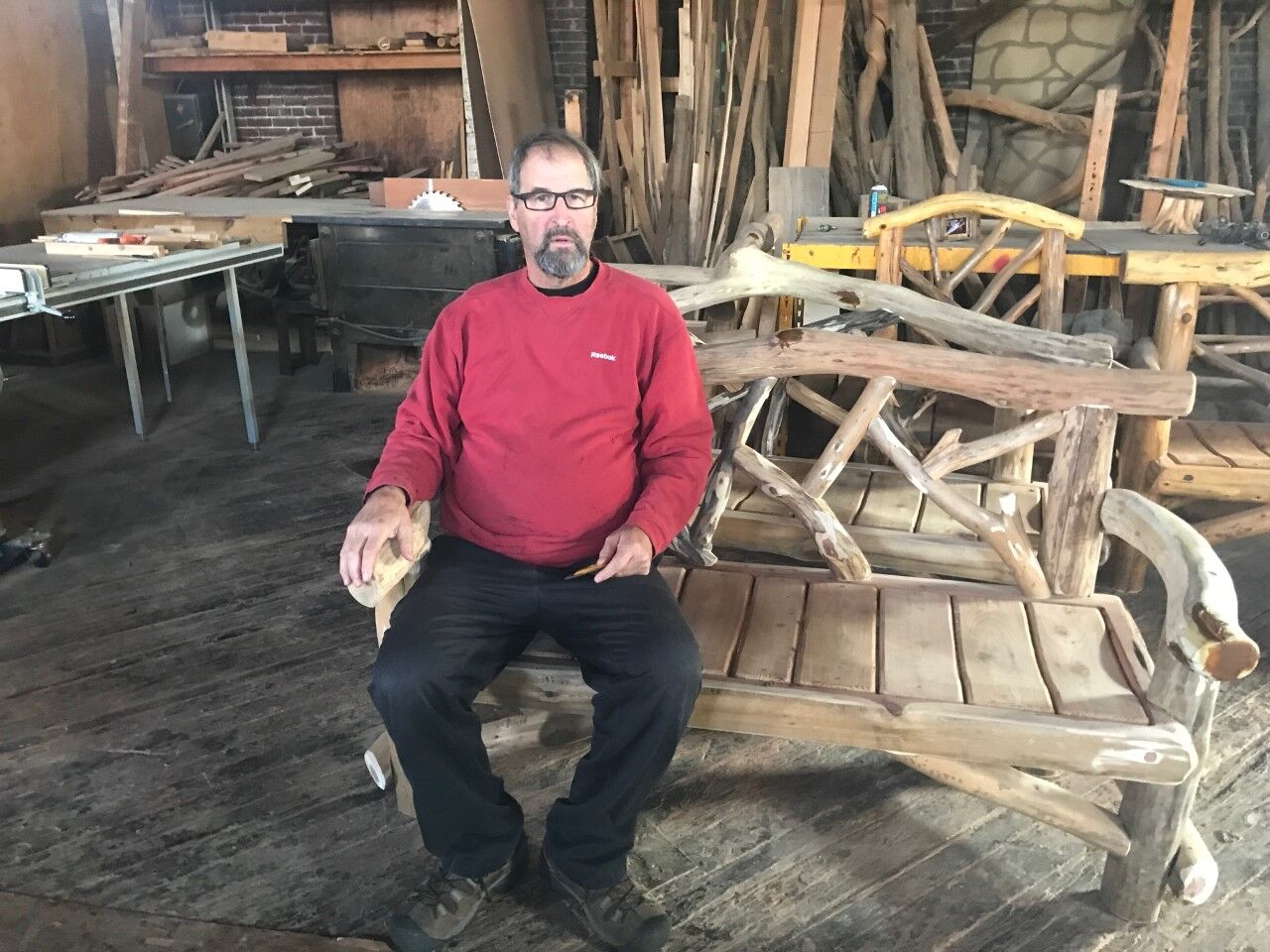
Pieces by rustic woodworker David Robinson, pictured above in his Trenton studio, dot the regional landscape.,
A bench at the entrance to the butterfly garden within Greenway Meadows Park in Princeton.,