Time travel back to the mid-century campus of Princeton University, when college men went to class in suits and skinny ties, beloved old buildings were coming down as new structures were going up, and people skated on Lake Carnegie during the cold and snowy New Jersey winters.
The delightful exhibit “Credit Line, Please: Photographs by Elizabeth Menzies,” is on view now through April 2025 in the gallery at the Seeley G. Mudd Manuscript Library in Princeton.
Curated by Phoebe Nobles, processing archivist; Emma Paradies, library collections specialist IV; and Rosalba Varallo Recchia, library collections specialist VI of the Princeton University Library, the exhibit features dozens of photographs by Princeton resident Menzies (1915-2003), culled from the Princeton University Archives collections at the Mudd Library, in particular the Princeton Alumni Weekly Photograph Collection and the Historical Photograph Collections.
There is no one collection of Menzies’ images in the Princeton University archives, and many of the photographic collections are not searchable by artist. The curators looked through hundreds of boxes of photos in different collections to put the show together.
“The formal work on this exhibit began a little more than a year ago,” says Nobles. “Since there were three of us, it was great to have multiple perspectives on what we had. (In addition to the images), we also looked through a database of digitized newspapers, and also Princeton Alumni Weekly’s archives, where so many of her photos were published.”
“We came up with hundreds to choose from but whittled it down to a manageable number of photos,” she says. “We did want to show (Menzies’) range: there’s campus life in the first case, then photos of campus architecture, as well as Lake Carnegie, sports, etc. You can see her signature style in each case.”
Elizabeth Grant Cranbrook Menzies was born on June 24, 1915, in Princeton, to Professor Alan W. C. Menzies and Mary I. Menzies (formerly Dickson). Both were from Edinburgh, Scotland, making Elizabeth a first-generation American.
Her father was himself a photographer and developed his prints out of a spare bathroom/darkroom in the family home on Prospect Avenue. Since childhood, young Betty took an interest in darkroom techniques and grew up to have quite a knack for this painstaking activity.
In 1936, just three years after graduating from Miss Fine’s School, Menzies sold her first cover photograph to Princeton Alumni Weekly. That photo and many others went uncredited. The back sides of the prints document an evolution from the lightly penciled “Menzies” to a polite “Credit Appreciated,” and finally to her rubber stamp insisting “Credit Line, Please.”
In 1939, at age 24, Menzies’ freelance career as a photographer got a major boost when she did a portrait of Albert Einstein, which she sold to Scientific American magazine. It was quite an achievement for any photographer, but especially for someone just starting out, since by this time Einstein was shying away from fame and did not enjoy being photographed.
Throughout the 1940s, ’50s, and ’60s, Menzies used her camera as an entry ticket to lecture halls that were not yet co-ed. While she was excluded from the education she documented, she enjoyed special access to the campus and its environs. In the words of one PAW editor, undergraduates “endured Betty Menzies’ tennis shoes silently padding through the back rows.”
If not a “fly on the wall,” she might have been more like a cat, quietly moving around unseen, but always keenly observant and ready to pounce on a decisive photographic moment. With her eye for architecture and wry sense of juxtaposition, along with her persistence and creativity, she developed a strong voice of her own.
Menzies’ credit line began to appear more and more, especially during the World War II years, and by the 1950s and ’60s, most of the PAW covers featured one of her photographs.
In addition, she often exhibited her photos, paintings, and prints on campus and in town, and eventually saw her work showcased in such national publications as the Saturday Evening Post, Time, and Life magazines.
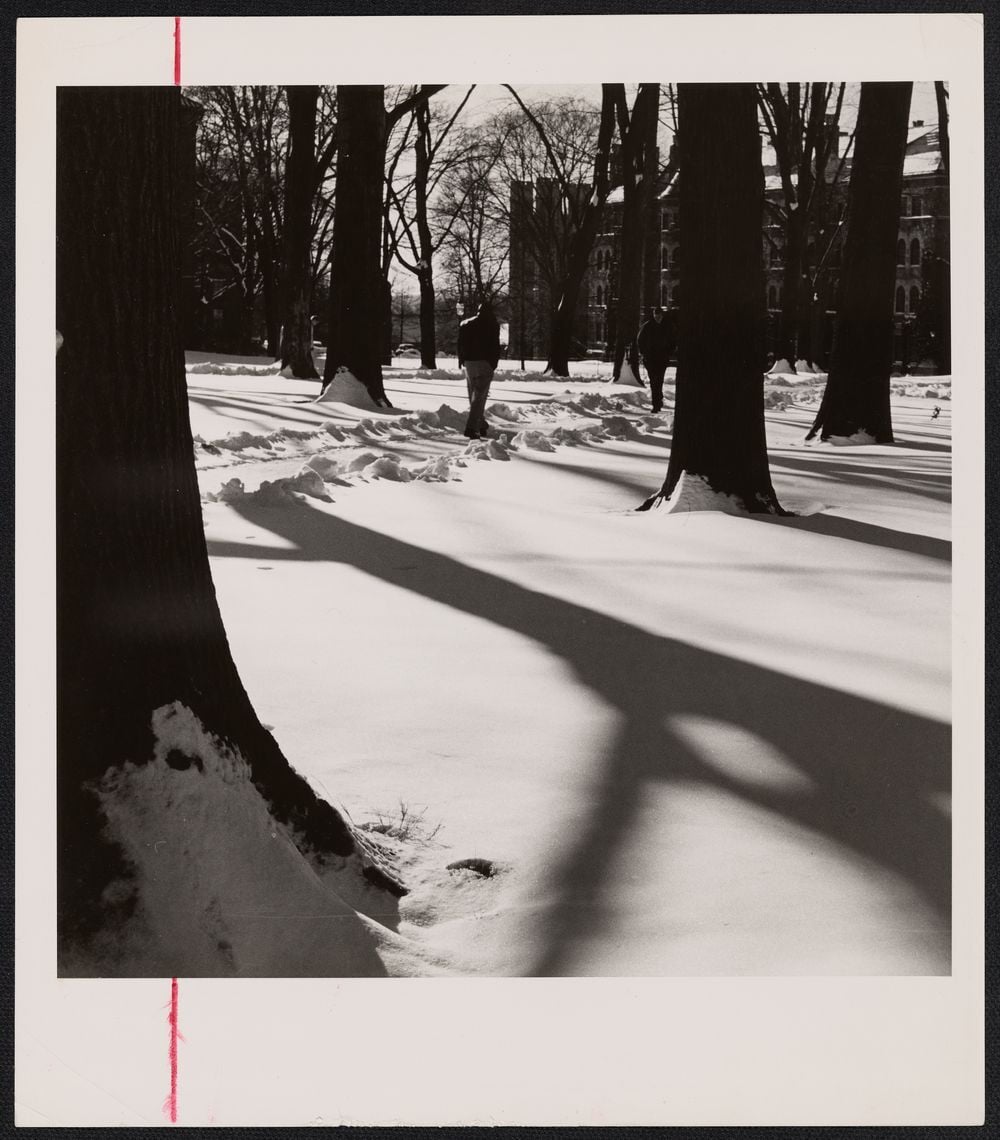
This writer viewed the exhibit in late July during a heatwave, so I gravitated toward one of Menzies’ 1950s-era shots of the Princeton campus in snow. This particular black-and-white image, beautifully printed, shows a usual “going to class” scene, but with stark black shadows of trees reflected in the bright white snow.
Slender men dressed in black with their backs to the camera walk the shoveled paths and seem as sculptural as the tree trunks.
(Menzies’ photo of bundled-up skaters on Lake Carnegie also provoked a yearning for a nice cold day, by the way.)
The photographer had an affinity for the lake and was born not too long after it was created in 1905. For years, Menzies lived within walking distance to Lake Carnegie, and became an early and staunch advocate for the environment, documenting encroaching pollution in the lake.
One case within the exhibition finds Menzies playing with patterns, repetition, geometric lines, shadow, and contrast.
She captured World War II-era Navy men in perfect formation, marching to their graduation ceremony. With their tidy white uniforms, fitness-trained physiques, and similarity in height, they resemble a collection of statues, or a box of toy sailors.
Menzies also experimented with solarization during the development process of her photos, and we can see examples of her work with this technique in shots of the Nassau Hall cupola, a brooding sky over Palmer Stadium, Commencement 1941, and other images.
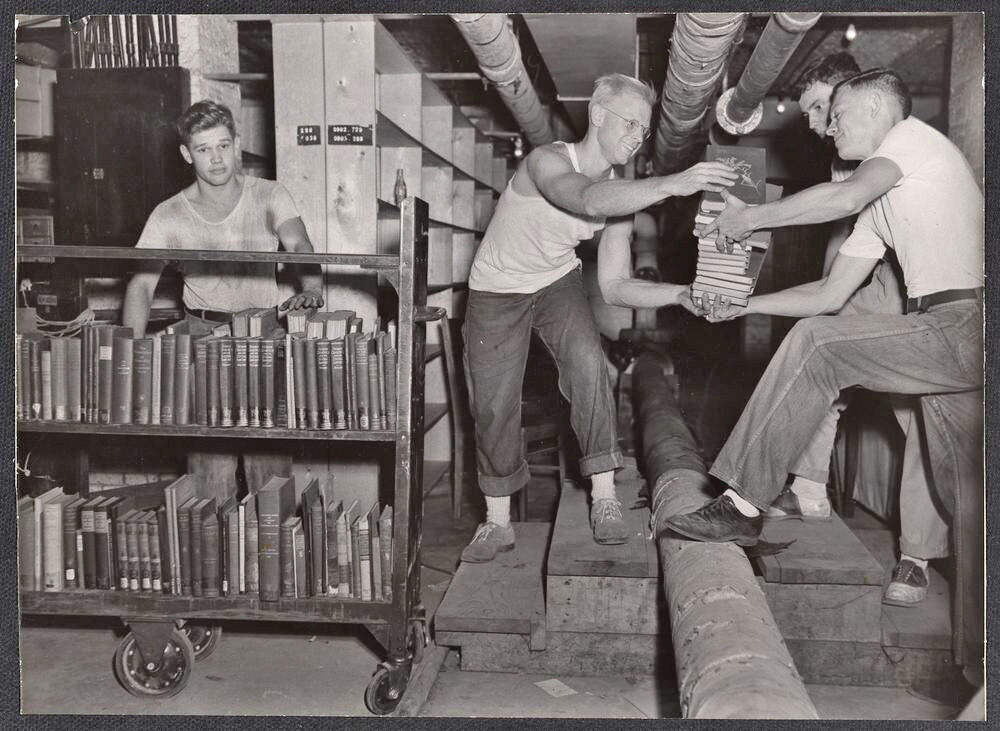
The photographer liked to focus on various behind-the-scenes personnel at the university, such as maintenance workers. One outstanding photo shows men working on the façade of Alexander Hall. It’s a study in the contrast between the vast and elaborate exterior of the building and the tiny humans in white overalls, one high atop a multi-story ladder.
“I really like that photo of Alexander Hall, I like her inclusion of workers, which makes the architectural pictures more interesting,” Nobles says.
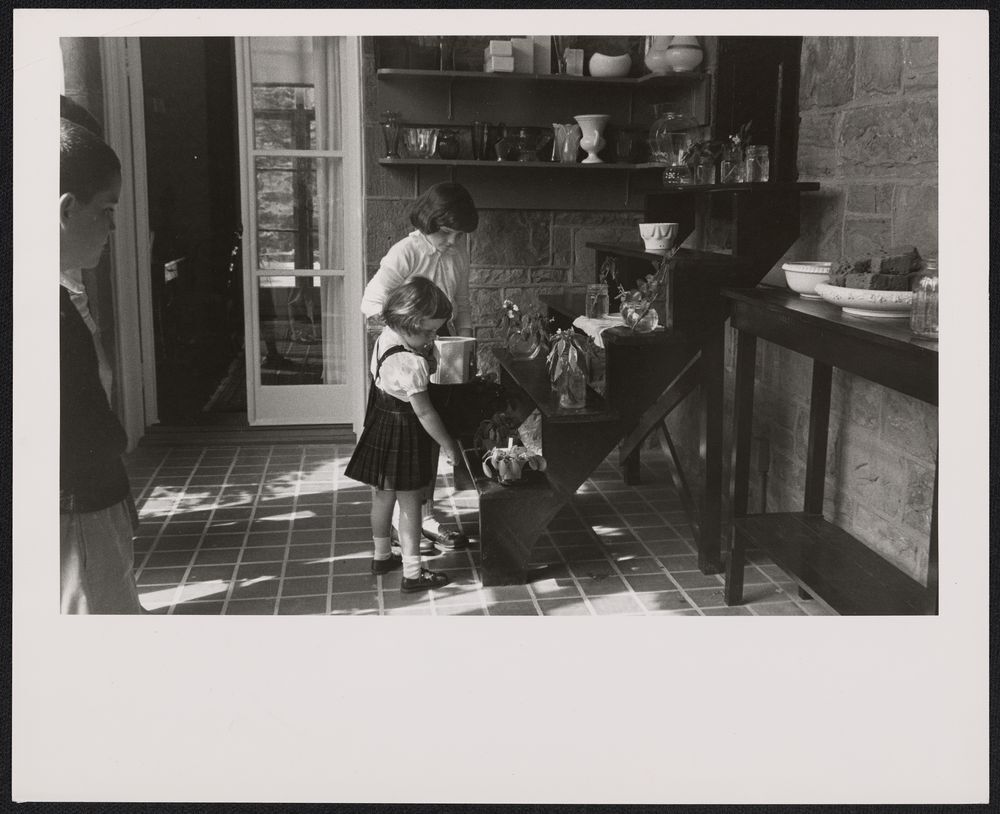
Another unsung member of the P.U. family can be seen in “Tony, Plant Tender (1962),” a dark-haired man carefully watering the fauna, assisting the biology department.
“We all like a lot of the photographs, but we all love ‘Tony the Plant Tender,’” Nobles says. “There’s so many plants in front of him and he’s there in this (jungle-like) environment — there’s just something moving about it.”
In her subtle way, Menzies showed, without judgment, the stratification of the university, where the professors were the likely stars, with a large cast of unseen assistants and supporters. Or perhaps Menzies just liked to portray the lives and routines of the Princeton University staff.
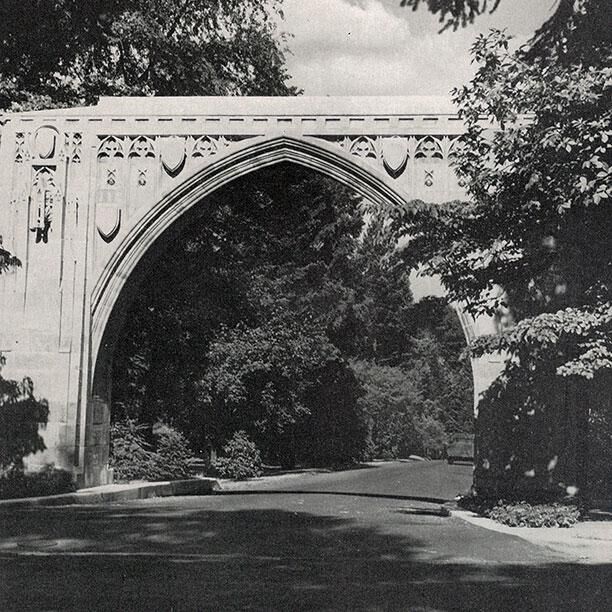
She also had a love and eye for architecture and architectural detail, capturing doorways, stairways, corridors, as well as grand gates and façades around campus. From Gothic arches to the then-new Brutalist buildings, Menzies loved the older buildings but also embraced the geometry of the modern structures.
The photographer often contrasted the blunt, man-made angles of various structures with tangled and bare tree limbs. For example, “New South (1965)” shows a plain and rather unattractive building softened with lacy branches of a magnolia tree in the foreground.
In 1954 Menzies was invited to work at The Index of Christian Art at Princeton University (now called the Index of Medieval Art), and continued to work there part time through the early 1980s. Campus instruction at Princeton was a job mostly reserved for men, so this department was unusual because it was staffed predominantly by women and led by director Rosalie Green.
Menzies found a special niche there. Working at the Index saw her taking several summertime trips to Europe with Green and other colleagues. In fact, Menzies’ photographs from a sojourn in the summer of 1955 became the basis for a solo show at the Baltimore Museum of Art.
Perhaps most notably, Menzies had a wry sense of humor about her human subjects.
She delighted in capturing students in the library drooped over their books, actually asleep, barefoot, or twisting their torsos, feet up on the rails while absorbing their reading material.
“Studying (1955)” especially shows Menzies’ lighter side. This specific young man, shot from below, is such an oblivious human pretzel that the curators chose the photo as the exhibit’s main image, which graces the cover of the show’s brochure.
“It’s a classic and funny view of a typical student, and he’s totally unaware that his picture is being taken,” Nobles says.
She notes that, in order to protect the somewhat fragile prints, the photography will be rotated throughout the show’s run.
But it doesn’t matter when you see “Credit Line, Please,” there will be something there by Menzies that is well worth viewing.
“I hope people will get a sense of her visual acuity and her sense of humor,” says Nobles. “She had a certain local celebrity in the 1950s, and people would have known her name. This exhibit is a reminder that Elizabeth Menzies was there in Princeton and recorded so much of the campus in mid-century.”
Credit Line, Please: Photographs by Elizabeth Menzies, on view through April 2025, at the Seeley G. Mudd Manuscript Library Exhibition Gallery, 65 Olden Street, Princeton. Free and open to public during regular library opening hours. Check the website for current hours, as these change throughout the year. 609-258-1470 or library.princeton.edu/services/special-collections/seeley-g-mudd-manuscript-library