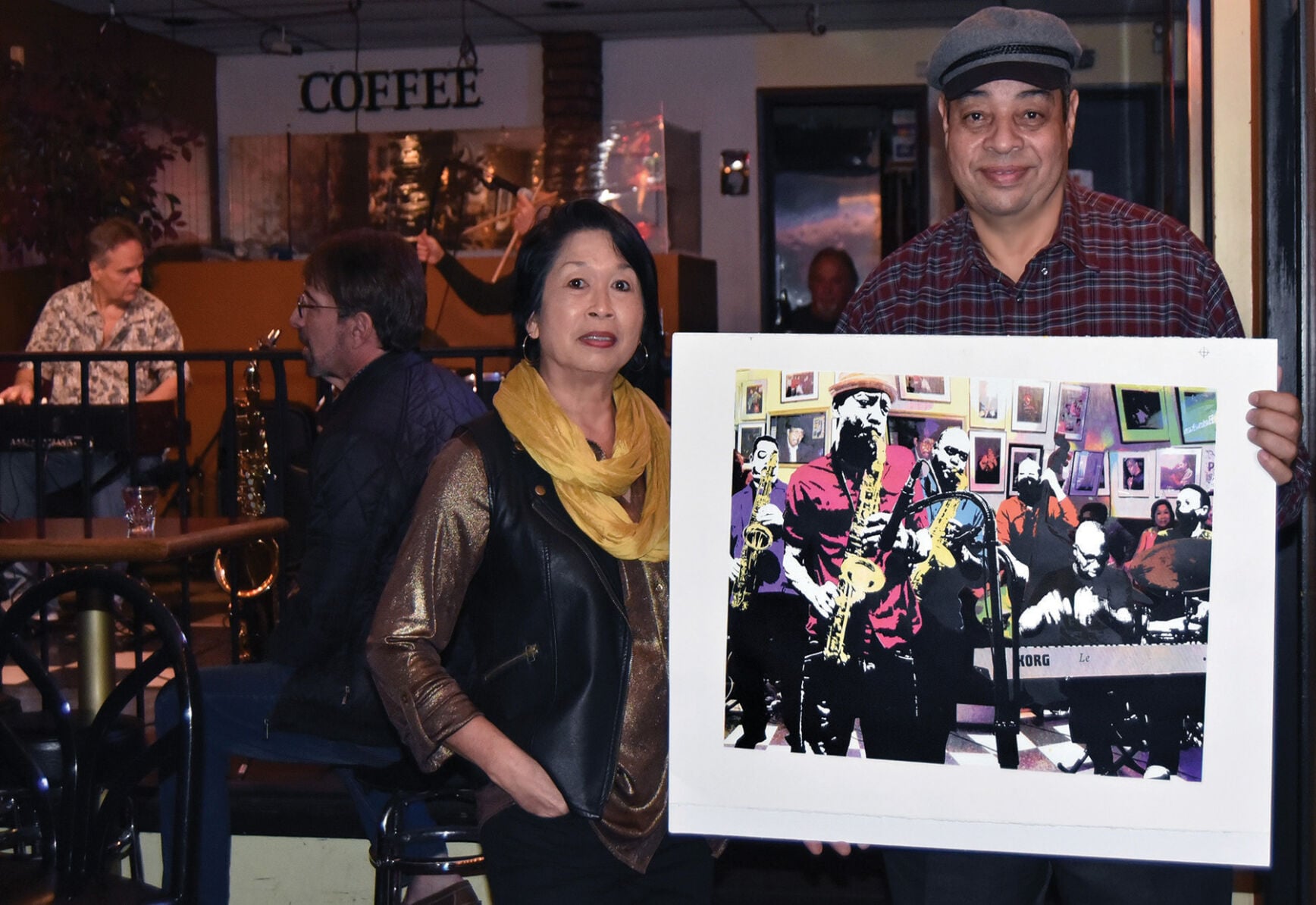
Look closely at Chee Bravo’s latest silkscreen of the Candlelight Lounge in Trenton, and you’ll see the artist herself sitting behind the drummer.
The work, “Candlelight II —The Celebration,” depicts her birthday party last May at the Candlelight. Six of a dozen jazz musicians who were on hand for “The Celebration” appear in the silkscreen.
In this post-Covid Candlelight reopening, the jazz was as effervescent as the champagne Bravo enjoyed with friends and family.
The Candlelight Lounge is a renowned jazz club that attracts musicians from New York, Philadelphia, and Washington, D.C., as well as from countries in Europe, South America, and Asia.
As soon as she moved to Trenton in 2017, Bravo scoped out the Candlelight and brought her husband, Juan Bravo, there. “We’re regulars,” says Bravo. “We have friends in the neighborhood, friends in the art circle that I know, who go Thursday and Saturday nights. It has such a cool vibe that you don’t want to lose it … it feels like family.”
Candlelight owner E.C. Bradley says “Chee fell in love with our place and has been coming back ever since.”
Bravo has depicted the Candlelight in three other silkscreens, one of which recently hung as a banner beside her portrait of local DJ Ms. Sue of WTSR, 91.3 FM. Those banners, as well as the pair, “Delaware at Trenton,” her rendering of the “Trenton Makes, the World Takes” bridge, and “Trenton LOVE,” a bus shelter vinyl, were Bravo’s contribution to Trenton’s TRANSITional Art Project. The project was meant to beautify the area surrounding the train station as it undergoes renovation.
Bravo’s fascination with musicians as the subjects of her silkscreens began in 2011, when she discovered a group playing beside the subway tracks in Manhattan. With her camera, she captures “that joie de vivre, that element of people having a good time in doing what they do.”
Her process involves three media: the photography, a digital collage created from it, then a small-edition silkscreen. The pre-silkscreening process involves separating the collage into layers, each representing a different color. The layers are converted to transparencies, or film output, to be burned on screens, which are prepared with a light-sensitive emulsion, then exposed to light from a large flatbed camera. The positive areas allow light to pass through and washes out; the negative areas block the light, remaining opaque. On the silkscreen press, Bravo squeegees ink through the positive areas onto the paper, one layer at a time.
Bravo was an emerging artist even as a toddler. She would draw on the walls of her house with crayons until her Trinidad-born mother gave her paper. During elementary school, Bravo would save up her allowance earned from helping out in her parents’ food truck and visit the local bookstore after school. “I can’t remember seeing any art books [there], so I was drawn to comic books, picture books, fairy tale books, even science books—for the illustrations.” She would imitate an illustration, “then make it mine.”
Her first art class was in high school, when her teacher made still life studies for the students. “I drew my way through high school. Any question that had a diagram, I would pick that one and draw it, such as the circulatory or nervous system.” At the time, she wanted to be an archaeologist, taking pre-college courses in zoology, physics, and calculus. After high school graduation, Bravo worked for three years as a bank teller, earning enough money for one year at the International Fine Arts College in Miami.
As the featured artist in September at Grounds For Sculpture, Bravo told interviewer/curator Áine Mickey that her father, an immigrant from China, wanted her to pursue a career in science. Even though he was illiterate, he valued education but wasn’t happy with her decision to go to art school. Bravo remembers him saying, “Artists don’t make money until they die.” However, when he saw how she excelled at the college, he managed to fund not only the second year of her associate’s degree, but also the completion of her bachelor in fine arts at Florida International University (FIU).
At FIU, Bravo majored in printmaking, or lithography — etching on stone or metal plates—since FIU did not have any silkscreen presses. After college, since she still didn’t have access to printmaking facilities, she started painting then creating three-dimensional bricolage, which led to her work in multi-media installations.
Bravo spent 20-plus years as a graphic designer in Miami after graduation. She met Juan Bravo when they were both students in an FIU environmental class. When he took a job in Cranbury, New Jersey, in 2011, she told him, “Whatever you make, that’s what we’ll live on.” She decided to concentrate on her art full-time.
Bravo enrolled in one silkscreening class at Frontline Arts in Branchburg, and that’s all it took for her to begin mastering that medium. The subway musician series has taken her to Paris, Barcelona, and Cuba. Her goal is “to recreate the intoxicated, congested feeling that she gets when she is there.” Bravo’s silkscreens explode with color much like the costumes she saw at Carnival. She vividly recalls how “when hundreds of steel-pannists are performing, it feels like the earth is shaking as the bass reverberates through your body.” Bravo feels that her two-dimensional art has come full circle, in that it evokes the vitality of Carnival in Trinidad and Tobago. Thirty-plus silkscreens may be viewed on her website, jcheebravo.com. “Barcelona” is in Trenton City Museum’s permanent collection. Bravo has given the “Candlelight” banner to E.C. Bradley, who will display it in his club.
Before they moved to Trenton, Bravo and her family rented the refurbished “chicken coop” on the 90-plus acre Philips Mill estate in New Hope. Now they own a house in Glen Afton, one of Trenton’s historic neighborhoods. Bravo likens what is happening in Trenton to what she saw in South Beach, Florida, where she had a studio. Since the neighborhood isn’t “economically thriving, artists move in because of the cheap rent for studios where they can work.” (Bravo’s current studio is in her home.) “In Trenton, people [besides artists] who also work in Manhattan, are buying the more affordable houses.” She says many families with children are moving in and references the state-of-the-art high school recently built on Greenwood Avenue.
Bravo is happy to be part of the fabric of the art community in Trenton, whose mayor, Reed Gusciora, is an important advocate for the arts. She is a member of Artworks Trenton, “the art hub. It is the main connecting artery in Trenton,” says Bravo. It houses three galleries, rents studios, has a small print-making facility including silkscreen equipment, and sponsors community arts programs.
While Bravo has recently focused on silkscreening, her website reveals that she has worked in many other media. Her installation, “Zygote Garden,” uses lighting, movement, and the sound of a heartbeat to imitate the feeling of being in the womb. Her latest installation, “Free Me—The Ritual” allows guests to meditate while chanting to an OM soundtrack, free themselves of a particular worry while dancers twirl fiber optic wands around them, then add to a community painting with a glow stick. It was one of several installations at the Chashmala Gala at Times Square in Manhattan in November. In the planning stage is another installation that will address the issue of women’s suffrage.
“I enjoy the process of silkscreening. I’ll see where it leads me, perhaps to more mixed-media works. I’m inspired to use new media which I research and experiment with before incorporating them into the final pieces.” Her installation art is influenced by the work of James Turrell, whose “Aten Reign” she saw at the Guggenheim in 2013. And Yoko Ono, whose multi-media retrospective Bravo recently attended, she regards as a kindred spirit. Bravo says, “I’ll use whatever medium it takes to present the art.”
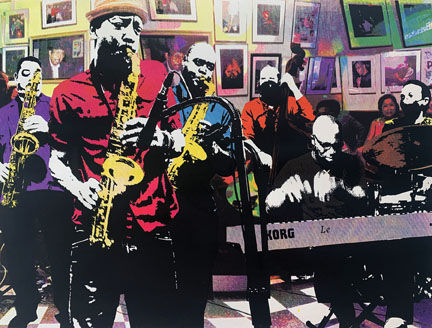
Chee Bravo’s silkscreen ‘Candlelight II —The Celebration.’ ,