They say they want a revolution — or to just continue the one still making its impact on the world.
They are Sally Lane and Carrie Fellows, respectively the board president and executive director of the Crossroads of the American Revolution.
And they’ve been busy recruiting support and resources to mark the 250th anniversary of the American Revolution — a world-changing event that happened near and here.
That “here” is New Jersey and it is more significant than most people realize.
“New Jersey saw more armed battles than any other state, and (George) Washington spent a quarter of the war in New Jersey,” says Lane at the nonprofit’s office in the Old Barracks in Trenton — a significant structure itself.
One of the only buildings of its type in the nation, its former occupants were British military troops and Hessian mercenaries sent to New Jersey to quash that pesky 1776 revolution.
Now, Lane, Fellows, and three additional Crossroads staff members use the space as their own “war” room and count down the days to 2026.
Their aim is to make sure that the state and nation understand that New Jersey was a literal crossroads where warring armies crisscrossed and stay-at-home citizens had their own conflicts.
“New Jersey was a in a civil war for eight years,” says Lane, adding that people needed to find ways to persevere despite the uncertainty of the era.
“Not everyone was not a patriot or a loyalist,” she says. “This was the most diverse of the colonies. This colony never had an official religion. You had diversity of religious belief and populations. How did those people survive? We want to help people see that the people in the revolution were people just like us.”
She and Fellows also keep their eye on something else important to modern day state citizens.
“We are interested in heritage tourism,” says Lane as she opens a study that shows how other states are capitalizing on Revolutionary War history — sometimes with recreated villages like Williamsburg in Virginia.
One of the report’s colorful graph lines shows just how much New Jersey lags in comparison to the others, even though there were approximately 600 recorded Garden State battles.
That includes Washington’s bold Christmas Day crossing of the Delaware River to take Trenton and then Princeton — putting the Revolution on a winning course.
In order to help heritage tourism, Crossroads is doubling down on its mission to get people aware and to get ready.
And the team has made substantial advances.
They have established a National Heritage Area eligible for federal funding, created a database and map of state Revolutionary War sites, created a sites need assessment, connected site personal, and obtained funding from the federal government and the State of New Jersey.
The New Jersey State Legislature also allocated for funds to address upkeep or facilitate improvements at several key Revolutionary War locations, including Washington Crossing State Park and Princeton Battlefield.
While the efforts seem to be a matter of course or time appropriate, they were, in fact, launched decades ago by individuals with the ability to think ahead — and big.
One of those early enlistees is Lane, who was in her own way a witness to the history.
Born into the family that published the Trenton Times, Lane was an editor and reporter for the paper and the Trentonian, served as the director for the Trenton Convention and Visitors Bureau, and was a staff member New Jersey Department of Environmental Protection and Thomas Edison State College.
The Trenton resident is also the only member of the original team of organizers who were recruited by the socially minded Somerset resident Marguerite Chandler in 2002 to begin preparing for 2026.
According to Lane, Chandler had the forethought to engage state agency heads and representatives of the New Jersey Historic Trust, New Jersey Historical Commission, and Green Acres Program.
Chandler’s efforts were aided by the addition of Helen Fenske, whose decision to fight the establishment of an airport in the Great Swamp area of New Jersey led her to become an expert on environmental regulations and planning, an assistant commissioner of natural and historic resources, and acting commissioner of the NJDEP. Land calls her, “a towering figure in mid-20th century land conservation.”
Between 2002 and today, the project became a nonprofit informed by national studies and programs and became eligible for national funding through the sponsorship of past United States Congressional Leaders Rodney Frelinghuysen, a Morris County Republican, and Rush Holt, Democrat from Princeton.
Lane says another indication of success was the hiring of Fellows as Crossroads executive director.
In addition to serving as the director of the Hunterdon County (NJ) Department of Planning & Land Use and Hunterdon’s Cultural & Heritage Commission, the curator and educator was also involved with past Crossroads projects.
Yet despite such progress, the team is working to follow the recommendations of a panel of experts in heritage tourism to maximize the benefits to the state.
One calls for the establishment of a tourist center connected to the New Jersey’s only National Heritage Area that includes sites in Mercer County.
“The consultants say that Trenton would be the best site because of its physical location and accessibility by public transportation and seminal role as the turning point of the American Revolution,” says Lane.
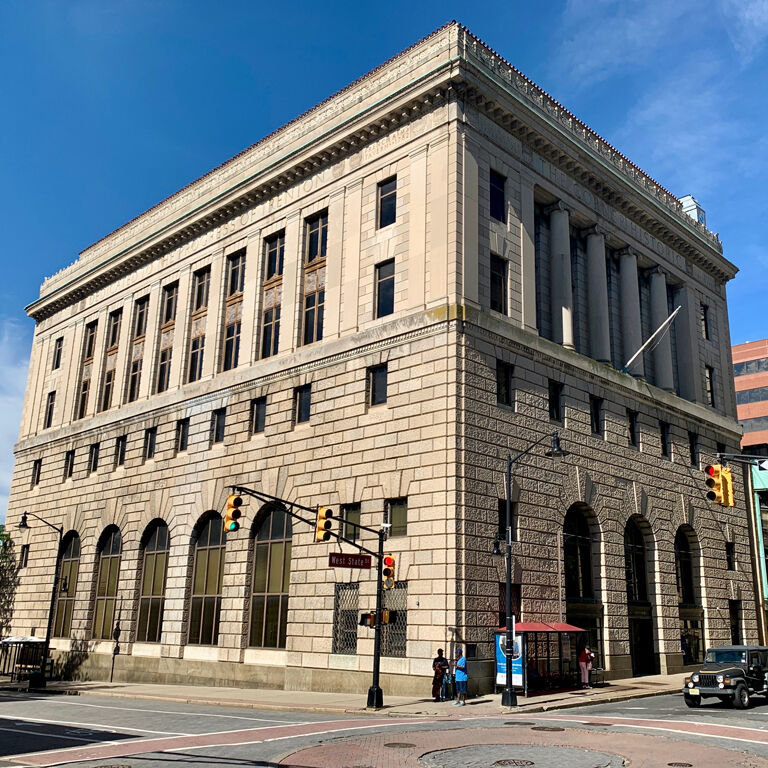
After some considerable site searching, the planners say the ideal location is the site of the now-defunct First Mechanics National Bank, a 1930s-era bank building on the corner of West State and Warren streets.
As bronze signage over the entrance notes, the building stands on the site of the French Arms Tavern where the U.S. Congress carried on the nation’s business in 1784.
Other historically aware building elements include bronze doors sporting images of tavern visitors, including George Washington and the Marquis de Lafyette.
The structure is now owned by its second-floor occupant, digital data company Mastro Technologies, whose principals are willing to work with the nonprofit.
Lane says the center would use the first floor’s elegantly designed bank and the lower floor’s bank vault area.
In addition to its proximity to other attractions — including the Capitol Complex, Old Barracks, and New Jersey State Museum — the site would become a showcase for rare materials maintained by the New Jersey State Archives.
Referring to a “wow factor” to attract history buffs, Lane references a New York Times article featuring her, archives director Joseph Klet, and one of the state’s gems: An ornate three-page 1762 document in which King George III appoints William Franklin as the royal governor of New Jersey.
As Lane sums him up, Franklin was Benjamin Franklin’s illegitimate son, the “kid” who held the kite during Franklin’s rainy experiment with electricity, and the last English governor in New Jersey — although he didn’t know it at the time.
Since that document and others attracting attention in history and culture circles are currently stored in a secret vault with limited access, a center would allow them to be shared with the public on a regular or rotating bases.
In addition to other exhibitions or programs, the visitors’ center can also be used as the start of day bus tours of Revolutionary War sites. Other mentioned uses are a Trenton visitor center and central city box office for performing art events.
Lane calls the visitor’s center “an idea with legs” actively being considered for the state budget and attracting visits by state officials and legislators.
Lane and Fellows say while planning was initially interrupted by the pandemic, it has resumed with a high interest in getting 2026 in focus.
That effort was enhanced recently by the Crossroads hiring a director of development to engage more funding to address program needs and aid in addressing the stipulation that federal funding be matched.
Current funding includes a state and federal match of $500,000 each.
The general public may also become interested when they see state resources applied to regional sites as follows:
Princeton Battlefield: rest room rehabilitation, colonnade restoration, mobile visitor center, signage, and American Disability Access compliant access to Clarke house, parking, pathways, and restrooms.
Old Barracks Museum in Trenton: foundation fortification and installation of new HVAC system.
Washington Crossing: outdoor classroom, landscaping, new signage, Johnson Ferry House restoration, and, through another state project, the addition of a new visitors’ center.
And the Trenton Battle Monument (under the jurisdiction of Washington Crossing State Park): lighting and interpretation panels detailing the monument features and allowing a digital view from the monument’s top (the defunct former elevator had been removed and refitting a new one had become unfeasible).
Although the history of the American Revolution was not Lane’s initial area of interest, she says she became engaged with its importance to the city and region — and its bold ideas.
“One of the common things is for people to say that the American Revolution is not about my background,” says Lane. “But the conversation in the news today is often about the promises that the founders didn’t keep. It is part of the conversation today. And no one in this county is untouched by the American Revolution.”
For more information on the Crossroads of the American Revolution, visit revolutionarynj.org.
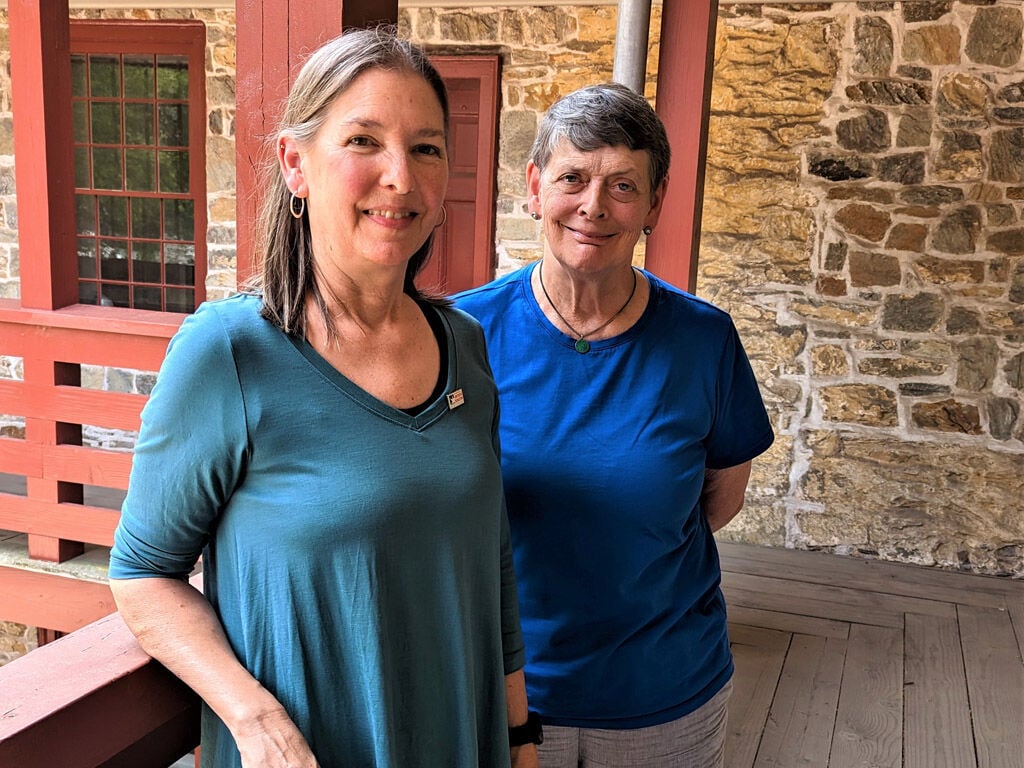
Carrie Fellows, left, and Sally Lane are working to highlight New Jersey's role in the American Revolution.,