
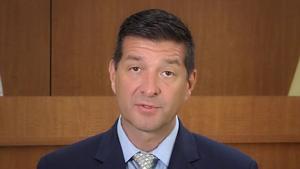

When Mayor Dave Fried steps away from public service Jan. 15, he will close out a more than two-decade career defined by a willingness to pursue unconventional solutions to municipal challenges.
Those efforts ranged from affordable housing and open space preservation to shared services, fiscal policy and public facilities.
Throughout his tenure, Fried often opted for approaches that departed from the traditional playbooks used by other towns, favoring long-term planning, collaboration and what he frequently described as “thinking differently” to address the evolving needs of a fast-growing township.
Fried’s legacy is tied to defining accomplishments including:
• Maintaining flat or reduced local tax rates for most of his tenure;
• Expanding preserved open space to almost 2,000 acres;
• Keeping the town in compliance with state affordable housing mandates through innovative strategies; and
• Advancing a shared-services municipal complex centered on the former Roma Bank (Investors Bank) building in Town Center.
Ha has said that one of his proudest accomplishments is launching the Pay it Forward initiative that raised more than $600,000 since 2015 for families and organizations in need.
Looking forward, he said he is comfortable with his decision to retire.
“Had I not been supremely confident this incredible community was in the best possible hands with Council President and Mayor-Elect Mike Todd taking the helm, perhaps I could have been persuaded to make a different choice,” Fried wrote in his final mayor’s column (see page 18).
“But at the end of the day my tremendously supportive family, especially my wife Kitt, deserve more of my energy and it is time for new challenges,” he said.
Fried’s departure will bring a transition to Todd, who was elected mayor on Nov. 4 and will officially be sworn in at the annual reoorganization meeting on Jan. 15.
Fried has urged residents to remain engaged in local government as the administration changes hands.
“If I could make one request it would be to support Mayor-elect Todd and this hard-working Township Council,” Fried said. “Remember, this is your town. We are just the caretakers.”
For his part, Todd said he plans to continue the township’s existing trajectory while bringing new ideas to the role.
“Building on the strong foundation established by Mayor Fried, I’m excited to introduce fresh ideas and innovations for Robbinsville,” Todd has said. “My goal as mayor is to stay committed to guiding us toward even greater achievements. ”
For many residents, Fried’s tenure is most closely associated with a fiscal record that became a defining feature of Robbinsville’s identity.
This past summer the township adopted a $32.3 million municipal budget for 2025. It marked the township’s 11th flat or reduced municipal tax rate in the last 14 years, with the rate holding steady at 57.7 cents per $100 of assessed valuation. This is despite rising costs tied to health insurance, pensions, utilities and seasonal services.
“Robbinsville continues to do all it can to keep the municipal side of taxes stable in the face of rising rates elsewhere,” Fried said in a statement following that vote. “Doing all of this without a municipal tax increase was no small feat, but it is something we are extremely proud of.”
Fried has described budgeting as a long-term exercise rather than a one-year calculation.
“Every year we’re always thinking ahead—planning for next year,” he said. “That long-term mindset really helps us manage the budget.”
He has frequently tied fiscal discipline to broader measures of community health, particularly its demand for housing.
“A home value is sort of the report card that I get as mayor,” Fried said.
During his tenure, Robbinsville’s home values have continued to climb.
“We now have the fastest growing property values in Mercer County,” he said during an interview with the Adveance last year. “We used to be behind Hopewell, but we’ve passed them. We’ve passed West Windsor. Now we’re slugging it out with Princeton.”
Alongside tax stability, open space preservation became a central pillar of Fried’s governing philosophy. Robbinsville expanded its preserved land holdings to nearly 2,000 acres, a figure Fried highlighted repeatedly in his final months in office.
He has said the strategy helped control sprawl, protect sensitive areas and preserve the township’s character as development pressures increased across the region.
“Our open space program is probably the most aggressive in Mercer County,” Fried said. He has framed the milestone as part of a broader sense that the township was reaching the end of a long planning arc.
“Getting our open space inventory near 2,000 acres and improving the trails in the Miry Run Recreation Area just feels like the end of my runway,” he said.
Affordable housing policy became another major component of Fried’s tenure, marked early on by an emphasis on inclusion rather than isolation.
One of the township’s first significant steps came through partnerships with Project Freedom, a nonprofit developer focused on creating affordable, barrier-free housing for people with disabilities within traditional neighborhoods.
Project Freedom developments in Robbinsville predate later court-mandated planning efforts and were incorporated into the township’s broader housing mix as examples of community-integrated affordability.
The nonprofit established Freedom’s Legacy at Robbinsville, a 30-unit affordable and accessible rental community on Hutchinson Road near the township’s growing Town Center resdiential.
The township later partnered on the nonprofit’s Freedom Village at Town Center South, a larger mixed-income and accessible development that further embedded affordable housing within Robbinsville’s commercial and residential core.
“What we should be doing is using our money to expand homeownership,” Fried said. “Because when people are invested in their community, they’ll defend their community.”
While Project Freedom addressed specific housing needs, Robbinsville’s broader affordable housing obligations came into sharper focus during the state’s Third-Round planning process.
Rather than challenge its assigned numbers, the township reached a court-approved settlement with the Fair Share Housing Center, resolving its requirements and securing protection from builder’s-remedy lawsuits through 2035.
Advocates for affordable housing say Robbinsville’s approach reflects a broader shift among municipalities toward proactive compliance rather than litigation.
One independent affordable housing planning expert recently told the Advance that a Robbinsville getting its plan approved by the Fair Share Housing Center is the “gold standard” of municipal affordable housing planning.
“We’ve done a really good job with affordable housing in Robbinsville,” Fried said. “We went outside the box with the Mercer Mobile Home Park. We’ve done a bunch of creative things to get us to where we are.”
The township’s acquisition of the Mercer Mobile Home Park—a first-of-its-kind move in New Jersey—preserved long-term affordability while helping Robbinsville meet its obligations.
“They let me think outside the box,” Fried said of Fair Share Housing Center. “That mobile home park—that had never been done before—and they embraced it.”
Fried has said Robbinsville benefited from continuing to plan during years when other towns paused development.
“Other towns, during the Christie (Gov. Chris Christie) years, stopped building,” he said. “We kept going. So, when the governor changed, they were behind the eight ball, but we weren’t.” (Gov. Christie controversially stalled the construction affordable during his tenure.)
If Fried has a late-career project that ties together his fiscal, planning and regional philosophies, it is the municipal building strategy that will relocate township operations to the former Roma Bank building that later became an Investors Bank location.
Rather than constructing a new police and court complex as had been originally planned, Robbinsville opted to lease and retrofit the existing three-story, 47,000-square-foot building in Town Center.
“With so much commercial space available in the post-pandemic era, and the high cost of building new—even the most basic of buildings—we had to think differently,” Fried said.
Fried has described the move as a modernization of public service delivery. “After we move, people will literally be able to do a one-stop shop,” he said.
The project includes a shared police and court facility with Hightstown.
“No community in Mercer County has ever shared a police station and court with another town,” Fried said. “The idea that we can share this with Hightstown has been a win for Hightstown and a win for Robbinsville.”
Throughout his tenure, Fried emphasized shared services and regional cooperation, working closely with neighboring mayors.
Those relationships proved especially important during the COVID-19 pandemic, when municipalities coordinated emergency responses, shared resources and worked with community partners to support first responders and vulnerable residents.
In his final column, Fried returned repeatedly to the idea that public service is collective work. “This is not really goodbye — it’s simply the next chapter,” he wrote. “I may be stepping away from this office, but I will never step away from this community or from the responsibility to serve.”