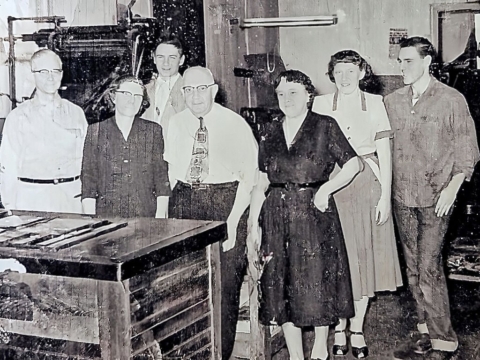
The Messenger-Press is back.
For Allentown, Upper Freehold and Millstone, the name is a shared record of community life spanning more than a century.
The story of local journalism in the three communities begins in the late 1800s, when several short-lived newspapers appeared in Allentown, including the Allentown Industry in 1880, the Allentown Times in 1881, and the Herald in 1883.
Those early publications are documented in records compiled by the New Jersey State Library, which maintains historical indexes of newspapers published throughout the state.
That lasting voice arrived in 1903 with the founding of the Allentown Messenger, also documented in state library records and preserved through archival collections.
For nearly 70 years, the Messenger served as the primary newspaper for Allentown and, by extension, Upper Freehold Township.
Based in Allentown, the paper covered local government, schools, churches, farms and the day-to-day lives of residents throughout the township.
The paper’s early leadership included founder John W. Naylor, who established the Messenger in 1903.
It later passed to Ellis Hull, who served as owner and editor and guided the publication through much of the mid-20th century.
In its later years, the paper was owned and edited by Robert Halle, with Joan Halle also associated with ownership, continuing the tradition of local, independent stewardship.
That model — one paper serving both a borough and the surrounding rural township — was typical of the time. Upper Freehold did not develop its own standalone newspaper, but it was continuously covered through the Allentown-based publication.
The same was true for nearby Millstone Township, which, like Upper Freehold, did not sustain a long-running newspaper of its own and relied on coverage from neighboring communities.
In 1972, the Allentown Messenger entered a new era, becoming the Messenger-Press, as reflected in listings maintained by the New Jersey State Library and other newspaper directories.
The addition of a name like “Press” often suggests that a newspaper may have combined with another publication or absorbed a competitor.
However, based on available records, there is no clear evidence that such a merger took place in this case. Instead, the change appears to reflect a rebranding or modernization of the existing paper rather than the combination of two separate publications.
At one point, the Messenger-Press was part of the Princeton Packet group, which expanded across Central New Jersey under publisher James Kilgore, acquiring and operating a number of community newspapers during its period of growth.
The exact timing and details of that ownership are not fully documented in readily available records, but the connection reflects the broader consolidation trends that affected many local papers in the late 20th century.
For decades, the Messenger-Press continued that role, publishing week after week and documenting the growth and changes across Allentown, Upper Freehold and Millstone. Like many independent weekly newspapers, it remained closely tied to the community it served, even as ownership structures evolved over time.
That run came to an end around 2008, according to archival listings and newspaper databases, as shifting economics and changes in how people consume news led to the paper’s closure.
During the 2010s a short-lived paper called The Examiner covered the area for a time, but that closed shop during the COVID-19 pandemic in 2020.
The absence of a commmunity paper left a gap.
Not just in news coverage, but in the shared sense of connection that comes from seeing your town, your neighbors and your institutions reflected in print.
That is what makes this moment meaningful.
Reading through the pages of the old Messenger and Messenger-Press is like stepping into a time machine.
Each issue offers a snapshot of life as it was lived—what people saw, what they worried about, how they worked, and how they understood their world.
From quiet walks through the countryside to the impact of war overseas, the papers captured moments both ordinary and extraordinary, preserving them in real time.
That is part of what made those papers so valuable—and why their return matters today.
A 1904 article, “The Earliest Settlers in Allentown,” described the town’s beginnings:
“Around Nathan Allen’s mill there were soon clustered a store, tavern, blacksmith shop and other kinds of business.”
Another 1904 article brought Revolutionary history to life:
“The soldiers cut down big trees… and so the bridge went up, and the troops crossed over.”
A 1912 article, “A Patriotic Pastor,” described Rev. David Jones as “exceedingly patriotic,” noting that his outspoken support for the American cause during the Revolution made him a target of Loyalists and forced him to leave Imlaystown for his safety.
A 1917 article, “The War Brought Home,” reported on the impact of global conflict:
“A torpedo… killed outright two men… [the men endured] five days in the open boats… with a scarcity of water.”
A 1938 Messenger series, “Robbins Family History,” reflected on how the region changed over time:
“The crooked path became a crude road traveled by white men with oxen and carts… and now hundreds of motor cars glide swiftly over it.”
The same series also documented the Underground Railroad:
“The family made their house a ‘station’… where the runaway negroes could be in hiding during the day time, and at night could be forwarded to the next station.”
A 1908 article, “A Walk to Allentown,” captured the enduring character of the town:
“Soon we had passed the great Roebling works and the gloomy old prison walls… we were free of the city’s throngs, reveling in the fresh air of the country and the quiet stillness… In a few moments we are in the town, quiet and serene, away from the whirring trolleys and roaring railroads.”
These were not just stories. They were moments captured as they happened—snapshots of daily life, records of change, and firsthand accounts of events both large and small.
Together, they formed the first draft of a community’s history, preserving not only what happened, but what it felt like to live here at a given time.
That is why local newspapers are so important—and why their disappearance from the local landscape is so significant.
Without them, what does the future look like? How will people know what happened here, or understand the lives and experiences of those who came before them?
It’s for this reason the Messenger-Press is starting again. Its return is not simply about reviving a familiar name, but about restoring a local platform dedicated to documenting these communities in real time, just as it did for generations.
In a fitting connection to its past, the paper’s new office is located on Main Street, in the same space where earlier editions of the Messenger and Messenger-Press were once printed and published.
Looking ahead, the goal is not only to report the news, but to strengthen the connection between readers and their local institutions, with plans to include periodic columns from local officials, including the mayors of Allentown, Upper Freehold and Millstone, as well as the superintendent of the Upper Freehold Regional School District.
The paper also hopes to feature a regular column focused on area history, potentially written by a local resident, continuing the tradition of documenting the community’s past.
But the paper’s future will also depend on its readers. Residents are encouraged to help shape the next chapter by sharing story ideas about interesting people, organizations, businesses and community efforts, and by submitting letters that reflect the full range of voices across the community. Please send your tips to news@donnelly.media.
Readers can also follow ongoing coverage on our website at TheMessenger-Press.com and on social media, where stories and updates will continue to be shared throughout the week.
The tools may have changed, but the mission has not.
At the same time, the way people receive and share news has changed dramatically. Where the Messenger once arrived once a week in print, today’s readers expect updates throughout the week, across both print and digital platforms.
The goal moving forward is to meet readers where they are — while maintaining the same commitment to accuracy, depth and local focus that defined the paper for generations.
That balance between tradition and change will shape the next chapter of the Messenger-Press.
The stories may be delivered differently, but the core purpose remains the same: to inform, to connect and to reflect the communities it serves.
The Messenger-Press is here once again — ready to capture the next chapter of these communities’ stories.