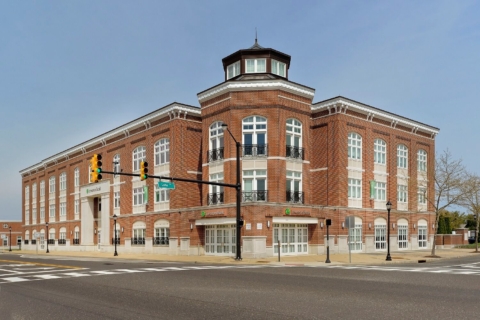
Robbinsville has moved into a new municipal building, marking the transformation of one of the most prominent structures in Robbinsville Town Center into the center of township government.
But the conversion of the former bank building at 2300 Route 33 began years earlier—and required a final push to bring the project across the finish line.
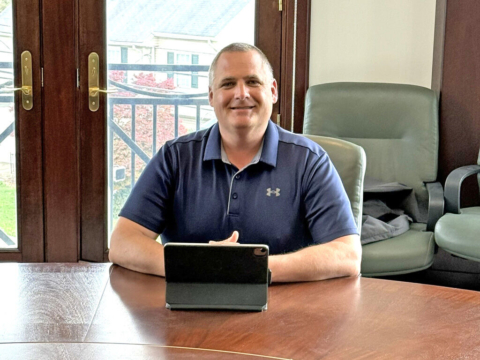
Seated inside the building’s top-floor conference room, Mayor Mike Todd took in the space that now serves as the nerve center of township operations as he discussed the transition with the Robbinsville Advance.
The interview unfolded at a massive conference table surrounded by large television screens and video equipment—a setting more typical of a corporate boardroom than a municipal office.
The room sits beneath a vaulted ceiling that rises into a windowed cupola, with natural light filtering down from above—one of many reminders that the building was originally designed as a flagship financial institution.
The three-story, roughly 47,000-square-foot structure—once home to Roma and later Investors Bank—has been converted into Robbinsville’s new municipal complex.
The building now houses most township offices and will soon accommodate police, dispatch and court functions for both Robbinsville and neighboring Hightstown. That move is expected to happen sometime this month.
The project represents a rare convergence of planning, economics and opportunity.
First envisioned under former Mayor Dave Fried, who retired in December, the move reflects a shift in how municipalities respond to changing market conditions, particularly the decline in demand for large-scale office space following the COVID-19 pandemic.
It also required the coordination of construction, technology and public services to turn a dormant commercial property into a functioning town hall.
“He saw this building empty for so many years,” Todd said of former Mayor Dave Fried. “With commercial office space declining… it was just going to sit here and collect dust.”
* * *
The building’s history mirrors the growth—and changing economic realities—of Robbinsville itself.
Constructed in 2005 as part of the township’s Town Center development, the structure originally served as the headquarters for Roma Bank before becoming part of Investors Bank following a 2013 acquisition.
For years, it stood as a symbol of the township’s commercial strength along what became known as “Bankers’ Row,” a stretch of Route 33 lined with financial institutions.
In 2021, the building was sold for about $20 million to Realty Management Systems in a leaseback deal. After Investors Bank was acquired by Citizens Financial Group, the building was eventually vacated.
“For at least eight years it was just nothing,” Todd said.
At the same time, broader market forces were reshaping demand for office space, particularly in the wake of the COVID-19 pandemic.
For Robbinsville officials, the situation created an opportunity.
Despite the extensive reconstruction, elements of the building’s original purpose remain visible throughout the interior. Much of the high-end trim, millwork and even furniture typical of a corporate banking headquarters have been preserved, giving the space a distinctly different feel from a traditional government building.
The overall effect stands in contrast to the utilitarian sparseness of the township’s previous municipal building and most other public facilities.
* * *
Fried, who served as mayor for two decades, recognized that the township faced a choice: invest heavily in new construction or adapt to changing economic conditions. The township had explored constructing a separate police and court facility, but rising construction costs made that option less attractive.
Instead, officials turned to the former bank building.
In November 2024, Robbinsville entered into a 10-year sublease agreement to relocate most municipal operations to the property. The plan called for consolidating services that had long been spread across multiple locations, while also expanding shared services with Hightstown.
“When we were retrofitting this building (for the police department), it was literally down to just the beams,” Todd said. “You could see wall to wall. It was crazy.”
Todd said his background in engineering and construction played a key role in bringing the project to completion after he took office in January.
“With my background at PSE&G, I deal with engineering construction projects all the time,” said Todd, who works as an electric transmission supervisor for the utility.
“My role (as mayor with this project) is kind of a hodgepodge role where it’s construction management, it’s project management, it’s a little bit of engineering in there. You name it.”
Much of the heavy construction had already been completed when he took office in January, but the final phase required detailed coordination.
“I was trying to manage what was left, managing the contractor, getting those finishing touches in, looking at schedules,” Todd said. “It was an aggressive schedule to begin with… but overall, it was a huge team effort.”
The shift from construction site to an operational municipal building required careful planning and coordination. The township moved departments in phases, ensuring that services remained available to residents throughout the process.
“We weren’t going to move unless we knew we were ready,” Todd said. “We actually delayed the administration moving over here a week… we needed that extra week, especially on the IT side.”
Maintaining public access was critical.
“The other complicated piece is the public,” Todd said. “We have to keep the building open for the public, we have to maintain our services.”
Township staff implemented a plan that allowed departments to move one at a time while maintaining redundancy.
“We came up with a logistical plan that made sense, moving one department at a time,” Todd said.
Communication with residents was also key. “Letting residents know what was happening was big. The messaging to the residents was important,” Todd said.
“In light of everything that did move… it went very smooth,” he added. “I’m very happy with the collective teamwork that we have here.”
* * *
Behind the scenes, one of the most complex aspects of the move involved establishing the building’s communications and dispatch systems.
“We actually had them all together in another site, fully up and running testing,” Todd said. “Then they have to take it all apart and reassemble it here.”
And the system must operate in tandem with the existing dispatch center before a full switchover.
“We have to get them up running in parallel with our existing dispatch, making sure that 911 calls are coming in,” Todd said. “Then we’ll eventually cut everything over to this building.”
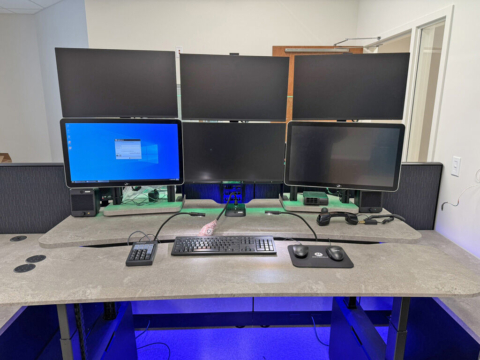
Inside the new police operations area, the transformation is especially visible. The dispatch center, equipped with multiple consoles, clustered large screen monitors and integrated communications systems, more closely resembles the bridge of a futuristic spacecraft than a traditional police station.
The building will serve as a joint hub for Robbinsville and Hightstown in several key areas, including police administration, dispatch and municipal court operations.
“This is a prime example,” Todd said. “Hopefully it would be a model for the future for other towns.”
The arrangement was supported by state funding, including a $600,000 allocation for 911 upgrades tied to the shared facility.
Under the plan, Hightstown’s administrative police staff and command personnel will be based in the building, while patrol officers remain stationed in Hightstown.
Dispatch services will be centralized.
“We’re going to take over their dispatch services,” Todd explained. “So, the 911 system, when a call comes in, will accurately pinpoint where exactly they originate,” Todd said. “If you’re in a car, even if you don’t know where you are, we know where you are.”
“Dispatch can get that information to the officers as they’re responding, so they know exactly what they need to do when they get there,” he said.
* * *
The new facility represents a dramatic increase in space compared to Robbinsville’s previous municipal building.
The former town hall, built in 2016, was approximately 15,000 square feet. The new building offers more than three times that amount.
“It’s funny because… the square footage in the old building is about 15,000 square feet… we’re at 47,000 square feet,” Todd said. “But we filled every single space so quickly.”
The move represents the latest step in a decades-long effort to establish a permanent municipal headquarters. Robbinsville had been without a dedicated town hall since 2005, when its previous building was abandoned due to mold and asbestos problems.
For years, municipal offices operated out of temporary and rented spaces. In 2015, the township constructed a new municipal building on Route 33. That building provided a central location for some services but did not include police or court functions.
The move to the former bank building marks the first time in many years that most municipal operations will be housed under one roof.
Everybody’s in one spot now,” Todd said. “It’s better for the public. It’s one-stop shopping essentially.”