
Tyrone L. Robinson’s production of “Jelly’s Last Jam” at Bristol Riverside Theatre is so sharp, polished, and glowing, it doesn’t seem regional.
It has the sheen and assurance more associated with a Broadway or West End stage.
Taking Keith Baker’s “Jesus Christ Superstar” and “The Producers” into consideration, “Jelly’s Last Jam” might be the best single production to grace the Bristol stage, now in its 40th season.
Contributing mightily to the production’s success is the exciting choreography of yaTande Whitney V. Hunter, Ph.D., who brings the Bristol stage alive with rousing, exciting dances that are as stimulating as they are entertaining,
Dr. Hunter’s work is contagious. My feet, knees, shoulders, and waist responded to his lithe, right-at-you gyrations of the nimble “Last Jam” chorus. I had no choice.
The music — mostly by early jazz giant Jelly Roll Morton, the subject of the musical, with help from Luther Henderson —invited participation. (Even if muted by theater decorum). The choreography made me want to be part of the action. It satisfied the eye, the narrative, and the natural urge to succumb to the rhythms and dance.
Acting keeps pace with the terpsichore. Stanley Martin finds the right occasions to balance Jelly Roll’s brashness, ego, charm, and abundant talent. Renée Reid is a formidable yet human and vulnerable Anita, the woman who wins Jelly Roll’s heart but is too practical and independent to satisfy his need to be the one and only.
Forrest McClendon is appropriately haunting and superiorly sinister as Jelly Roll’s angel of death cum ghost of Christmas Past, the Chimney Man. Dana Orange continues a string of excellent performances as Jack the Bear, a sidekick from scuffling days that Jelly Roll cuts completely when rivalry and jealousy seep in.
The ever-reliable Tamara Anderson expectedly wails, and nails, her big blues number at the Bessie Smith/Ma Rainey surrogate, Miss Mamie. Ryane Nicole Sturdivant is the picture of traditional authority as the well-to-do Creole grandmother who casts Jelly Roll out of the family once she finds he haunts New Orleans’s Elysian Fields and Tremè dives to hang around with honky tonk dancers, singers, and budding blues musicians.
Robinson’s entire production sails along with ease, vivacity, and inherent drama. There’e the usual wrinkle or two, to be noted later, but in terms of sheer entertainment of high quality, with the texture of an engaging story, Bristol’s “Jelly Last Jam” is a revival worthy of transfer to a bigger stage.
It joins last season’s “Dreamgirls” at Philadelphia’s Walnut Street Theatre as being as good in significant ways at its original Broadway production. (Forrest McClendon and Dana Orange were in “Dreamgirls” too.)
Being from 1992, towards the beginning of the time when a hero’s flaws received equal footing with his or her merits in musical biographies, “Jelly’s Last Jam” emphasizes Jelly Roll Morton’s downside as much as it celebrates his contribution to jazz and other music.
Pride, selfishness, ego, braggadocio, and disloyalty take a lot of focus, more perhaps than is warranted. They keep the audience from totally admiring Jelly even though Jelly Roll Morton deserves his standing as one of the first performers of jazz and blues as they became popular and lasting.
George C. Wolfe’s book castigates Jelly Roll for declaring himself the “inventor of jazz,” thereby ignoring the African roots of the music or the use of music and song as communication among enslaved people (as well as the work of others like W.C. Handy, Eubie Blake and Scott Joplin). It definitely scorns Jelly Roll’s constant notion that by being Creole, he is of a higher class and station than others with African blood.
It shows Jelly Roll as being stubborn, intransigent, and averse, if not deaf, to criticism. It takes a moralistic attitude toward his womanizing and unfaithfulness, not only to women but to his erstwhile pal, Jack the Bear.
McClendon’s Chimney Man amasses a lot of ammunition as he shows Jelly Roll his seamy life.This all makes the audience ambivalent about Morton. It makes him an anti-hero.
Stanley Martin overcomes this negative look as a lead character when he demonstrates all Jelly Roll brought to entertainment, including the integration of classical structure and the legacy of music in general within jazz, but the idea Jelly Roll’s big picture is cloudier than it is laudable, prevails.
Luckily, it does not prevail in a way that preclude enjoyment of Morton’s music or Martin’s presentation of it.
The jaundiced look at Morton’s life also gives lyricist Susan Birkenhead opportunity to use the melancholy, moralism, and setbacks to give the character of Jelly Roll some introspective numbers than include telling dances of angst or disappointment, well conceived by Hunter and well executed by Martin.
Bristol’s “Jelly’s Last Jam” has superlatives that override the few blemishes in Robinson’s production. The problem is, these shortcomings glare amid the brilliance.
A nagging distraction is in the costuming and grooming for Martin. The script defines the character as being a dandy, a clothes horse who aims for elegance and style. Yet, throughout the performance I saw, the dress shirt Martin wore had a collar that kept overlapping the right lapel of his suit.
No one conscious of his appearance would allow such a gaffe, one that lasted throughout the production whenever Martin donned Jelly Roll’s suit jacket.
Also, while Dana Orange always looked dapper in his costumes, and Forrest McClendon was regal and portentous in his, skull-laden hat and all, Martin’s suit looked ill-tailored and in desperate need of pressing.
If Wolfe’s text said Jelly Roll was careless about his dress, this would be fine. At Bristol, the relatively slovenly garb and that stubbornly uncooperative collar go against the hauteur and grandness Jelly Roll affects and Martin can exude, his stage grooming notwithstanding.
At one point, one that may not occur in any other performance, Martin’s suit coat collar failed to lie flat, again on the right side, and was sticking up all the way to the nape of his neck.
One benefit of a live performance is you can correct some on-stage errors by intervening. Some cast member must have noticed the wardrobe flaw, probably caused by a fast, cue-related donning of the jacket. It was a time to break blocking, or even character, to adjust Martin’s collar (collars?) to fit the image the script projects.
Yet “Jelly’s Last Jam’s” assets far outweigh any glitches. Robinson, Hunter, and their ebullient troupe create a good and fulfilling time. In all ways, Bristol Riverside has a hit on its hands. Stanley Martin has the spark to reflect Jelly Roll Morton’s innovations and lasting greatness.
Morton’s music, some with his lyrics and others with Birkenhead’s, set the mood for all that happens on the Bristol stage, from the jubilant to the mellow and thoughtful, while Martin shows his character’s due pride and satisfaction in bringing such music to life.Among other talents, Martin is a nifty tap dancer who brings extra zest to numbers already creating ecstasy.
Ethan Hart, who plays Young Jelly, attracts immediate attention as a hoofer, whether in character as Jelly Roil or part of Hunter’s chorus. He also does well in dramatic scenes, as the adolescent scamp who explores the seedier side of New Orleans and can’t help going into one dive to hear another seminal jazz artist, Buddy Bolden, perform.
Forrest McClendon sets a tone and establishes an attitude as The Chimney Man. Everything about McClendon’s performance is intelligently controlled and disciplined. He walks slowly with a definite sense of intention. He adds a delicious brand mystery and a tinge of cold resolve to Robinson’t staging.
Every one of his lines is spoken plainly and with purpose, so Chimney Man’s place is the musical has a chillingly hypnotic effect that makes you accept the moralism implied in some of it.
Renèe Reid is the epitome of no-nonsense sophisticated and subtle sexuality as Anita.
Reed’s is a masterful performance of a woman who know what she wants, is in command of it, and won’t stand for compromises or patronization.
She also sings beautifully.
Dana Orange is so natural as Jack the Bear, you see no acting, just a seemingly effortless portrayal of a good guy Jelly Roll cannot forgive for besting him at one particular thing.
Tamara Anderson rocks the joint, as usual, in her big blues number as Miss Mamie. She also brings focus to many of the ensemble numbers, even when’s she sitting at a table keeping or batting out rhythm.
The chorus is spectacular, especially when launching into Dr. Hunter’s jubilating dances.
Jason Simms’s set accommodates several settings well. LeVonne Lindsay’s costumes fit the period and the characters with the exception of Martin’s too-tight suit and fly-away collar.
Alan E. Edward’s lighting enhances Robinson’s stage, especially when its projects larger-than-life shadows of Jelly Roll performing in his prime. Bristol Riverside can use a better sound system to clarlify vocals, but Ryk Lewis does well in creating sound for Robinson’s production.
“Jelly’s Last Jam” runs through Sunday, April 26 at Bristol Riverside Theatre, 120 Radcliffe Street, in Bristol, Pennsylvania. Showtimes are 7:30 p.m. Wednesday and Thursday, 8 p.m. Friday and Saturday, 2 p.m. Wednesday and Saturday, and 3 p.m. Sunday.
Tickets range from $74 to $65 with military and student discounts available. They can be obtained by visiting www.brtstage.org or calling 215-785-0100.
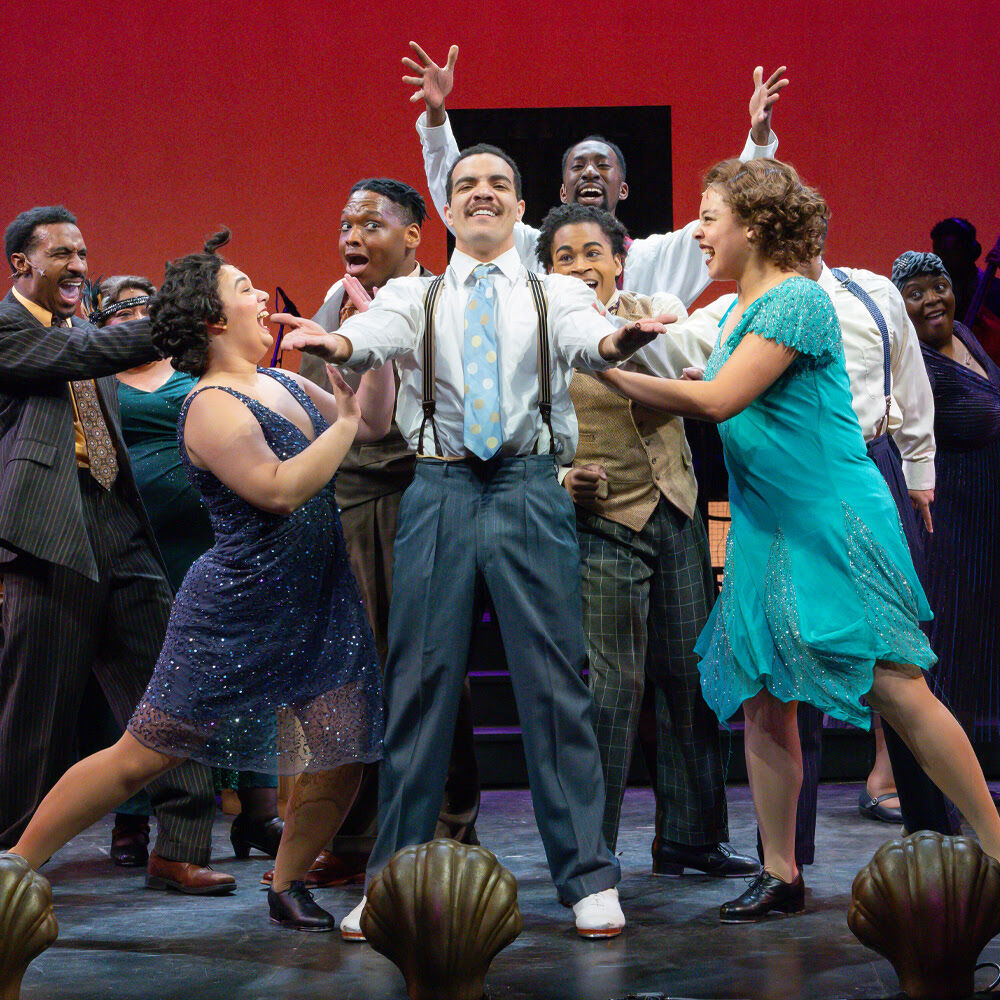
Stanley Martin as Jelly Roll Morton in Bristol Riverside Theater's "Jelly's Last Jam.",

