The Pennington Avenue reservoir sits in the middle of Trenton. It supplies water to 151,900 people in Ewing, Hamilton, Hopewell, and Lawrence. And it has been federally illegal for more than a decade.
* * *
If you pay a water bill to Trenton Water Works and you don’t live in the lower-elevation parts of Trenton, your drinking water passes through the Pennington Avenue Reservoir before it reaches your tap. Not near it. Through it.
The reservoir is a seven-acre, open-air body of finished drinking water adjacent to the Central Pumping Station on Pennington Avenue. According to the October 2022 Unilateral Administrative Order issued by NJDEP, it supplies water to 70% of TWW’s customer base — approximately 151,900 residential consumers in the high service area, including every customer outside the city. The other 30% receive water through a direct gravity feed within Trenton, bypassing the reservoir entirely.
That math matters. What grows in the reservoir, what breeds in it, what contaminates it — ends up in your water. And what has been happening in it is not reassuring.
Federally Illegal Since 2012
Under the EPA’s Long Term 2 Enhanced Surface Water Treatment Rule, all finished water reservoirs must be covered or decommissioned. TWW’s compliance deadline passed in 2012. NJDEP first ordered the reservoir covered in 2009. A second order extended the deadline. A third set July 31, 2023 as a firm final date. That deadline passed with nothing built. The current plan projects compliance no earlier than 2032 — twenty years after the federal deadline.
What Regulators Found
In October 2022, NJDEP issued a Unilateral Administrative Order — a tool that doesn’t require the utility’s agreement — placing TWW under direct state oversight. Items 44 through 67 address the reservoir. They describe a series of compounding failures.
NJDEP inspectors visited the reservoir in August 2022 and documented the conditions firsthand. They found waterfowl swimming in the finished water, bird droppings and animal fecal matter on the walls and fence line, and an unidentified dead animal floating near the inlet pipe. Bird and animal feces are a documented source of vibrio cholera, Salmonella, Typhoid, Legionella, Giardia, and Cryptosporidium. The reservoir had an unnatural blue-green color consistent with a cyanobacteria bloom. Security cameras were inoperable. Structural cracks were visible in the concrete walls.
Also that summer: residents in Ewing began reporting midge insects coming from their taps. TWW sampling confirmed their widespread presence throughout the distribution system. NJDEP determined the midges were breeding in the reservoir, feeding on algae — and that chlorination, TWW’s primary disinfection tool, is ineffective against midge larvae.
The algae had a cause. A broken check valve was allowing zinc orthophosphate — ZOP, a corrosion control chemical — to backflow from the distribution system into the reservoir. Phosphorus in ZOP is a primary nutrient for algae and cyanobacteria. The backflow fed the bloom. The bloom fed the midges. And the cyanobacteria produced cyanotoxins — poisons linked to abdominal pain, vomiting, liver and kidney damage, and nervous system effects, with the most serious risks falling on children.
If that sequence sounds familiar, it should. The Flint water crisis was driven, in part, by the failure to maintain adequate corrosion control — the same category of protection that ZOP provides. When TWW shut off ZOP dosing, it created a secondary risk: without ZOP, lead service lines in the gravity zone lose their protective coating and become corrosive. The Flint parallel is not rhetorical. The same chemical protection that failed in Flint is the one TWW was now unable to deliver to part of its own system.
The UAO’s conclusion: TWW “has missed key milestones to remedy the threat of contamination of the open finished water reservoir” in a way that “may present an imminent and substantial endangerment to the health of its consumers.”
What the State Is Now Requiring
On March 4, 2026, NJDEP ordered TWW to submit a comprehensive Finished Water Reservoir Management Plan within 120 days and — immediately — to begin intensive water quality monitoring. The new requirements include daily testing of pH, turbidity, and chlorine residual at the reservoir; continuous flow and chlorine monitoring at the Central Pumping Station; weekly testing for coliform bacteria, phytoplankton, and copper; and monthly testing for disinfection byproducts, Cryptosporidium, Giardia, and total organic carbon. Cyanotoxin testing is triggered by phytoplankton counts. All data must be reported to NJDEP monthly.
The breadth of that list reflects how seriously regulators view the contamination risks from this reservoir. This is not routine monitoring. It is surveillance — an attempt to catch the next outbreak before it becomes a crisis.
What We Don’t Know Yet
The first monthly monitoring report — covering data collected under the new requirements — should now exist. I have submitted an OPRA request to NJDEP for that report.
When it arrives, it will be the first systematic look at what is actually in the water leaving the Pennington Reservoir under the new monitoring regime. It will tell us whether cyanobacteria and phytoplankton counts are elevated. It will tell us whether disinfection byproduct levels are within limits. It will tell us whether coliform bacteria were detected — and whether microcystin testing was triggered, and what it found.
The data may show nothing alarming. I will report that plainly if it does. But the history of this reservoir doesn’t inspire confidence. The monitoring requirements exist because regulators share that concern. Keep checking trentonwaterworks.substack.com for more updates.
Marc Leckington
Leckington is a Trenton-based writer and civic watchdog best known for his in-depth reporting and commentary on water infrastructure and governance issues, particularly involving Trenton Water Works. Through his Substack newsletter, “From the Mains of Trenton,” he has built a reputation for closely tracking regulatory actions, environmental concerns, and political decisions affecting the region’s water system. The site can be accessed at trentonwaterworks.substack.com
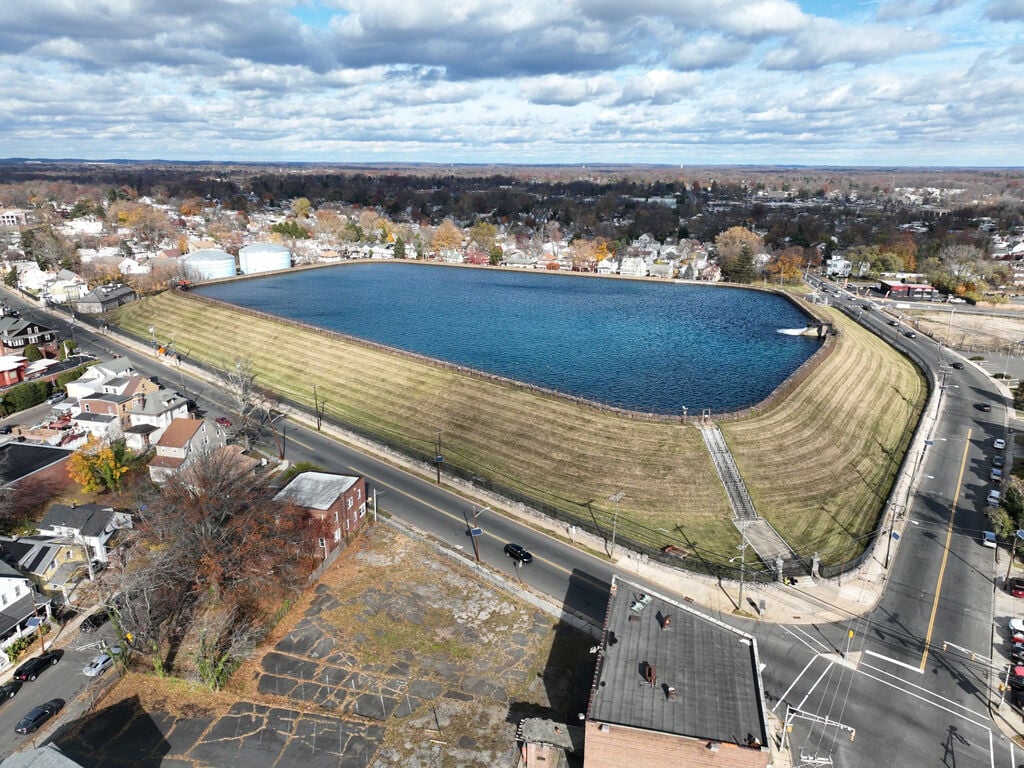
Trenton Water Works’ reservoir on Pennington Avenue in Trenton. (Trenton Water Works photo.),

