Shane Courtney has an eye for composition. He is a digital painter. He spends countless hours getting his compositions just right.
The Hamilton West graduate’s work will make you look twice or three times and challenge you to figure out what he wants you to see and understand. Personal yet universal themes may be observed.
What are you communicating with your art?
I’m interested in pulling complex, sometimes uncomfortable emotions out of very ordinary things. I like it when something feels familiar at first glance and then slowly unravels into something more odd or uncomfortable or unconventional. I thrive in the “uncanny valley”.
What is your primary medium, and how did you arrive there?
I primarily work digitally now. I started with simple black Bic pens and a piece of printer paper. I would often make art at my work desk on slow days. Then when I became busier, I moved to digital because it was simple to pick up an iPad and doodle. Putting together an easel and setting up/breaking down paints was just never feasible with my lifestyle. Moving to a digital medium has allowed me to push detail, color, and texture to appeal to a wider audience and explore different imagery.
Do you consider yourself to be self-taught?
Yes. I didn’t come up through a traditional fine art pipeline. My grandfather was an artist on the side, and my main career is as a medical provider specializing in dermatology. I think I have an innate appreciation for aesthetics, color patterns, and tiny details. I tend to let what feels visceral and organic guide me.
Do you still sketch the original ideas on paper?
Rarely. Most ideas go straight from my head into the digital space. I do start with a rough outline and then I refine it gradually. Most of my earliest sketches look like the skeleton of a tattoo. Then I let the details happen organically as I work
What is more important in your work: composition, color, or texture?
Composition comes first. Often, the title of my pieces come to me first and then an image is conjured in my head shortly after. That then becomes the art. Other times I will see an image in my head while daydreaming and if I find it whimsical or absurd or downright weird, I will refine it until it blossoms into something wonderful. Color and texture are what give it a pulse and a personality but creating an engaging and imaginative composition is always my top priority.
Your work appears to have classical influences. Is that intentional?
Absolutely. I’m drawn to the drama and storytelling you find in classical art. There’s an intricacy and hyperdetailism in classical art that I find is often lacking in modern art. I do, however, enjoy disrupting classical concepts with modern, mundane, or even irreverent subject matter.
Who are some of your artistic influences?
Salvador Dalí is my hero. His ability to create true visceral reactions and his flare for drama are exceptional. Hieronymus Bosch, Michael Chevall, Francis Bacon, H.R. Giger — their intricacies and attention to detail are also inspiring. I also love artists like Banksy who can make a powerful statement with only a simple image.
What is your biggest struggle as an artist?
Firstly, time. Creating the way I want to, requires mental fortitude and hours upon hours of focus. Most of my pieces take 60-80 hours. Balancing life, work, and the need to create thoughtfully is the ongoing challenge. Secondly, there is a lack of appreciation overall for digital media. Many have commented that they feel it is a ‘lesser’ art form or is somehow easier because of tools like copy/paste, programs like Photoshop, and the incorporation of technology.
There is a deep aversion in the art community to AI and when I share a piece, I inevitably get comments relating my pieces to AI and it’s awfully frustrating. I now share videos of my art process from start to finish and this has helped. But I suppose a goal of mine is to show people that digital art is unique art form that can be just as challenging and rewarding as conventional art. My hands just don’t get as dirty!
Your work makes the viewer look twice. Is that the intent?
Yes! That is absolutely my goal. I want people to have a gut reaction before the brain even knows it has reacted. It could be shock, disgust, longing, hilarity, or just plain confusion. Either way, the purity of a ‘first impression’ is what I live for. Most comments on my artwork will range from “this is brilliant” to “this is uncomfortable” to “WTF?” and I love seeing my art’s ability to evoke such a breadth of emotions. All reactions are valid and appreciated.
How do you know when a piece is finished?
Most malignant perfectionists like me will tell you that when you work on a piece long enough you begin to despise it. When I feel my resentment starting to build, I start wrapping it up. There’s a moment when it feels complete rather than perfect… and that’s when I let it go.
Do you feel your work is evolving?
Definitely. I’m less interested in decoration and more interested in the piece resonating with the viewer. The subject matter I work on now is chosen carefully. I have a line-up of 20-30 ideas written down that I hope to start working on. My style as well is evolving. I can make my ideas come to fruition faster and more precisely. And working with the Procreate art app as well as my iPad and Apple Pencil have a learning curve that I keep improving upon with each new iteration. You never stop learning.
What’s on the horizon?
More provocative ideas, more stepping outside of my own comfort zones, more exploring techniques that feel foreign, and simply — more playing. I make art because it’s therapeutic for me. It keeps me mentally sound. And yet I feel myself yearning to break more rules and play increasingly more.
My artwork is the only autobiography I have that places the images in my brain into a palpable form that can be enjoyed by others. Long after I am dust, that will be the legacy I choose to leave to others. That’s the greatest gift I can give.
Instagram: @thatsketchyguy.
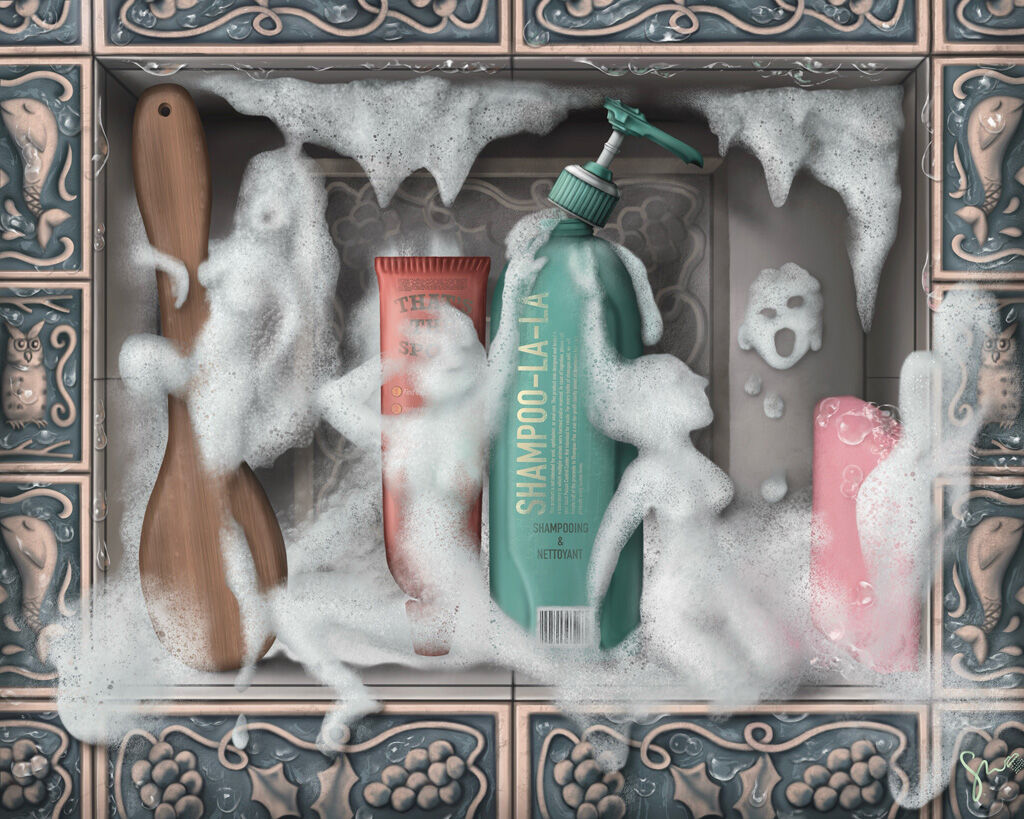
“Shampoo-La-La,” digital illustration by Shane Courtney.,

