Hopewell Museum’s Board of Trustees is pleased to announce the start of Phase 3, the $1.5 million portion of its renovation project, Reimagination.
Its master plan, designed by LayerX Architects of Philadelphia, was finalized in September, with newly configured rooms, modernized mechanicals and lighting, and enlarged capacity. Permits from the state and borough have been approved. And Princeton-based contractor, C. Raymond Davis & Sons, has begun the careful interior work.
Museum board president Vincent Janoski, spoke of the challenge of “reimagining” a 19th-century home into a 21st-century museum.
“Our house is the first item in our collection,” he said. “Preserving its classic qualities, and at the same time transforming our space into a 21st century meeting place and gallery—that’s been our mission from Day One.”
LayerX’s lead architect, Wolfram Arendt, echoed this commitment. “The house at 28 E. Broad St. is a beautiful building, but it’s an old building. Our charge is to put in elements for long-term sustainability, at the same time we preserve the building’s historic integrity.”
A never-ending task for any museum is the cleaning, repair, and management of its collection, and the building that houses it. Time and weather take a toll.
Preservation and restoration are critical for the long view. The Hopewell Museum’s collection holds many objects of great age, but one of the older ones is the building itself.
In 2020, the Board of Trustees launched Phase 1 of an ambitious “reimagination” effort. Its goal was to revamp its interior space, refine and conserve its collection, and restore the building’s glory.
These aspirations were abruptly derailed by the spread of Covid. The museum was forced to close its doors to visitors. Reimagination was put on hold, as were the plans of many.
For nearly two years, Reimagination’s flame guttered, though it never went out. In 2022, the board rekindled the project with renewed vigor: to repair and polish the 150-year-old mansion’s exterior.
Its facade of graystone was cleaned and repointed; mortar was replaced; all woodwork repaired and repainted. The front porch was returned to its original design. And the pathway, stairs and handrail leading to the front door were all reworked.
Phase 2 (2023–2025) focused on preserving the museum’s vast collection: archaeology artifacts, 18th- and 19th-century clocks and furniture, prototypical American textiles and decorative arts, standout ceramics and other exemplary artifacts of village life in New Jersey.
Archivists and conservators assessed, catalogued, remediated, and repaired these unique holdings, moving them to storage.
Which set the stage for today: Phase 3’s comprehensive modernizing of the building’s mechanical systems, and renewing the interior, ceiling to floors.
Board trustee Sarah Mezzino, put it like this: “To date, we’ve been very limited in how the Museum preserves, protects, and displays our collection. Though we’ve loved our landmark home, it was built for a 19th-century family to live in, and it clearly isn’t suited for 21st-century museum practices. And that’s what’s really exciting about Reimagination. As walls and closets are removed, as the space is given new dimension, as we put in new materials and new mechanicals, it’s freeing us up to do what we’ve wanted for so long—provide a sustainable, accommodating home for local artifacts and community interaction.”
The display areas will undergo significant reconfiguration, creating a versatile visitor experience with both permanent and rotating exhibits. And the building’s third floor will become dedicated offices.
While Phase 3 expands the interior space, plans are already in place for Phase 4, which will be secured through a dedicated capital campaign: extending the building’s rear to create an archive room for researchers; a state-of-the-art meeting room; additional storage space; and an outdoor patio and garden. Phase 4 will also offer a new entry for wheelchair access.
Though sustainability typically focuses on energy-efficiency and using recycled materials, Arendt thinks of it as an encompassing, holistic concept. “Everything in a building is connected,” he explained. “For it to be truly sustainable, all parts must work together. Take lighting, for example. Bright blue light may be harsh to visitors’ eyes, and potentially harmful to the artifacts. We’ve specified correct color temperature for all lights on all floors. And we’re using LED lighting wherever we can, which will reduce overall electrical load, as will track lighting, which we’ve added for flexibility. Track lighting can be repositioned to alter environments and change the mood and drama for exhibits.”
“Another factor is ambience,” Arendt continued. “This gets into sustainable health and happiness issues. Indoor air quality, for instance. We’re exposing windows that had been walled over, providing more sunlight. And we keep asking ourselves, ‘How can we expand the gallery’s floorspace for ease of visitor experience?’ We’ve had to undo some walls and shelving that covered windows and obstructed movement through the space.”
Sustainability and preservation go hand in hand. “To protect the artifacts,” Arendt said, “we’re using nontoxic paints throughout. These have no VOCs [volatile organic compounds] whose particles can cause damage over time. Mineral paints allow the walls to ‘breathe.’ They prevent moisture damage and block out ultra violet light, which can fade displays.
“And we’ve made sure to install mechanicals that work without being seen. Call it functionality balanced with comfort. The design will deliver tempered air, and fresh air, to all of the spaces without having to use soffits or visible duct work. The A/C will be delivered from the basement to the first floor through floor registers. And the upper floors will be fed from mechanicals in the attic.”
Once the contractor enters, the team will clear the interior down to its basics in order to begin rebuilding it. Because it’s an historic building, they’ll first protect elements that are going to remain, such as parquet floors, original fireplaces, and ornate mantles.
They’ll start on the upper floors and work their way down, installing systems, building new walls, fitting doors, windows, and cabinetry, floor by floor, backing out of the building slowly. This won’t be visible from the outside, however.
The result? True to its founding mission of 1922, the reimagined Hopewell Museum—in a resplendent refinished home—will resume its proud role as a showcase that tells the story of Hopewell-area life and culture, pre-colonial beginnings to the present, for decades to come.
That’ll happen in a mere matter of months.
To learn more about Reimagination, or to participate in its realization, contact the museum’s executive director, Asher Lurie asherlurie@gmail.com.
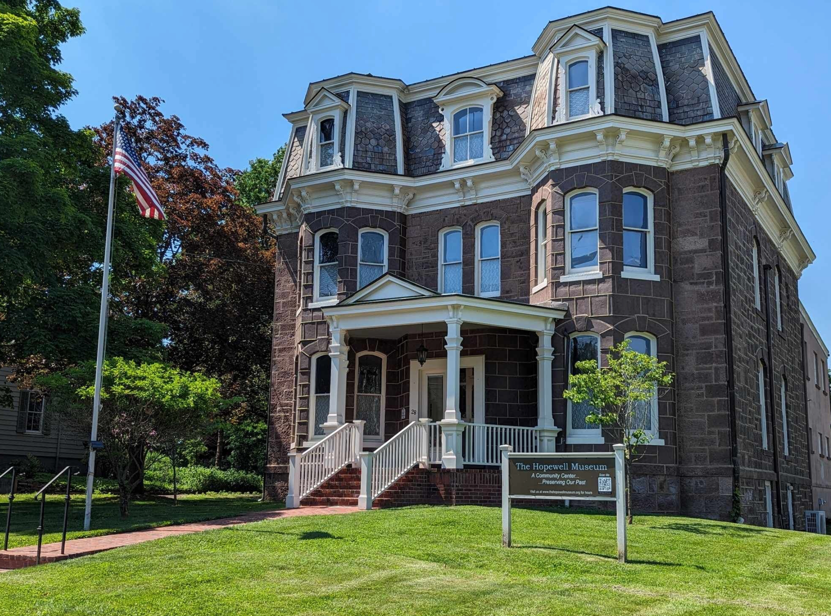
The Hopewell Museum.,

