Rebecca Singleton is an artist and an art educator who teaches at Steinert High School in Hamilton. She shares her artistic energy with her students in painting and ceramics.
A large part of her teaching is about the process. The ideas, the attempts, failures and successes. Inspired by many arts educators during her learning, she is instilling in her students the same motivations and skills to pursue their passions.
When did you begin in the arts?
At 6 years old, I would set up my stuffed animals and draw them. I drew everywhere on everything: paper scraps, homework, church bulletins. My mom scolded me multiple times for writing on our walls.
When I was nine, my mom enrolled me in art lessons with Juanita Crosby in her Bordentown gallery. I gained confidence in my ability a bit later, after studying with Mel Leipzig at Mercer County Community College.
Which media do you work in?
Primarily acrylic paint. I also enjoy sculpting, ceramics, collage and mixed media.
Who are some of your inspirations or influences?
My mom is number one. Former teachers: Mrs. Abbott (3rd grade); Mr. Kane (middle school English); Mr. Morgan (middle school graphic arts); Mr. Wood (high school art); Mel Leipzig (MCCC painting, life drawing, art history); Jim Colavita (MCCC sculpture); Michael Welliver (MCCC ceramics); Michael Kendall (MSU art education).
Elisa Cooper (former employer, business owner and artist). Musicians and dancers. Poet Maya Angelou. My children: Arthur (31) and Jake (26). My students. Visual artists, especially Rembrandt, Mary Cassatt, Edward Hopper, Faith Ringgold, Charles Demuth, Mel Leipzig, and Ruth Carter
What steered you into teaching art?
I decided I wanted to be a teacher in Mrs. Abbott’s third grade class at Hamilton Square School. She made lessons come alive. We used all the senses in her class, including writing and performing plays, making food, and listening to music.
Sometimes I stayed in the classroom during recess and she would reteach concepts or check for understanding. I felt this was a prize, not a punishment. My time with her was precious.
What age do you feel that students start to develop their own voice?
We have our own voice at birth and it evolves over the course of a lifetime. We start vocalizing our thoughts and feelings as soon as we make noise. Sometimes we stop using our voice due to feedback from our surroundings. We rediscover it at our own pace.
What fight/struggle do you have regarding your art and your teaching of art?
Sometimes I stop creating art, which used to concern me. However, I’ve learned that part of my process is time thinking about creating, so I no longer worry about daydreaming, procrastination or gaps in creation.
I have many ideas. Some come out quickly while others brew for years before I create. My primary struggle as an artist is the courage to share my artwork.
What is the state of visual arts in Hamilton Schools?
Our Steinert High School art students are engaged. This is evident daily as well as at the end of the year, when we cover the first floor of the school with student work at our annual Celebration of the Arts.
In addition to Celebration of the Arts and the Youth Art Month exhibit at the Hamilton Township Library, my students display their work each year at Artworks Gallery’s 10” x 10” exhibit, Art Educators of New Jersey, Mercer County Youth Art Month at Artworks Gallery in Trenton, the AENJ exhibition at Grounds for Sculpture, Mercer County Teen Arts at Mercer County Community College, Teen Arts New Jersey at Middlesex College and other exhibits when we are able.
Space and money are needed at all levels of education, and are issues not unique to our schools.
Which topics/methods are easiest and hardest for the students to grasp and excel in?
High school students adapt easily to art routines. Most students enjoy the varied pace and rhythm of an art class. Color theory, painting and creating in clay are favorite topics where most, if not all, students find success. Many students struggle with collaboration and time management. I see incredible growth in these areas during a school year.
Confidence is the other major issue I see. Students decide at an early age who is a good artist and who isn’t. Many students hide behind statements like “I’m not an artist” or “that’s the best I can do.” We work to dispel those myths and lead students to success.
Art includes developmental skills – hand-eye coordination and fine motor control. Students who struggle in these areas can still be successful in visual arts since it is more complex than just technical skill.
What is a dream project of yours?
First is to continue to modify the classroom to inspire voice and choice. I’d prefer a real studio setting with alternate seating and ample project storage — easels, art benches, shop tables, student drawers and project shelves — all on casters so we can adapt the space for the changes year to year.
It is inspiring to connect my students to working artists, especially when we can create art together. We’ve done this through mural projects and guest speakers as well as two career and create field trips (in 2016 and 2024). I’m always looking for the next opportunity.
A dream that recently came true is to adapt our art curriculum for the self-contained special education room. I am team-teaching with Mrs. Scrob and collaborating with a new teacher Ms. Robol in a self-contained Autism-Spectrum Disorder classroom. Students are working with varied media, tools, and techniques while making creative choices, building routines, and developing comfort with problem-solving.
Many of the lessons are cross-curricular. The experience is energizing and has offered more gifts than we ever imagined.
What is on the horizon? What are you looking forward to?
My students have multiple mural design and creation opportunities again this year. Also, my National Art Honor Society will host art activities for students in and outside of our group. Our first open event is scheduled for later this month.
Personally, I am working on six art pieces and answering open calls to show my work.
Instagram: 12_pt_helvetica.
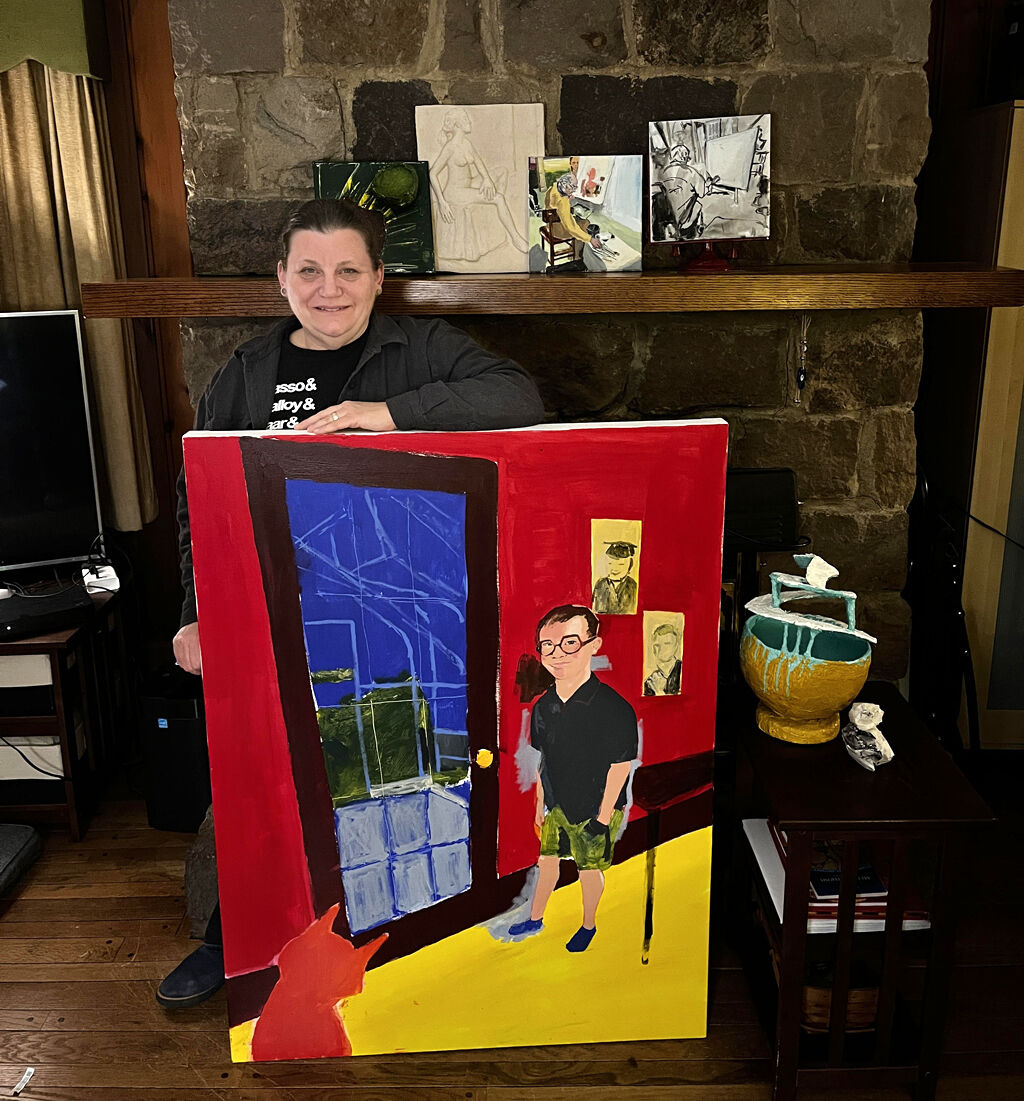
Hamilton artist and teacher Rebecca Singleton.,

