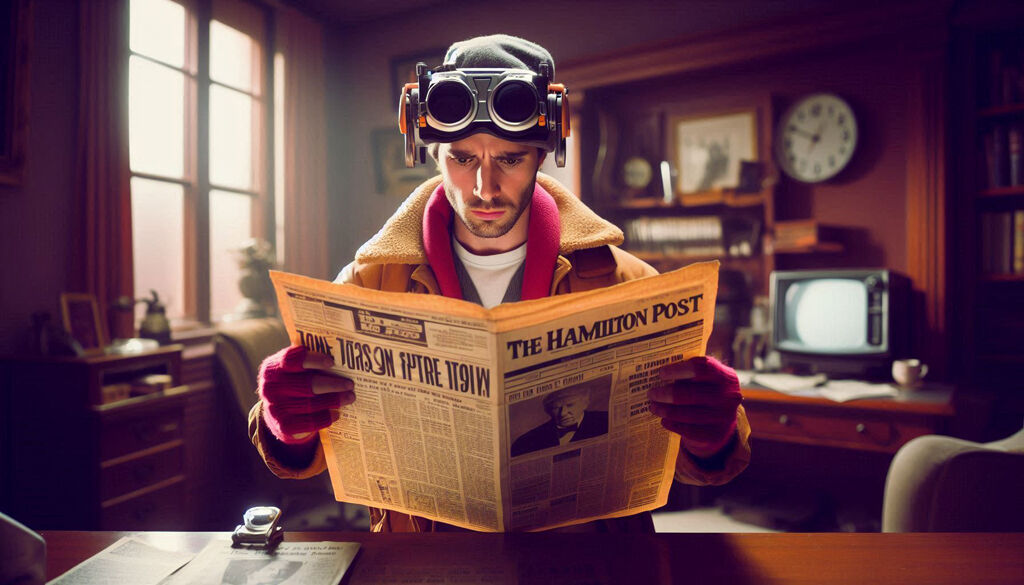
As I write this, I’m in my fourteenth day of withdrawal.
On Feb. 2, the Times of Trenton ended publication of its print edition, switching to an online-only format. I still have a backlog of print newspapers to get through, but eventually my morning routine of eating breakfast while reading the paper will be a thing of the past.
For me, it’s the end of a long relationship with print newspapers.
A long time ago, I was a paper boy. That’s not a reference to the fictional rapper Paper Boi on the TV series Atlanta, so for those younger than 30, allow me to explain: in much the same way my older relatives once explained “breaker boys” in coal mines.
Newspapers used to be delivered by children, often with the aid of a bicycle. Child-labor laws seemed to exempt such work, so unless you wanted to wait until you turned sixteen to get a job, delivering newspapers was pretty much the only game in town.
I recently reminisced with some childhood friends, now spread across the country, about our days delivering newspapers; I delivered the New York Daily News in the morning and the Staten Island Advance after school. In those days, nearly everyone subscribed to at least one daily newspaper, and economies of scale allowed those publications to be sold cheaply.
Newspapers were the source for everything: world news, local news, sports, comics, and classified ads to sell stuff or find a job or who knows what else.
Essentially, a paper boy bought newspapers at a discounted rate and then “sold” them to his customers. The newspapers would get delivered to a street corner near your house every day, and you’d take it from there, depositing them in mailboxes, railings, or inside storm doors, often cutting across perfectly manicured lawns to shave a few seconds off the task.
Once a week (or whenever you needed money to pay your newspaper bill) you’d go door-to-door, collecting your money from customers and recording their payments in a little black book—which, I realize now, has a whiff of organized crime to it. Luckily, I never had to hire any muscle to get someone to cough up their $2.50 a week, but I did have a good amount of money “on the street” for a 14-year-old.
I learned a lot about the efforts some people will take to avoid laying out money, most memorably a woman who tried to pretend she wasn’t home even as I watched through the living room window while she crouched down and waited for me to leave.
I always ordered an extra copy of the Daily News to read while eating breakfast, after my deliveries were complete. I enjoyed paging through the Staten Island Advance before dinner, but my parents, along with most of Staten Island, were already subscribers, so there was no need to buy my own.
The point is, I’ve been reading print newspapers since I was a kid. In recent years, they provided a welcome respite from staring at screens, which occupies an increasingly large chunk of every day for most people.
Ink stains and the smell of wood pulp? Sign me up. I’d even take a visit to a smoky newsroom circa 1985 or so.
The disposability of a newspaper was as appealing as its heft. You could tear out a recipe or an article without guilt, file it away or pass it along to someone who might appreciate it. People can download or share news stories electronically today, but it’s different, like sending an e-mail instead of a handwritten letter.
I get sent so many links from people, I often ignore or forget about them, but a ripped page from a newspaper will always capture my attention. Upon completion, plopping a newspaper into the recycle bin provided a brief, physical sense of accomplishment that closing a tab on a computer desktop will never match.
Unlike an iPad, you could spill milk on a newspaper without a major repair bill. If it got wet, you could dry it out and read it later, and when you were done you might leave it for some poor, information-starved passenger on a subway or bus.
It’s not just me who relied on the existence of print newspapers: comic book and television creators depended on them (and their highly relevant headlines) in the backgrounds of scenes, providing opportunities for silent, subtle exposition; movies did the same, especially during their heyday in the 1940s to 1960s, when the classic but not-so-subtle “spinning newspaper” trope reigned supreme.
Time travelers, fresh from a traumatic journey, often glanced at a copy of a newspaper to orient themselves. Back in reality, kids made paper hats, planes, boats; adults covered floors for painting, and bird owners lined the bottoms of their pets’ cages. Proof that an image was current was easily accomplished by holding up that day’s newspaper in a photo—what will suspicious online daters and aspiring kidnappers do now?
Nostalgia, durability, and versatility aside, a good print newspaper also boasted a balanced, expansive approach, in many ways the opposite of today’s heavily algorithmed news feeds, which mostly deliver news about stuff you’ve searched for in the past and points of view you tend to agree with. I wondered if an electronic newspaper could replicate the daily dose of serendipity that a print edition offered, presenting interesting articles I hadn’t sought out but enjoyed reading, and contrarian opinions—labeled as such—that might be infuriating but also forced one to reconsider one’s own stance on an issue.
My wife had been reading the news online for years, and seemed to think there was no reason to be upset. As I prepared for the switchover, I acknowledged I’d probably be losing something in the process, but at least I’d be saving money—right?
In 1988, newspapers cost 35 or 40 cents for a weekday edition. Adjusted for nearly forty years of inflation, that’s a bit less than $1 today. If everything else had stayed the same, home delivery would now cost about $30 a month; the actual cost of a monthly print subscription to the Trenton Times in December 2024 was approximately $110.
It proved to be an unsustainable price, unaffordable for some people, simply not worth it for others. I went to the Trenton Times website to find out how much the electronic edition would cost me, and was shocked at the figure: $22.99 per week. A representative dropped that to $18.99 when I asked for a better price, and later, $8.99 a week.
It seems the Times, along with much of the newspaper industry, hasn’t figured out its electronic price points yet, so if you’re in the market, use your negotiating skills. If an online subscription is out of reach, make use of the Hamilton Library’s online resources to access a free electronic edition from home.
I’m happy to report that the quality of the electronic edition is still high, and it’s easy to download or screenshot an article for sharing or later reference. But unread print newspapers stack up, a visual reminder (and in my case, a guilt-inducing prompt) to get back to them, while electronic editions are easy to forget about.
Within a few days, I’d fallen behind and the daily morning ritual of newspaper reading began to fade. This worries me, because if it’s that easy for me to drift away from newspapers, even temporarily, how easy is it for people without a longtime attachment to the medium?
* * *
The distinction between newspapers and other, less reliable news sources is often well disguised, but when was the last time you saw (or heard) an unforced self-correction on the internet, or cable news? They’re few and far between, and it’s not because they get everything right. Meta’s reluctant steps to identify misleading posts have all but been abandoned.
Maybe the next step is to establish a journalistic oath like the ones taken in other public service roles, like doctors, lawyers, police officers, and members of the armed forces. But there are bad apples in every bunch, so perhaps, as in so many other occupations, a recognized designation is needed, managed by a professional organization, with the loss of press credentials as the ultimate punishment for intentionally spreading false information.
This could be a valuable gatekeeper, separating real journalism from “feel” journalism. In a land where free speech is among our most prized rights, it would be a tricky line to delineate. But some people will do anything for a buck, and without changes, “news” will continue to degenerate into intoxicating cocktails of lies, garnished with a slice of truth.
One school of thought says to simply call them “alternate facts” and go our separate ways. But some things are facts, not alternate facts, and need to be agreed upon before solutions to problems are found.
Polls show that more and more Americans get their news online. The same friends and relatives who entertained themselves forwarding jokes and chain letters via e-mail twenty years ago now share political memes that are at best simplistic, and at worst outright lies. Younger folks turn to influencers whose job is to have an opinion about anything, whether that opinion is informed or not. With some Americans vindicating the likes of Luigi Mangione and Vladimir Putin, I wonder if a line has already been crossed.
The Trentonian still carries the local daily journalistic torch, though its approach often befits its tabloid format, with occasional tasteless NY Post-style attention-grabbers like “Roasted Nuts,” an infamous 2002 headline about a fire at Trenton Psychiatric Hospital. But, unlike so many modern examples, the editors of the Trentonian didn’t double down, dig in their heels, and insist they were being treated unfairly. Instead, they apologized.
Of course, the Hamilton Post continues. Though its reporters don’t typically cover national or international news, they serve a vital role as a local news source, and we’re lucky to have them. Support the Hamilton Post, the Trenton Times, and the Trentonian, as you can.
Meanwhile, next month, I’ll be writing about sound machines as sleep aids. God help us all.