Lawrence Township voters will have the opportunity to vote on a referendum on Tuesday, March 11, that would fund a variety of improvements to school facilities.
The Lawrence Township Public School District is asking voters to okay $94.9 million in bonds. If approved, the measure would increase annual school taxes by less than $350 for a home with the township’s average assessed value of about $285,000.
Proposed improvements and additions include:
A two-story addition at Lawrence Middle School, featuring an elevator;New specialized learning spaces for science, art, and life skills; designated special education spaces;Dedicated support spaces for the nurse, child study team, and guidance suites.Renovations to the technology, life skills, and music classrooms.
Security and safety upgrades include:
A new secure visitor entrance and vestibule;A traffic drop-off lane at LMS;Increased student parking on campus;Additional parking for building and event access, andRevisions to traffic circulation.
Capital maintenance improvements would include:
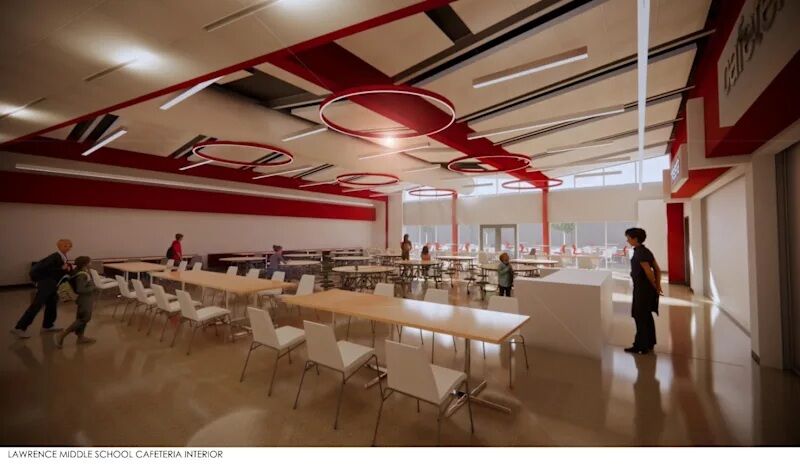
Roof replacements;Bathroom renovations;Asbestos abatement;Kitchen and cafeteria renovations;Parking lot repaving, andUpgrades to existing restrooms, including new finishes, fixtures, and partitions.
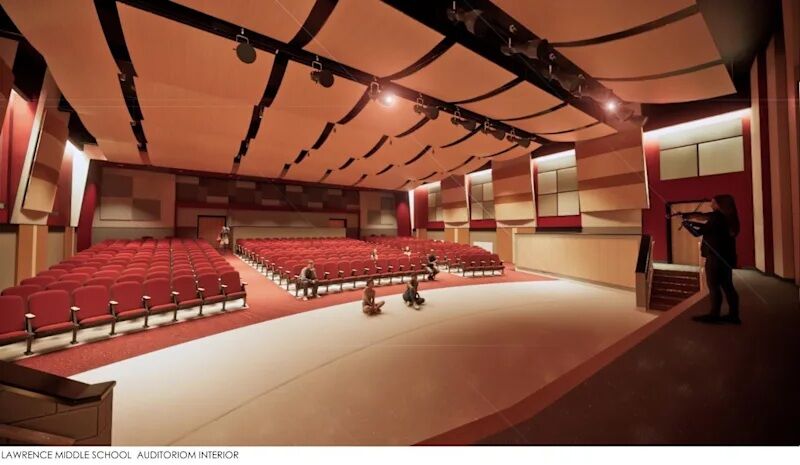
Proposed auditorium renovations at LMS include:
A new audio/visual system;A new lighting and controls system;A new theatrical curtains and rigging; andRefreshed interior finishes and seating.
For the sports program at the LMS/RHS campus, proposed projects include:
A gymnasium and fields addition;A full-size court with provisions for both basketball and volleyball;Built-in bleachers to accommodate 900 spectators;A local audio system for large assemblies;A multi-purpose synthetic turf field, andA maintenance building/concessions stand at the high school stadium.
Lawrence Gazette editor Bill Sanservino recently interviewed LTPS Superintendent Robyn Klim and Business Administrator Thomas Eldridge about the referendum and why they believe it is necessary.
The Gazette has also printed a letter from a recently created group called Taxed Enough Already Lawrence (TEAL), which opposes the referendum. Klim and Eldridge’s responses to TEAL’s position can be found below.
An edited Q&A from the interview with Klim and Eldridge appears below.
* * *
Lawrence LG: Is there any particular piece of the project you’d like to highlight?
Robyn Klim: I think one of the pieces of the project that I personally want to highlight—because when people are looking at a vote, they’re viewing it from the lens of “What’s in it for me?”—is that there’s a part of our population, like our senior population and people who want to have community events, but they’re no longer part of our school district.
For a good period of time, due to school security concerns, we’ve lessened the number of facility requests. Well, this project lends itself to a large, 900-person seated gym, which will allow lockout features. So that will essentially be a separate entity and not allow entry into the school building.
You’ve got the safety mechanism in place, but it allows for more partnerships— the rec department, our senior population, and people who no longer have students here, and they can enjoy this part of the footprint that we’re building.
LG: It’s a difficult economic climate to talk to people about a project that will impact school finances. First of all, is there a tax impact from the referendum. If so, what is it?
Thomas Eldridge: The average tax impact, based on the average assessed house, is roughly $350. It’s actually a little less than that. And so, we’re going to bond roughly $94 million, and that mortgage will be stretched out over 25 years.
LG: Does the referendum depend on any grant money that could be jeopardized by poliy decisions coming out of the federal government?
Eldridge: It’s unlikely because the funds we receive from state aid are in-statute through the state of New Jersey. In fact, just this week, we received our final eligible cost letters, which put down in writing and codify what we’ll receive aid on. And it’s not contingent on the federal government. There are very few things we rely on federal money for.
LG: Why should a person like you mentioned—seniors, or people in the township who don’t have children in the school district—vote in favor of the referendum? They could say, “This doesn’t benefit me, why should I approve this?”
Klim: Well, I think for under a dollar a day, as Mr. Eldridge said, for the average assessed home, what we’re looking at is investing in our future. When you have thriving schools, you typically have thriving communities, which drives up home values.
We definitely want to stay competitive within Mercer County. I would think that’s a pride thing for members of our township to be able to say, “Our homes are thriving, people take pride in our neighborhoods and community.”
Schools are the number-one factor when it comes to the resale value of your house. I would think that contributing to the future education of the youngsters who typically come back and serve us—is important.
We just celebrated the retirement of our police chief, who matriculated all the way through our school system since preschool. The idea about Lawrence is that we’re very tied into our community, and oftentimes, the kids we instruct come back to serve. I would think that pride is something we’d want to continue.
LG: Right. And it’s probably one of the first questions—or one of the first things, in my experience—that people ask when looking to buy a home: “How’s the school district?”
Klim: Right, and the ratings of the school district. And I’m proud to plug that we were the number-one academically achieving middle school in Mercer County. It was all over the news in the fall.
Again, we want to keep that grade level and continue to compete. These are adolescents and teenagers, and I feel very proud of the fact that our 7-8 building was the number one in Mercer County. We’d like to continue that trajectory of excellence.
LG: Can you highlight for me just some of the projects and why the projects are needed?
Eldridge: So, we have a variety of reasons, but I like to lead with the program. First things first, we’re doing this to make sure our spaces are the right spaces for delivering instruction.
I’m going to take one step back. What we’re doing is concentrating our expertise of our teachers in the grade levels where we can get the maximum efficiency and delivery of instruction.
What I mean by that is we’re regrouping our kids according to their readiness to receive instruction, and we’re deploying our staff in places where that expertise is concentrated.
So, we’re moving sixth grade up to the middle school, and we need to build appropriate learning spaces for those sixth graders. But we’re not just bringing them up for that; we’re bringing them up because it’s their level of readiness for their personal development. As you might know, sixth grade is when students start changing classes. Before that, they’re together in a more elementary setting. So, we’re bringing sixth grade up to experience subject-area mastery and grouping them with teachers who specialize in that.
That same idea applies to the middle school. Third grade looks a lot more like fourth grade than it does like second grade, so the intermediate school becoming a 3-4-5 school makes sense. When we do that, we also need to reflect that change in our buildings.
So, you’ll see us investing in things for two main reasons: first, to support the program, and second, to address capital maintenance and renovation needs. We’re creating science rooms and small group instruction rooms.
If you look at the floor plans, you’ll also see other necessary updates, like our auditoriums, kitchens and electrical panels. Things you’d update in your own home. These projects align with creating the appropriate spaces for students, supporting the program’s delivery and addressing the physical condition of the buildings.
For example, right now, if a student needs occupational or physical therapy in the middle school, they might have to find a spot in the library, because we don’t have a dedicated space.
We make it work, but we want to create spaces designed for these needs, in a private setting, so teachers can provide services when students are ready for them. Right now, it doesn’t align perfectly. We make it happen through a great deal of effort, but if we’re going to take the next step, we need to be ready for it.
These programs are also coupled with capital maintenance projects, so things like roofs and electrical upgrades will happen, and by doing it now, we’ll receive state aid. By bundling the program with the capital maintenance, we’re making the most of the opportunity.
LG: Education is always evolving, and technology is moving at an even faster pace. How is this referendum addressing that?
Klim: I think we have designed it with that in mind, we’re being future-ready. What I mean by that is we’ve got partitions in classrooms set up with the headers so that if we need to divide classrooms for small group instruction.
We have a STEAM program that we want to build with an outdoor courtyard, which will centrally enclose where the addition is put in.
What I’m trying to articulate is that every learner and future need was kept in mind when the leadership team looked at the beginning design plan. There are flexible spaces. We looked at accommodations for all of our kiddos. Any child that’s medically impacted, we’re moving the nurse’s station up. We’re outfitting spaces to attend to the needs in a more private way, in a way that feels like children’s needs are being met to the fullest extent.
As for technology, when we start running wires and getting down to the nitty gritty and looking at the sound system in the gymnasium and talking about the details of the auditorium, let’s say, we will make sure that these spaces are designed to be dual-purpose, that they will outlive some of the changes that we anticipate coming down the pike.
We’ve had experts come in, looking at our security infrastructure, our traffic pattern, and our wiring in our systems of how we’re even setting up these rooms. We designed this footprint to set us up for the next 75 years with flexibility, with sort of that growth mindset that the space can change and adapt to a change in curriculum or a mandate that comes down that now we have to deliver in a different way. We’re so used to pivoting, quite frankly, post-COVID. I think we all had that mindset going into the footprint of this project.
Eldridge: The things that Robyn described are things that help us not become antiquated. So when we designed these things, we gave the architect marching orders to make sure that it’s ready for the future, and not the future that we see, but to make sure that we can roll out the technology and make the spaces more of an open floor plan so that they can be used for other things that we can’t see coming.
And we’ve laid the groundwork for that in any number of ways. That is exciting and we began that process in the last referendum. So, this isn’t new. We did things with the last referendum, getting ready for this referendum. We’ve been looking at for quite a long time. Now, it’s just a matter of, “Okay, when are we ready? Who has the vision?”
Klim: I just want to add, we asked every leader that came in to look at these plans, including our two architects, to really learn Lawrence and what we were asking for, for a great deal of psychological flexibility. We asked them to dream. We asked them to envision the future. We asked them to look at the space so that we can change, pivot and adjust for whatever comes down the pike.
Eldridge: You go into our auditorium—it’s a prime example. The auditorium, as we’ve drawn it up, is no longer laid out like just a performance area. Of course, it’s going to be a performance area, but we’ve taken out rows so that we can open it up for classrooms and use it functionally for that.
It has its own (computer) network all to itself. We have redundancies in the building, not redundancies by way of making it more expensive, but just redundancies for ourselves for all sorts of reasons, security and otherwise.
I don’t know how long we’ll all be here, but we’re going to leave the next people with options.
Klim: To Tom’s point, we have so much historical knowledge now that we used to look at these plans. We have had people’s eyes on this plan that have been here for 20 and 30 years.
LG: You mentioned the leadership team. Who was on that team?
Klim: The full leadership team includes every principal, every vice principal, every supervisor in the district. We have two directors now and our entire central office team in coordination with the board.
The school board has been through several renditions of our dreams and plans around this project and what we were going to include. For countless hours they have supported us to make sure that we nailed down the project to the essentials, but yet also the flexible-minded future that we need so desperately here to build.
Our principals are the leaders in their buildings, but they have absolutely also had teachers’ eyes on it. We’ve involved assistants and facilities and our technology team and many, many layers of renditions.
LG: You have been holding public sessions to talk to residents about the plan. Talk to me about the importance of having involved the members of the public in the creation process and now of informing them about the plan.
Klim: We’ve held many community conversations all across the district in every building, PTO meetings, you name it. We also have a structured setting. We meet quarterly. It’s called Direct Link. We get our community constituents, Boys and Girls Club, YMCA—the people who aren’t at the table with us every single day in daily operation—to get their ideas, lean into their desires and their wants. We also did a huge district survey—I think we got 600-plus responses.
That’s all incorporated into the plans. We have tried to be absolutely transparent every single step of the way. Gathering input, adjusting, making changes. When we get down to the nitty-gritty of the design, we want our community, our parents, to weigh in and drive up that excitement for when we reconfigure and decide exactly how that all is going to look and unfold.
LG: What about communicating with the students?
Klim: Jen Baldassari, our communications manager, ran a referendum art project that went out to the entire school community. We got around 100 submissions from across the district, all grade levels, for them to get excited about the referendum and start to discuss space.
As for our high school, we have the student council. We have a student representative to the school board. He is great at taking knowledge back to the student body, letting them know the updates and gathering input.
Eldridge: During our community conversations, nobody knows our kids better than their parents. When we say what we’re doing and you look at the parents and you see the parents go, “Yeah, that’s going to get my kid excited.” That’s the winner, because all the parents want is the most for their kids. The parents know that their kids’ buy-in is proportionate to their excitement.
Klim: Seeing our kids get excited and asking questions about the floor plans when we have had them out at events, I’ll never forget it. Things like when a kid turns to their parent and says, “Mom, this might be my new area by the time I get there,” or “Look, they’re going to add this piece of performing arts for the gymnasium,” or “Athletics are going to increase. That’s so exciting because by the time I get to sixth grade, maybe I’ll get to compete with the middle school.”
It’s exciting to hear. And then the parents are literally stepping back and listening. That’s been my experience. At swim meets, fairs, community events, music in the park. We’ve been in everything. In all, our only strategy was just, “Come and ask questions and get curious with us.” It’s been really tremendous.
LG: Do you think that the parents and kids see schools in other highly performing districts in the county and compare them to what’s in Lawrence? Do you think they have a sense of competitive pride in their own facilities? Robbinsville High School, for example, is not a new building, but it’s one of the newer high schools.
Klim: It’s a pretty darn nice facility.
LG: Right. Do you think they see a school like that and they say, “We want our schools to be like that too?”
Klim: So, when you feel good about the space you’re in, whether it’s a field, a classroom, an auditorium, or a cafeteria, you feel better in your day, right? Your sense of self-efficacy is increased. You’re likely to do more academically. It’s designed for you. The lighting is geared towards your ability to focus and lean in, and there’s no distractions and noise.
LG: Security is always a major concern. How will this referendum help increase security in schools?
Klim: While we won’t be talking about the nitty-gritty of our infrastructure, one of the biggest ticket items that will change is simply bringing the buildings to be forward-facing. So, getting that middle school entrance off Princeton Pike, doing drop-off and pick-up lanes, building out more spaces for parking so that our kids aren’t lining up in areas where we don’t have cameras.
Right now, some of them park so far away in the surrounding neighborhoods. The idea is to bring them into the footprint where we have eyes on them, where we can draw in a security camera and make sure that they’re actually navigating to school safely and that there’s enough parking spots for them to do so.
We had a traffic engineer study our footprint, because we know we’re tight, but it’s not undoable. And there were some things just from a safety perspective—ADA accessibility, etc. There were things that just didn’t feel good—like having our parents feel jammed up in the morning. If you’ve ever driven on Princeton Pike during those times, it’s a little stressful. And safety is our number one concern. Changing that forward-facing door to face the high school door and making some decisions about how cameras are going to be accessible in our parking lots is really a big ticket item for us.
Eldridge: You have a more single point of supervision and all within our campus in a single line of sight. This goes to what we talked about—Consolidating the expertise for student readiness, for learning. We’re doing the same thing with respect to safety. And we’ve already begun that. We began that in about 2018. This will put us on steroids for that.
LG: How long has the board and administration been looking at this as saying, “We’re going to start making a list of the things that we really need to do so we can get them done all at once in the most cost-effective way. It’s better to address everything at one time rather than piece it out over X number of years?”
Eldridge: I can probably document for you renderings all the way back that look similar to the renderings we have today to about 2002. The additions for this initiative are very similar to that initiative. The spaces inside are different, but the idea was there.
We’ve been looking for a long time to change and consolidate and bring over the sixth grade. And what we needed more than anything was time and the vision. I think Robyn has brought that vision, and the board has adopted those goals. In prior referendums, everything we’ve done has been to prepare for that eventuality in our minds. We can show you what we did in the 2018 referendum, which was focused mostly on safety and HVAC, and show you things we did to get ready for this referendum.
All of those things are leading us to this point. And prior to us moving into this referendum, we had begun an initiative that’s on file now already for the auditorium renovation. So, this has never been far from the forefront of our minds.
Once we adopted the goals and Robyn was brought on as the superintendent, we strategically moved forward and held ourselves accountable to making this change in program, and following that, of course, is the change in the facilities.
Klim: And the change of the program is driven by academic achievement. We are diving into our data. We know the pockets of readiness and rigor that we need to reassign and make sure that expertise is deployed accordingly.
It is so hard to talk about this project in silos, because we know that we’re responding just to some academic needs post-COVID. We know that we had this idea in mind to reconfigure, and that 4-6 model is kind of a tough position to be in because, it’s an upper elementary schedule alongside a sixth-grade schedule. Coming out of COVID, our sixth graders are socially, emotionally and academically ready to be up with that grade level band of six-eight.
Eldridge: It’s been since 2001 that we had a referendum focused on the program. It’s been that long.
Klim: This has just been so intentionally designed—I can’t emphasize that enough—to make sure that our learners have the right spaces and that all students belong. So, on a pivot and a shift, if we need to add more classrooms, add more space, look at the medical needs of a more impacted population, there is a spot for these children to matriculate all the way through without a concern that we don’t have the facilities to support.
LG: Is this plan forward-looking enough so that based on the demographic projections you’re seeing, the district is going to provide enough classroom space so that you wouldn’t have to increase classroom sizes beyond a certain point. That this plan you will be able to accommodate the district’s projected future student population.
Klim: I would say the answer is yes, because we’ve even projected our preschool kiddos coming into that plan, right? So the answer would be yes. So, any three- or four year old in Lawrence Township under universal preschool will get that programming starting at three years old.
Again, we’ve built out with that population also in mind and including some spaces for students to possibly return to district, because we maybe in the past we could not program for them prior, because we didn’t have the appropriate space or facility or access.
Eldridge: Appropriateness is huge. Support services use space, and I think we all wrestle with that. So, providing appropriate space for those services is important. It doesn’t have to be a big space, but you need to have a place where you address speech. You can’t do it in an echoey hallway. You can, but you’re not going to do it well.
You need to have a place where a child study team can meet the teachers. The faculty room is not the place where you want to do that, when you have somebody coming in to get their lunch. There are 100 other ideas that are similar to those examples that we can give you. But yeah, that answers your question.
LG: One question people might ask is, “Why should we do this, for this amount, now, as opposed to kicking the can down the road?”
Klim: There’s two different “why nows?” I want Tom to answer the financial “why now?” and then there’s the “why now” for student achievement. Tom, do you want to talk about the finances first?
Eldridge: I’d rather follow you, if that’s okay. Because my heart tells me I believe in what you’re going to say, and I always, just by sequence, believe the program comes first.
Klim: So why now? Our kids need more. We need to lay a footprint for academic achievement so that we are putting them in the right spaces with deployment of our supervisory team, instructional coaches and data team to be able to utilize and emphasize their expertise.
For example, in grades pre-K to 2, they’re learning to read. By 3 to 5 they’re reading to learn. The deployment of curriculum, supervisory support, principal and VP infrastructure operationally is two different sets of expertise. When you start to look at these age categories, it lends itself to a design that is necessary now.
We’re looking at our student achievement. We have our test scores. We know the areas that we need to bolster and lean in and provide different support. I want to get the spaces in place in the district, reconfigure to finally address all of those areas.
LG: So, are students being limited by the current situation?
Klim: Why would we not want to maximize instructional time and deployment of services? Think about it. Right now, you’ve got 4 or 5 elementary buildings that have to conduct state testing versus one building. Can you imagine? Instruction carries on in all the pre-K to 2 buildings, and then testing can start in third grade instead of testing in five schools.
So, making these strategic decisions allows us to run building schedules and also meet the state mandates without losing vital instructional time during their developmental years. To me, that’s a great example of why.
When we have space and facilities, we can do the kinds of cool things that I have alluded at our community conversation. We’re developing a public service academy where it’s not just college ready, it’s career and college ready. When you have space, you can do some really cool things and design electives, even starting at the middle school for kids to get exposure in a different way.
Our life skills classrooms having kitchen areas and science rooms that lend themselves to more design thinking. You start to put those components into the curriculum in live time in a physical space that lends itself to be able to do these projects. You’re forward balancing our future graduates. So, the high school is going to be in receipt of these kids that have the skills and innovation simply because they have had access in a space that was designed for them.
This is just about as much about the investment in early childhood education and early intervening as it is about getting middle school infrastructure in place for the grade levels. And also, building public service academy, because we need prerequisites to get them ready for high school.
This entire design is unique because it’s pre-K through 12-plus. And when I say 12-plus, that is our extended learners, special education who stay with us 18 to 21. We’re starting a transitional space for them now at the middle school so that by the time they get to the high school, they have flexible life skills training, and we can get them out into the community doing more sooner.
LG: And the financial side?
Eldridge: If you were to take the question and flip it on its head, then why not sooner as opposed to why now? One, I go back to program. (In the past) We didn’t have a mission that went up and down the grade levels like we do today. So that’s the first reason.
The second reason is that we were waiting and biding time, developing the mission. At the same time, we were waiting for some of our existing mortgages to expire. That began the year before last, and they’re still falling off as we talk.
So financially we weren’t ready. We had begun to save, and we were getting ready. We started putting money away in our capital reserve, building up for this. Now we have $6 million in our capital reserve. We’re taking $4 million out and we’re buying down the cost of this referendum with that $4 million.
We have been planning for it, and we have been looking at it. There’s been a great number of people, and not just new people. There are those who have been here a long time that have been laying the groundwork for these things.
LG: And construction costs don’t generally get cheaper, right?
Eldridge: Interest rates are falling and have they started stabilizing six months ago and getting better. But I don’t think the cost of materials is any cheaper now.
LG: I’d like you to address the Taxed Enough Already Lawrence group which was formed primarily by resident Don Dodson. The group has released a white paper in opposition of the referendum and challenging some of the numbers the district has released.
Eldridge: Our projections have been proven at least two times over. The assumptions built into his white paper are inaccurate for a number of reasons, some of which I can’t really put my finger on, because he has never spoken to me and asked me for figures.
He originally went on to say that our estimates were incorrect. Then we put an amortization schedule up on the website from our financial advisers—that I also approved separately, which wasn’t difficult—to show that our tax impact calculations were correct. Since then, he kind of attenuated his statements of, “They’re not correct” to, “Did you know that it could cost you this amount of money?” So, he’s changed that.
I think I know what he was doing incorrectly, but I don’t know for sure, because we haven’t talked about it. He has never asked, and I would have been very happy to give him everything and anything. In fact, without ever talking to him and never saying anything, I intentionally laid out the amortization schedule and made totals in different places so that people who were trying to calculate it themselves had a better chance to figure it out.
And so, the question comes up as to why we didn’t do that to begin with. Well, we can’t put out information that would answer everyone’s questions, because we don’t know what everyone’s questions will be. As far as I recall, I don’t know of anyone else in the four or five bond referendums that we’ve had over the years who has ever tried to calculate the tax impact outside of us. And if anyone asked, we wouldn’t cover anything up.
He has also made accusations that we have understated our operating costs, and he goes on to say that they should be $2.5 million. I can’t get into someone’s head who I have not spoken to. So, I decided to take his estimate of $2.5 million for capital maintenance and maintenance for an 83,000-square-foot addition and apply it to the rest of the district.
If that’s the case, then we would be spending $20 million a year for our 650,000 square feet. Well, we actually spend $7 million. Our audit shows that we spent $7 million, and it also shows that we spent about that for the last 10 years or so.
There have been people who have contacted us and said, “We’d like that information,” and we actually put it on the website.” It’s our practice that if you asked us for information, if something new comes up, we proactively mail it to you. We send it to them directly.
He has done some other things that are interesting. He says, “Here’s what it could cost you,” and bring out the referendum cost. But, for whatever reason he completely misses the concept of preschool. And he published that white paper after being at our community conversation where we told him that preschool pays for itself 100%. But he still tells people that, “You might be on the hook for that too,” in his paper.
So, they he the tax impact of the bond principal and interest payments and then adds it to the cost of preschool. Then he adds the $2.5 million in what he thinks our operating costs should be. And he says, “This is what your liability is.” Well, that’s incorrect. Not just because of his logic in adding things up, but he also presupposes that we would always do the same things if anything did happen.
He makes a lot of assumptions. For example, he says in this paper that Lawrence is contributing $500,000 to preschool. That’s true. We are. We have been since maybe 2000 or before, because even though the preschool is going to be upwards of $4 million in total cash flow in and out for that program, the $500,000 we’re contributing is for students with special needs that we’re federally obligated to contribute. This isn’t an enterprise where we’re kicking in $500,000. But he doesn’t show tha. And he seemingly has no curiosity to understand those things. I don’t know what to tell you.
Klim: I see him as a disruptor. There’s no end game where he’s truly seeking the answers for his constituents. So no response will be good enough, because it’ll be a different spin.
LG: Jonathan Swift said, “You cannot reason someone out of a position they did not reason themselves into.”
Klim: Quite frankly, I take his remarks to be someone that is intending to gaslight, intending to disrupt, not intending to be truthful to his constituents. And to be honest with you, I don’t think he’s gained much traction.
LG: Bottom line—how confident are you in the tax impact projections and the cost projections that you have put together in this proposal? And how vetted have they been?
Eldridge: I am confident in our architects to give us adequate estimates with contingencies. I can never tell you what the economy is going to do for material prices or labor coming down the road. I believe, yes, the estimates are right. And we’ve planned for those types of things. Yeah, we may struggle, but we’ll deploy the expertise to find our way through. Construction is not tidy. It is difficult. And we are going to have to make decisions as we move through the design.
But I am confident that after having gone through bond attorney review, having gone through our financial consultants’ reviews, having done my own proofing back of their numbers, that we look good. I have done this now for—I have got to say this is probably my fourth referendum. And having built a school from the ground up before, having done renovations all across this district, that I’m confident that what we’re doing is along the lines of what must be done.
The other thing regarding tax impact that people don’t know is that these are conservative estimates that we give people. I told you $350 on average, knowing in the back of my mind it was $326. I know what it is, but I feel better about $350. These are estimates right now.
We held property values flat and included no ratable growth in our projection. It’s not going to happen. We’re going to have ratable growth, which means the tax impact isn’t going to be as much as we say, because that tax impact is going to be spread out in other places.
LG: How confident are you that you’re proposing a project that’s going to have as little impact on residents’ wallets as you possibly can while still providing a high level of service to the township’s kids?
Klim: I feel wholeheartedly confident that we are being strategic, fiscally sound and reasonably minded to put a project forth that continues the footprint of excellence here in this district that has been led for a number of years. Times are changing. We would like to be able to adjust to that and give our kids something different. And our teachers.