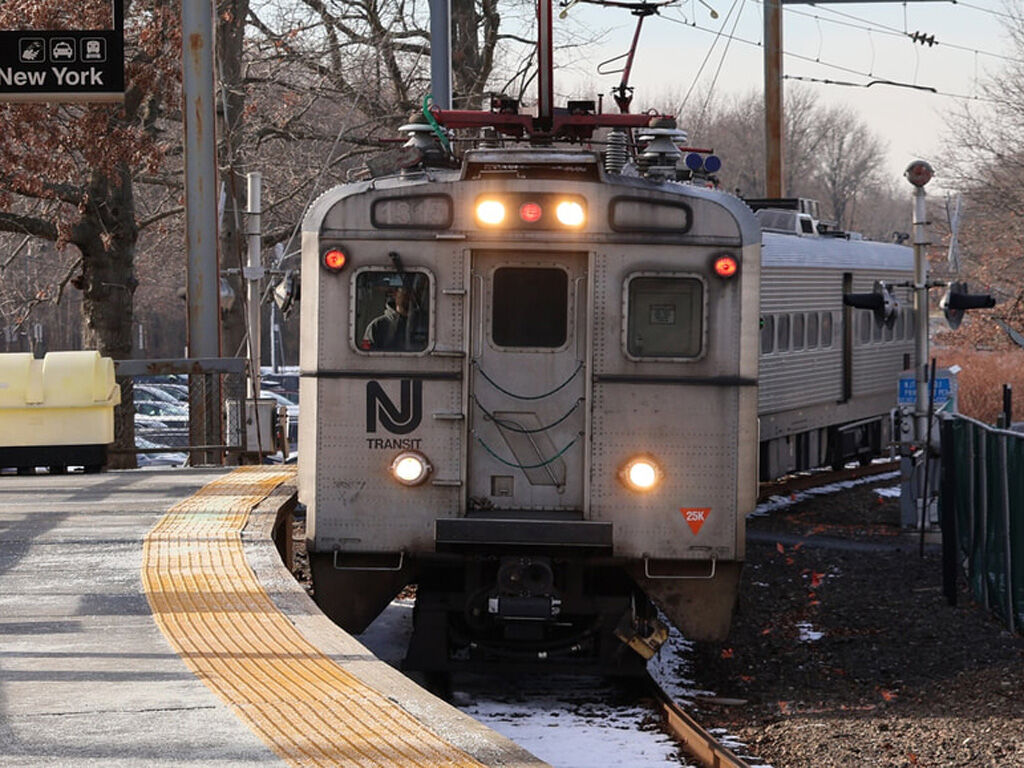
This is the tale of the Princeton Branch Railroad—an 1860s-era rail line linking Princeton and West Windsor.
Also known as the “Dinky,” it has ferried everyone from ordinary folk to President Woodrow Wilson and has had notable political and cultural ties as well. It’s also the shortest passenger rail line in the country. Its future has been a subject of debate for generations, including now. Read on to learn more.
For much more on the Dinky’s history (including maps/photos), visit: westwindsorhistory.com/Dinky.
Trains have played a significant role in West Windsor’s history. The first railroad through town was opened in 1839 by the Camden and Amboy Railroad and Transportation Company. It followed the southeastern bank of the Delaware and Raritan Canal.
Both rail and canal could efficiently transport people and cargo and brought much growth to the region. The train, especially, helped West Windsor and Princeton residents travel between New York and Philadelphia. A depot at the long-gone village of “Princeton Basin” (where Alexander Road crosses the canal) was the main station from 1839 to the mid-1860s.
However, in 1863, a new, straighter route was built, to accommodate faster and larger trains. This updated alignment, a few miles east of the old one, is now known as the “Northeast Corridor.”
The Princeton Junction train station opened almost immediately thereafter. This realignment benefitted many residents of West Windsor Township, of course, and gave rise to the historic West Windsor community of Princeton Junction, which grew around the train station.
However, it also meant Princeton residents now had to make a significantly longer journey to get to the mainline. So, on May 29, 1865, the “Princeton Branch” railroad opened. This single-track rail route directly connects the Princeton Junction train station to the municipality of Princeton. In fact, “Princeton Junction” is named after the “junction” (intersection) of the Princeton Branch and the Northeast Corridor.
The Princeton Branch is also commonly called “Princeton Junction and Back” or the “Dinky.” It was originally about 3.2 miles long and has always used the Princeton Junction train station in West Windsor as its southeastern terminus. However, over many decades, the stations on the “Princeton” end were replaced several times, each time further southeastward. Now, the line is about 2.7 miles long.
The first station on the Princeton end, a one-story wooden shelter, sat within Princeton University’s campus, close to present-day Joline Hall and Campbell Hall. The Dinky’s passengers rode on a small wood-burning steam train called the “Dummy,” capable of transporting 30 to 40 people (often college students and professors).
The Dummies were often unreliable locomotives that sometimes veered off the tracks at bends in the branch railroad. And, when too many passengers were sitting inside, the trains occasionally couldn’t even make it up some modest hills!
The Dinky line crosses the Stony Brook and Delaware and Raritan Canal, which naturally requires two bridges. The earliest one over the canal was a wood-and-metal trestle with drawbridge to let tall boats pass along the canal. It was reconfigured a few times over the years. In 1905, the current metal bridge was constructed across the canal. This structure was designed to rotate horizontally—again, to let boats through— but has not turned in generations.
From around 1865/75-1971, the Dinky also had an intermediate stop in the historic West Windsor community of “Penns Neck.” It consisted of a simple waiting shelter on the southeast side of Route 1, directly where the Dinky crossed that road.
In 1871, the original wood passenger depot in Princeton was replaced by a stone building, in the same general location. However, 25 years later, in 1896, as Princeton University celebrated its 150th anniversary, it spearheaded significant improvements to its buildings and grounds and moved the passenger depot to the circle between Buyers Hall and Little Hall. A new, paved drive connected University Place to the passenger depot.
Meanwhile, the newly constructed Blair Arch tower loomed over the depot’s northeastern side. First-year students entering campus for the first time via the Dinky now had quite a first impression upon disembarking the train!
One of the Dinky’s most popular early uses was for football games. In the late 1800s and early 1900s, matches between Princeton and rival “Ivy League” universities were so well-attended that a second track was added and “train yards” built in Princeton, where dozens of tracks could hold extra locomotives. These were removed in the mid-20th century.
Although the passenger depot’s positioning at the foot of Blair Hall made for a grand first impression, students living in Blair Hall suffered from regular smoke and noise. So, in 1918, it moved to its fourth location.
This building still stands across from McCarter Theater, although it’s now the “Dinky Bar & Kitchen.” Next to it stands the old baggage and express depot, also from 1918 and now serving as the “Roots Ocean Prime” restaurant.
The Dinky also crosses over Route 1 in West Windsor. At first, this was an at-grade crossing. However, automobile traffic grew as the decades passed. So, an elevated railroad bridge was built around 1930, and a replacement constructed in 1994.
Over the decades, the Dinky Line has passed through several owners, culminating with NJ Transit in 1983. The following year, Princeton University purchased the old depots along University Drive. In the 2010s, a long-discussed arts complex on University Place—anchored by McCarter Theater and other institutions such as the Lewis Arts Center and Effron Music Building—became a reality.
In 2014, as part of this reconfiguration, the current Dinky waiting room in Princeton opened off Alexander Street and Theater Drive, next to a modernized Wawa convenience store.
The Dinky has also permeated culture and politics over the years. While he was Princeton University’s President, Woodrow Wilson used it often. So, too, did Nobel and Abel Prize laureate John Forbes Nash—a longtime West Windsor resident and Princeton University professor. Others, such as actor Christopher Reeve, starred in productions put on by McCarter Theater’s “Princeton Junction and Back” stage troupe—so named because many of its members regularly used the Dinky.
The Dinky was also mentioned in F. Scott Fitzgerald’s This Side of Paradise and featured in the 1934 Bing Crosby movie She Loves Me Not and the TV sitcom Family Ties.
Over the decades, the Dinky’s future has been frequently debated. Its viability as a passenger rail system has been scrutinized since as far back as the 1970s, if not earlier, largely (but not entirely) because it is generally a money-losing venture.
However, the utility of having some a transportation corridor between Princeton and Princeton Junction remains. NJ Transit is now considering converting the Dinky route into a mixed-used system of pedestrian and bicycle paths, bus lane, and light rail.
Various stakeholders have different visions for the Dinky’s future. This includes NJ Transit, municipal governments, Princeton University, and several nonprofit advocacy groups —including those that want change and those that advocate for preservation of the current system.
However, at least for now, the old Dinky keeps chugging along.
For more info on the Dinky’s history, visit: westwindsorhistory.com/Dinky
The Historical Society is an all-volunteer nonprofit; all our volunteers donate their free time to document and promote our Township’s history. There is a lot to celebrate, but we can’t do it without your support. Please consider volunteering and/or donating to help us grow and expand our impact. To learn more, visit: westwindsorhistory.com.
Paul Ligeti is the president of the Historical Society of West Windsor.