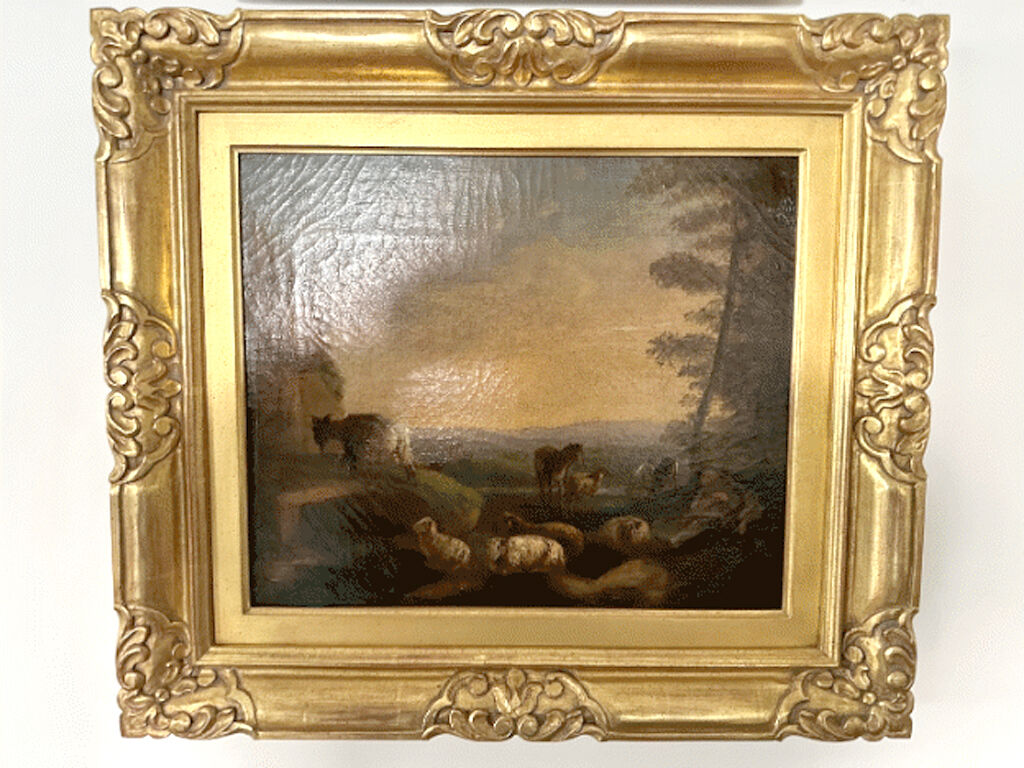
Joseph Bonaparte (1768-1844) was the oldest brother of Napoleon Bonaparte. After Napoleon became Emperor of the French in 1804, he made Joseph first King of Naples (1806-1808) and then King of Spain (1808-1813). After Napoleon lost the Battle of Waterloo on June 18, 1815, Joseph escaped to the United States.
He eventually made his way to New Jersey and built a lavish chateau in Bordentown, New Jersey. He furnished his chateau with the finest mahogany furniture and other empire-style furnishings. He also decorated his palatial estate with the largest art collection in America.
This private collection of over 200 paintings included works by Rembrandt, Rubens, David, Titian and Vandyke.
Today visitors can see some of his European paintings on display at the Bordentown Historical Society’s Joseph Bonaparte Exhibit. One such painting is the pastoral landscape of a resting shepherd with his flock which epitomizes 17th century Dutch landscape painting (at right). Warm golden rays illuminate the panoramic landscape creating dramatic dabs of light that delicately feature sheep, goats and cattle, as a sleeping shepherd lies in the shade.
This oil on canvas painting brings to mind the works by the famed Dutch Golden Age painter Pieter Wouwerman and is most likely by the hand of one of his gifted apprentices.
After gaining independence from Spain in the 17th century, the Dutch Republic became one of the greatest economic powers in Europe. During this period, now known as the Dutch Golden Age (1588-1672), the Dutch expanded their colonial empire to Africa, Southeast Asia, and South America, and established a global trade network for imported luxury goods, including porcelains, textiles, and spices.
Cosmopolitan cities, like Amsterdam, Leiden, and The Hague, were increasingly populated by wealthy bankers and merchants who profited from this international trade. Dutch artists responded to the demands of this new class of patrons by painting portraits, still lifes, and seascapes, all representing the riches of the Dutch maritime empire. They also produced genre paintings, highlighting the virtues and vices of humanity. These intimate scenes of everyday life in the Netherlands are alternately somber, sentimental, and humorous, informed by Dutch Protestant ideals.
The Dutch Golden Age was short-lived. In the 18th century, England and France grew more powerful, and the Dutch Republic’s global influence gradually waned. Yet the paintings of this period represented the height of artistic achievement in Northern Europe, and they were widely collected across the continent in the following centuries.