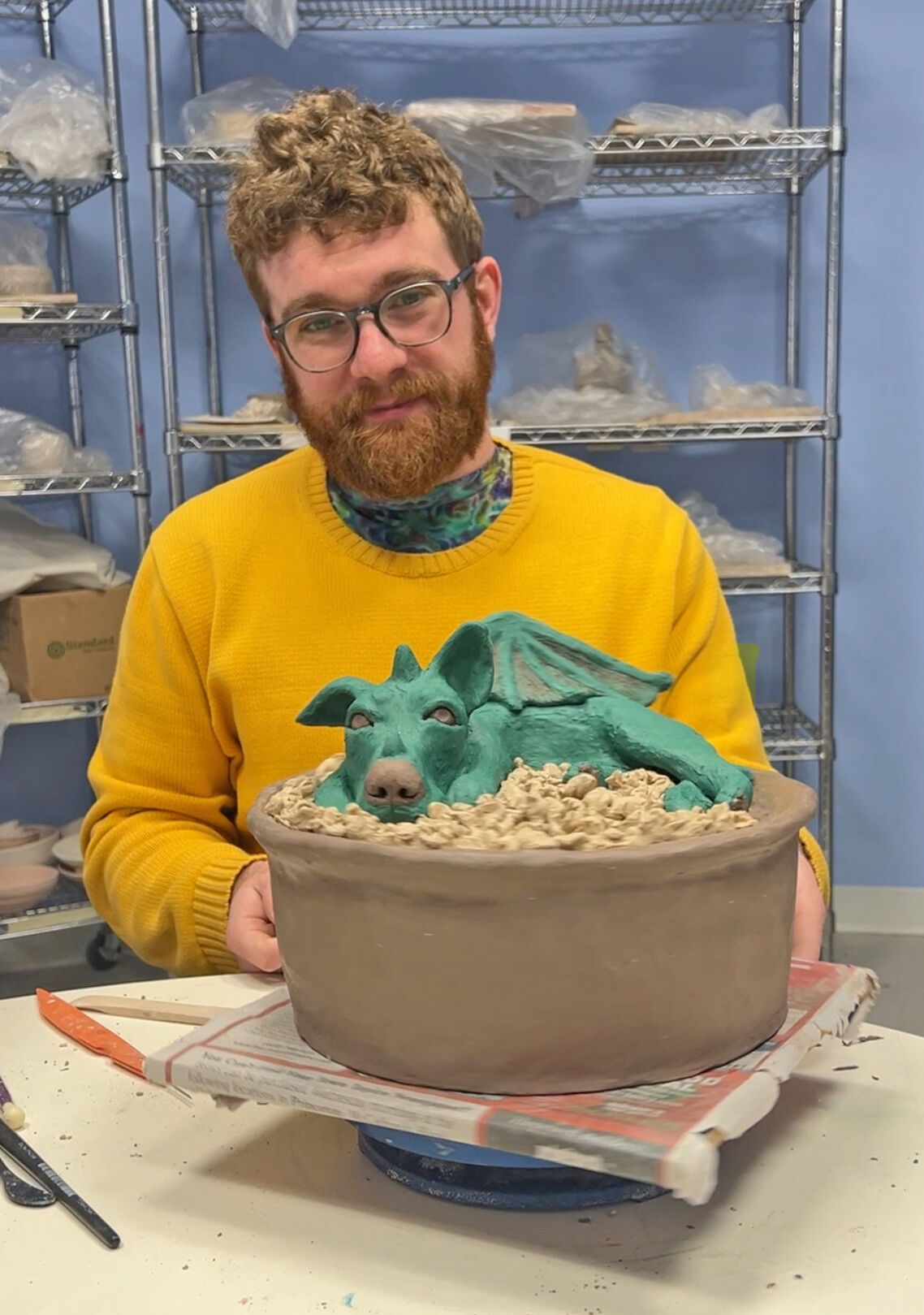
Victor Bell’s “Dogoyles” aren’t just sculptures; they’re symbols of loyalty, protection, and second chances. As the artist-in-residence at the Arts Council of Princeton (ACP), Bell is using his unique creations to promote animal rescue. Through his work, Bell hopes to prove that all things — dogs and ideas alike — can find new life with the right care.
Bell’s residency at the ACP provides him with the space and opportunity to share his creative vision with the community. Through workshops and hands-on demonstrations, he invites others to explore their creative spark.
“The Arts Council is constantly having events that are purely just for the community to come together and learn new things and meet new people,” says Bell. “It’s an awesome place for people of all ages to learn and create.”
Founded in 1967, the ACP, a nonprofit organization, continues to make art accessible to everyone in its community. From hands-on classes to rotating exhibits, the Arts Council fosters an environment where creativity can flourish. Supported by donations and grants, the organization ensures that everyone — regardless of background and experience — can explore the transformative power of artistic expression.
Bell’s connection to the Arts Council began long before his residency. Growing up in Princeton, he spent time at ACP, exploring different artistic mediums and refining his skills. “I learned how to sculpt at the Arts Council,” said Bell, reflecting on the space that played a key role in his creative development.
Creativity was always a part of his life: His mother, an artist, and his father, an inventor, nurtured his imagination from an early age. With their support, he learned to see the world through both an artistic and innovative lens. He graduated from Rowan University in 2019 with a bachelor of science in management information systems. He took a single ceramics class but did not envision a future in art.
“I work for my family’s small business and, until recently, I did not consider myself to be much of an artist,” Bell said in an interview with ACP. “About three years ago, I got my hands back into clay and I am so grateful. I started taking beginner ceramics classes at the Arts Council, where I found a passion for sculpting dogs.” He also hones his sculpture sills at Mud Matters, a studio in New York City.
Now, as artist-in-residence, he has come full circle, using the same space that once fueled his creativity to inspire others.
The Anne Reeves Artist-in-Residence Program, launched in 2009, gives artists the opportunity to develop new work while engaging with the community. Named after Anne Reeves, ACP’s longtime executive director and leading advocate for the local arts scene, the program invites artists from various disciplines to create projects that connect with the public.
Over the years, residents of the program have contributed murals, public sculptures, and other community-driven initiatives. By providing artists like Victor Bell with the time, space, and resources to explore their craft, the residency program fosters both artistic growth and public interaction, strengthening the bond between art and community.
Maria Evans, ACP’s artistic director, understands the impact the program and its residents has on Princeton. “The community gets to meet people and work with people that they may never have crossed paths with.”
The ACP’s mission of “building community through the arts” comes to life through projects that foster connection, storytelling, and shared experiences. Evans shared the story of an artist who was able to give back to the community he grew up in.
“Marlon Davila, who did that mural on the corner of Leigh Avenue and John Street, actually grew up in that neighborhood. He lived half a block away from the wall that he made into a mural. While he was painting that mural, many classes from the Community Park School came over and visited him. They would help him paint and listen to his story.”
These projects, and many others, highlight how the community not only supports the arts but actively participates in them — coming together to celebrate creativity and the stories that make Princeton unique.
This deep connection between artists and the community is exactly what makes the ACP’s residency program so impactful. By blending personal storytelling with public engagement, each artist brings something unique to the town’s cultural landscape. Victor Bell is no exception: Through his Dogoyle sculptures, he not only showcases his creativity but also uses his work to inspire conversations about rescue animals.
“The idea of Dogoyles came to life because I was thinking of the magic that my dog exudes and wanted to capture it, so I gave my sculptures wings and dragon-like colors and features,” says Bell. “I also chose to incorporate gargoyles because they are supposed to ward off bad energy. So, these sculptures kind of do the same thing, where they protect a space.”
As part of the community engagement for Bell’s project, these sculptures will be placed in several small businesses around Princeton. “I chose places that I have memories at and I feel that people will connect with,” Bell says.
Bell says he hopes that when people encounter his Dogoyle sculptures, they feel a sense of joy. “I want people to have joy from my art on sites that bring joy to the town,” he says.
By placing his work in community spaces, he encourages people to consider adopting a pet or exploring their interest in art. Princeton Garden Theatre, Small World Coffee, Community Park Pool, Conte’s, Princeton Record Exchange, Labyrinth Books, JaZams, Princeton Public Library, Bent Spoon, Hoagie Haven, SAVE, and the Arts Council will host a total of 12 Dogoyles from late May through September.
In addition to sparking joy and creativity, Bell’s Dogoyles will also serve a greater purpose: connecting people directly to animal rescue efforts. Each sculpture will feature a QR code linking to SAVE, a local animal rescue organization dedicated to finding homes for shelter dogs. This partnership merges the two things Bell is most passionate about: art and rescuing animals.
When people admire Bell’s work, he hopes not only to illicit joy but also spark a sense of purpose. The playful sculptures are meant to serve as a reminder of the many rescue dogs in need of homes. For Bell, art is more than just expression, it’s a way to inspire action.
Bell’s passion for rescue animals isn’t just reflected in his art; it’s deeply personal. His commitment to advocating for adoption comes from his own experiences with rescue animals, shaping both his work and his mission.
Rescue animals are more than just pets to Bell; they are family. His two rescue dogs, Penny and Dibz, have shown him the pure, unconditional love that animals bring into our lives. “They taught us the pure love we all share,” Bell says. Beyond companionship, he credits dogs for deepening people’s connections to nature, reminding them of the simple joys of being outside, going on walks, and appreciating the world around them.
Penny and Dibz share an inseparable bond — Bell jokingly refers to them as “married” because of how much they love each other. “Every day they teach us patience and kindness,” says Bell. “A dog will never do you wrong if you do them right.”
Bell strives to capture the same love and loyalty he experiences with his own rescue dogs in each Dogoyle he creates. “I try to capture the expression and gesture that a dog gives,” he explains. One of the most fascinating details he incorporates is the small muscle above a dog’s eyes — something wolves don’t have — that helps them communicate with humans. “It’s purely to make their eyes look pure and have us feed them, which is pretty awesome if you think about it,” Bell says.
This natural connection between dogs and people is what he hopes to reflect in his sculptures. More than just playful figures, his Dogoyles embody the way dogs try to communicate with us, forming a bond that is both instinctual and deeply emotional.
While Bell’s Dogoyles capture the warmth and connection of rescue dogs, bringing them to life is no easy task. Sculpting each piece is a time-intensive process, requiring patience and precision to shape their expressive faces and playful stances. The lack of dedicated studio space at the ACP also presents a challenge, forcing Bell to adapt and work within limited areas. “I have to make a lot of dogs in a short amount of time,” Bell says. “I’ve got to stay at the Arts Council pretty late to make them.”
Finding a workspace has long been a challenge for the Arts Council, as its building serves many purpose — from hosting classes and workshops to community events. “Probably one of the biggest challenges is maybe the lack of an established studio space,” says Maria Evans. “Our building is really multi-use, and we try our best to give a resident their own space in which to work. But it’s really hard because our rooms are constantly changing over.”
Artists like Bell find ways to make it work, adapting to the ever-changing space while still creating meaningful.
Another special aspect of the ACP is the opportunity for artists to collaborate and receive valuable feedback from their peers.
“All the awesome artists give great input, and I love having people around to show the art to and have them give me their thoughts,” says Bell. The residency gives emerging artists like Bell the ability to create around more experienced artists.
Bell hopes to continue to grow this project beyond Princeton, bringing its message of rescue and companionship to other communities. For him, these sculptures represent something deeply meaningful. “Owning a dog is magical, so I hope to bring that magic to other places and have people share their feelings,” Bell says.
Beyond promoting dog adoption, Bell says he hopes his project inspires people to embrace their own creativity. Bell wants others to see that creativity isn’t limited to professional artists, he hopes to spark that sense of possibility in others, encouraging them to explore their imagination and turn their own visions into reality.
“I hope that people realize that they can make anything with their hands and with their minds,” he said. “If they imagine something, it can come to reality.”
More information: www.artscouncilofprinceton.org.