When most people think about economics, they think about supply and demand, the allocation of scarce resources, and the behaviors of consumers and markets. For retired Princeton University labor economics professor Orley Ashenfelter, wine is also on that list.
Last fall at the inaugural New Jersey Wine Exposition at the former Bell Labs campus in Holmdel, Ashenfelter gave an enlightening interview about the American Association of Wine Economists, an association he helped found in 2006. The meeting/festival, organized by the Garden State Wine Growers’ Association, brought together nearly every vineyard in New Jersey.
Ashenfelter, raised in the San Diego area by a mother who was a nurse and father who worked blue collar jobs in the aircraft industry, said his fascination with all things wine-related didn’t begin until he was well underway teaching labor economics at Princeton. He earned his undergraduate degree in economics from Claremont College in California and came to Princeton in 1964 to attend graduate school, earning his PhD in 1970. He has remained at Princeton for most of the last five decades and transferred to emeritus status in July, 2024.
As for the American Association of Wine Economists (AAWE), “there are lots of academics involved,” Ashenfelter explained recently by phone. “We taste wines and present papers and publish a journal. The online journal has no paywall anymore, so you can take a look at anything you want.”
The AAWE website, wine-economics.org, is “the one place where all these books about wine are reviewed. There are also a lot of movies about wine, and we review those too,” Ashenfelter explained. Officers in the group include Ashenfelter as well as also Robert Stavins, professor of energy and economics at Harvard; Karl Storchmann, professor of economics at New York University; and Kym Anderson, an economist specializing in trade policy from the University of Adelaide in Australia.
Papers presented at the annual conference — this year’s take place in late June in San Luis Obispo, California — “are mostly about all the different aspects of wine, and one of the big ones: wine is what you call an experience good — you don’t know what it’s actually like until you open it — you can’t just look at it and figure it all out. One of the things we’re constantly fascinated by is rating systems and the ability to predict how and what are going to be good ones before you actually taste them,” he explained. Whether one buys a bottle of wine for $12 or $92, “you don’t know what it’s going to taste like; you have to rely on what someone else tells you, so one of the things about wine that we constantly examine is the use of ratings.”
Curious to know more? There are three podcasts visitors can access on the AAWE website that explain the business of wine ratings.
Another big topic for discussion is climate change.
“Grapes are extremely sensitive to climate, so climate change is a constant subject of discussion; how you adapt to it, do you grow different grapes, do you put them in different places in the vineyard, and so forth,” he said.
Pressed for a revelatory moment that sparked his nearly lifelong passion for and fascination with wine, Ashenfelter said he was several years into teaching economics at Princeton when he had an epiphany one day in 1973.
“A lot of people who get interested in wine have an epiphany,” he said. “Somebody gave a bottle of red Bordeaux wine to my father-in-law, and he didn’t like it. He opened it and gave it to me. That was the start of it all,” he recalled.
“It was a red Bordeaux from the 1960s; I don’t remember what it was exactly, but suddenly, I realized, not all red wine is the same!”
“I got so interested in all of it, but I couldn’t afford anything that was very good. I tried to find an angle, and what came of all of that was, I realized the Bordeaux wines are not so interesting when they’re young, but they become much more interesting when they get older.”
But how does one know which are going to be the good vintages?
“I discovered you can figure out the good vintages because of the weather patterns for that year. It’s the weather variability from year to year that basically determines how much the vintages can vary,” he said.
“It varies in how ripe the fruit is, how ripe the vines are, and how concentrated they are,” he said, adding that grapes grown during a dry growing season generally produce wines that are exceptional. So what may be a bad year for the vegetable and fruit farmers in New Jersey can be a very good year for wine growers and makers.
Last year’s very dry summer and fall, he said, “was probably the best vintage growing season we’ve had in New Jersey since 2010. Many good wines should be produced from the 2024 growing season, as all that dryness and heat results in some very high quality grapes. High quality grapes produce superior wine. Those New Jersey wines won’t be available until 2026, Ashenfelter noted, “but they will be quite extraordinary.”
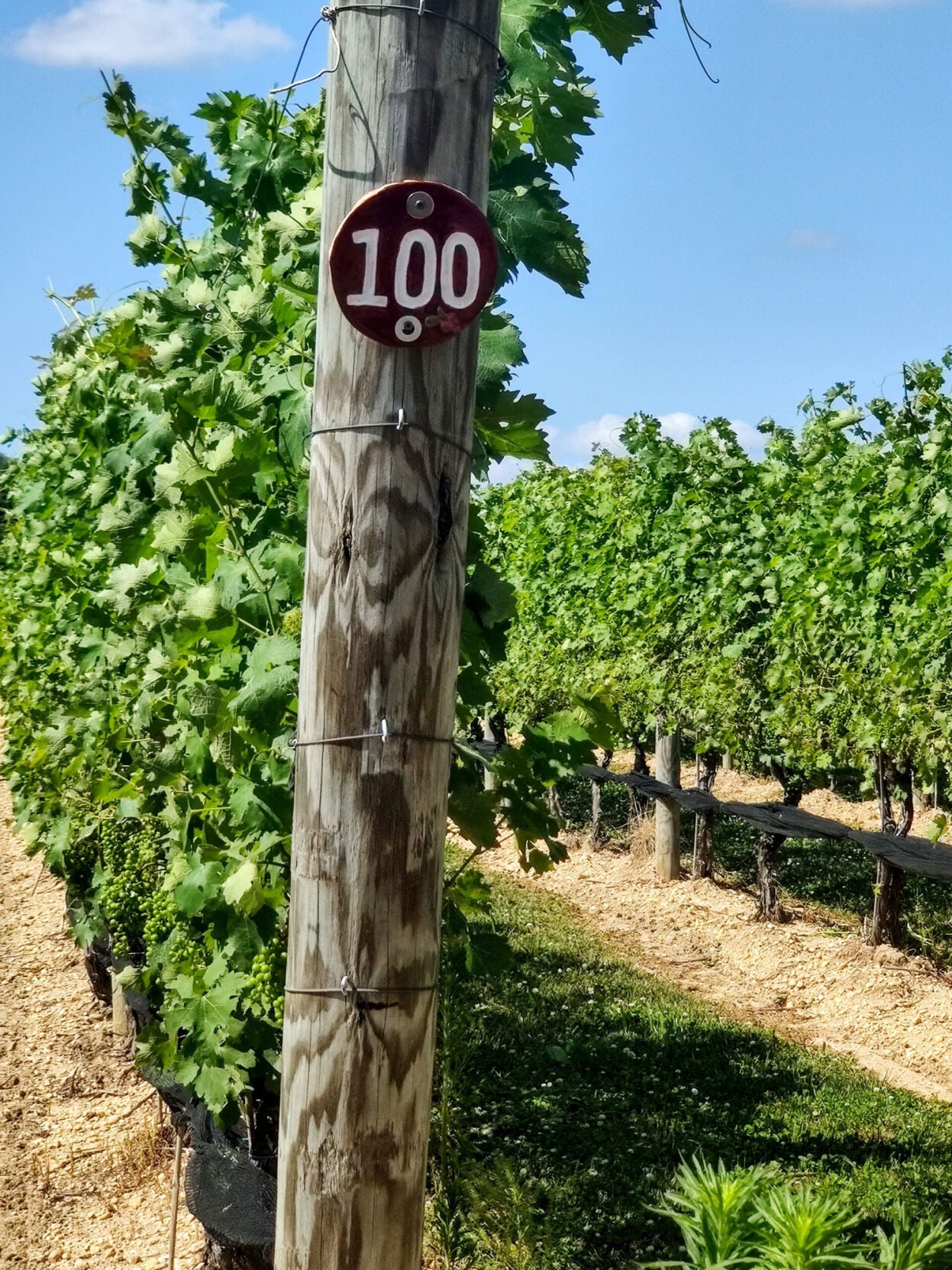
About a decade ago in 2016, after years of tasting wines and reading about what makes for good wine and traveling around the world for good wines, and attending conferences with like-minded people, Ashenfelter, now a spry 82, took the plunge and began growing his own grapes on a simple 12-acre piece of flat land near Vineland, in Cumberland County.
His frequent trips to his “vineyard” in Vineland to look after his petite Bordeaux grapes keeps him active in his retirement. His wife, Virginia, died in 2018. She taught math at Stuart Country Day School and then became a real estate agent, selling houses around Princeton in the boom years of the 1980s and ’90s.
Petite Bordeaux translates in English to “little green thing,” he said, “and that’s what the grapes are, they’re little green grapes. They are little green grapes for the longest time and then, finally, they change color.”
He freely admits his vineyard near Vineland “is way more that I can look after on my own, so I have a couple of guys that work with me. There’s a vineyard management company in South Jersey now called VineTech, and they do the maintenance for me much of the time.”
Ashenfelter notes VineTech’s services are in demand at vineyards around the Garden State, in the Hammonton-Vineland corridor where the soils are sandier, and in the northwest corner of the state where different types of grapes grow more easily. There are now at least 90 wineries or grape growing operations currently farming in New Jersey.
Asked about mentors, he cited specifically a Vineland-based retired oncologist — whose relatives were vegetable farmers from Italy — Dr. Larry Coia.
“He remains very influential and he has been involved for years with so many aspects of the wine industry here in New Jersey,” Ashenfelter said. Coia began growing his own grapes while still attending medical school in a small vineyard in front of his father’s farm house.
“He decided when he retired he was going to grow more grapes, and he’s grown grapes since the 1970s. He has vintages that go back to the 1976, so he’s very knowledgeable,” Ashenfelter said. Coia, also one of the movers and shakers behind creating the Outer Coastal Plain Vineyard Association, recently introduced a new grape from Italy called San Marco.
“In general, he’s been a great mentor for me.”
Now, with more than five decades of serious wine studies under his belt, what has Ashenfelter learned? What’s most important to impress upon others new to wine appreciation?
For one thing, wine is much more complicated in so many ways than producing beer or spirits. For another, there are more than 5,000 vineyards now in the United States and right about 90 vineyards in the Garden State. In recent years, California has lost vineyards while New Jersey has seen an increase in its number of vineyards.
Most of all, “I finally got to understand that there are very interesting good grapes and wines grown in many different parts of the world that you wouldn’t normally think would be good.”
“Finally, in my old age, I realized I shouldn’t be so snobbish about it and try what they have to offer. You shouldn’t be snobbish about wines that grown in a particular area! You don’t know, they often are very good.”
After all, many of us of a certain age remember former Gov. Thomas H. Kean doing New Jersey travel and tourism TV commercials in the 1980s declaring, “We’re fourth in wine production!”
For years, New Jersey wines had an image problem. Now, according to Rutgers Cooperative Extension Agricultural Agent Gary Pavlis and other wine experts at Rutgers, Princeton, and at the Outer Coastal Plain Vineyard Association, Garden State wines are ranked right up with the finest wines other parts of the world.
“I was on a road trip recently from Texas to Los Angeles. Of course we stopped in New Mexico. We discovered they make some very good wines in New Mexico, but it’s very difficult to get people in New Mexico to understand that. They don’t know that, so they tend to buy wines from California, even though if they bought the local ones they’d be very happy.”
The same thing applies to a decades old perception problem with New Jersey wines. That’s rapidly becoming a thing of the past now, as the Garden State Winegrowers’ Association puts more marketing dollars behind award-winning New Jersey wines.
Ashenfelter agrees with Rutgers’ Pavlis about his current assessment of the New Jersey wine industry, that we’re already there, competing and winning wine competitions around the U.S. and Europe. Ashenfelter is excited about several new wineries that have sprouted up in south Jersey, including Saddlehill in Voorhees, which also has a large restaurant, and other newer facilities in Hammonton as well as Beneduce Vineyards in Hunterdon County.
“We are now making wines here in New Jersey that competes with the best wines from France, Spain, Italy, and California.”
For more information on Ashenfelter Vineyards, visit www.ashenfeltervineyards.com.
Vineyards & Wineries
Angelico Winery, 20 Hamp Road, Lambertville. Open Wednesday, Thursday, Friday, and Sunday, noon to 5 p.m.; and Saturday, noon to 6 p.m. angelicowinery.com.
Cream Ridge Winery, 145 Route 539, Cream Ridge. Open Sunday through Thursday, noon to 5 p.m.; Friday and Saturday, noon to 6 p.m. creamridgewinery.com.
Hopewell Valley Vineyards, 46 Yard Road, Pennington. Open Monday through Thursday, 11 a.m. to 3 p.m.; Friday and Saturday, noon to 9 p.m.; Sunday, 1 to 6 p.m. hopewellvalleyvineyards.com.
Laurita Winery, 85 Archertown Road, New Egypt. Open Thursday to Saturday, noon to 9 p.m.; Sunday, noon to 6 p.m. lauritawinery.com.
Old York Cellars, 80 Old York Road, Ringoes. Open Wednesday, noon to 7 p.m.; Thursday, noon to 8 p.m. ; Friday, noon to 9 p.m.; Saturday, 11:30 a.m. to 8 p.m.; Sunday, 11:30 a.m. to 7 p.m. oldyorkcellars.com.
Terhune Orchards, 330 Cold Soil Road, Lawrence. Winery open Saturdays and Sundays, noon to 5 p.m. terhuneorchards.com.
Unionville Vineyards, 9 Rocktown Road, Ringoes. Open daily noon to 5 p.m. unionvillevineyards.com.
Working Dog Winery, 610 Windsor Perrineville Road, Hightstown Open Thursday, 2 to 8 p.m.; Friday, noon to 8 p.m.; Saturday Sunday, 11 a.m. to 6 p.m. workingdogwinerynj.com.

Orley Ashenfelter in Scudder Plaza on the Princeton campus. ,