If this 400-year-old G.P Maggini violin has a memory, could it ever recall playing music like this?
This will certainly be an interesting incarnation for the instrument if Grammy-nominated violinist Tessa Lark has anything to do with it. The music of Bach, Mozart, Belgian composer Eugene-Auguste Ysaye and other classical geniuses will come through its strings, but there will be lots of American roots music played on the Maggini as well.
Consider the sounds on Lark’s most recent album, “The Stradgrass Sessions” (Firsthand Records, 2023), which features an all-star roster of collaborations and composers including bassist Edgar Meyer, pianist Jon Batiste, mandolinist Sierra Hull, and fiddler Michael Cleveland.
Selections from the album mix original compositions by Lark and friends, with a sonata by Ysaye, a handful of Bela Bartok’s violin duos arranged for violin and mandolin, and the premier recording of John Corigliano’s “STOMP.”
But through the entire album, there are melodic and harmonic lines that evoke the yearning tonalities of the Appalachian Mountains.
“This album is a snapshot of the way I live in music — diversely, organically, intimately, sometimes collaboratively, sometimes solitarily, always sincerely, and anywhere, be it a concert hall or home studio,” she says. “There’s fusion going on in my head all the time. That’s what life is, you’re informed by all your experiences.”
Lark will perform a solo recital including works from “The Stradgrass Sessions,” on Thursday, June 12, at Trinity Church in Princeton. The evening of music is part of the three-week long Princeton Festival, running June 6 through 21.
“Exploring Americana sounds via classical music is a story arc in a sense, about my life in music,” Lark says. “Bach used forms that were folk dances, Ysaye has a folksy flare in his music. There are many folk-inspired classical pieces, and (on the album and in performance) I supplement these with works of my own and traditional fiddle tunes.”
Many may not be familiar with Ysaye (1858-1931), but Lark has immersed herself in his works and notes that he is quite well known in the violin world.
“You might even say he has a cult following,” Lark says. “He was very successful in his life and made quite an impact in the United States.”
She says Ysaye is especially associated with the city of Cincinnati, which borders her home state of Kentucky.
“He was music director of the Cincinnati Symphony for a while, and that’s one thing that’s very interesting to me,” Lark says. “Ysaye was not just a violinist, but also a gifted composer and conductor and dear friend to a lot of (more prominent) musicians.”
Lark says it’s not difficult for her to shift between classical and American roots music. She is a highly acclaimed fiddler in the tradition of her native Kentucky, performing programs that include Appalachian and bluegrass music and inspiring composers to write for her. (Lark herself coined the term “Stradgrass” when, in 2015, she played bluegrass on a 1683 Stradivarius violin.)
She comes by this talent naturally, with close and extended family members loving and performing music throughout the years.
“My mom was in a bell choir, and all her siblings took piano lessons; my grandfather played fiddle as well,” Lark says. “There’s a love for music on both sides of my family, and the Scot-Irish connection is palpable.”
In addition, Lark’s father used to take her along to play in his gospel bluegrass group, Narrow Road, as a child.
“When I was about 8 or 9, we’d go to different churches on Sundays, and that was a big influence on me,” she says, speaking from her part-time home in the Williamsburg section of Brooklyn. “I played a little mandolin, just basic chords but enough to strum along with my dad. I loved those gigs and got a feel for what it’s like being in a bluegrass band.”
It wasn’t always the violin that Lark had her heart set on: she really wanted to play piano. In fact, it was on a toy piano where she first explored sound, picking out favorite songs on the radio and playing them by ear. Her parents began to realize that young Tessa had a knack for music.
“I took some piano lessons as a teen,” she says. “I also took cello for a while. I am a music nerd — I’ll play anything I can get my hands on. But violin is the only instrument I formally studied, beginning with the Suzuki method (at age 6, with Catherine McGlasson). My parents have said that I declared myself a violinist when I was 7 years old.”
“There was always classical music playing in the house, it was kind of the soundtrack of my childhood,” Lark adds, noting Hilary Hahn, James Ehnes, Maxim Vengerov, Itzhak Perlman, and David Oistrakh as major influences.
Lark made her concert debut at age 16, playing Mozart’s Violin Concerto Number 3 in G, with the Cincinnati Symphony. She was accepted into Cincinnati College-Conservatory of Music’s Starling Preparatory Strings Project where she studied privately with Kurt Sassmannhaus.
Also at age 16, Lark was accepted into the New England Conservatory (NEC), where she completed her bachelor and master’s degrees. In addition, Lark attended the Juilliard School and studied in their Artist Diploma program until completion in 2017.
She has performed at recital venues and in festivals around the world, and she has appeared with such orchestras as the Royal Scottish National Orchestra, the Louisville Orchestra, the Stuttgart Philharmonic and the Indianapolis, Knoxville, and Seattle Symphonies.
As a chamber musician, she will continue to tour with her string trio project with composer-bassist Meyer and cellist Joshua Roman, to venues including Meany Hall, Seattle; Cal Performances Berkeley; WPAS in Washington, D.C.; and the Boston Celebrity Series.
Lark champions young aspiring artists and supports the next generation of musicians through her work as co-host/creative of NPR’s “From the Top,” the radio program that showcases some of the nation’s most talented up-and-coming musicians.
Her Grammy nomination in 2020 was for Best Classical Instrumental Solo for her recording of “Sky,” a violin concerto written for her by American composer Michael Torke.
Not being a violinist, this writer wondered if the Maggini can get the melancholy, keening sound you sometimes hear in bluegrass and Americana, or is it too elegant of an instrument?
“A lot of classical violinists need projection, but fiddle players can get away with darker tones that don’t project over an orchestra,” Lark explains. “This violin has the power to solo over an orchestra, but it also has a nice deep tone for the fiddle. I ‘met’ it in 2018 and it’s one of my favorites I’ve ever played. It’s a miraculous instrument, and it makes a mean fiddle.”
Tessa Lark’s Stradgrass Solo Recital, Princeton Festival, Trinity Church, 33 Mercer Street, Princeton. Thursday, June 12, 7 p.m. $35 to $50, half price ages 5-17. Post-concert reception, free and open to all concert attendees. 609-497-0020 or www.princetonsymphony.org.
Tessa Lark on the Web: www.tessalark.com.
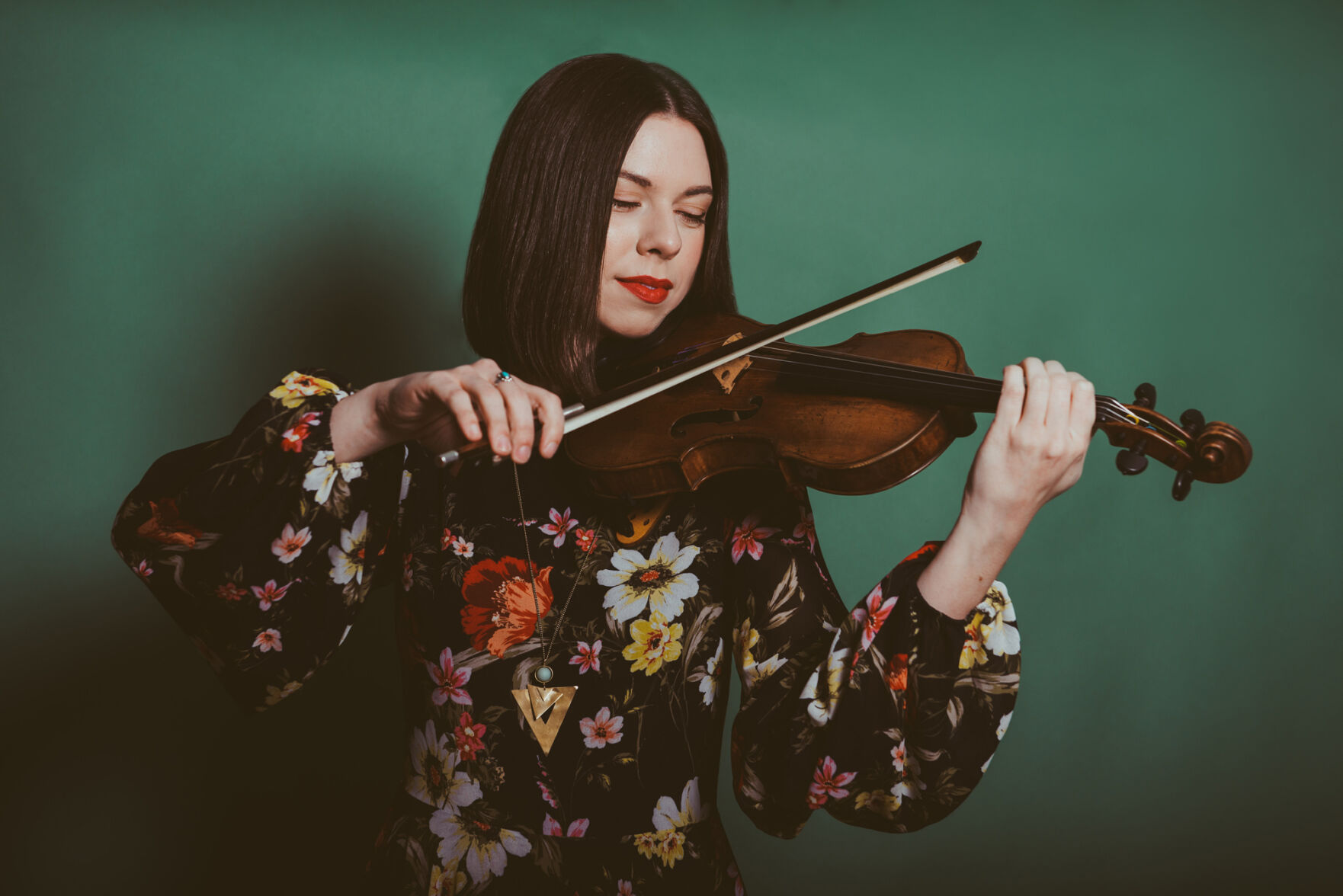
Tessa Lark performs at Trinity Church in Princeton as part of the Princeton Festival on Thursday, June 12. Photo by Lauren Desberg.,

