Francis Hopkinson (1737-1791) was one of five delegates from New Jersey that signed the Declaration of Independence. Although he is primarily remembered for this bold and decisive action during our country’s rebellious period with Great Britain, he exerted his talents in the fields of poetry, art, and music.
A chairman of Philadelphia’s Continental Navy Board, Hopkinson had talent as an artist that was favorably recognized by his constituents even as he devoted some of his attention formulating and designing the U.S. Navy flag, the U.S. flag, and the Great Seal of the United States. However, when he wrote to the Board of Admiralty requesting payment for his work in the unusual form of a “Quarter Cask of the public wine,” he was refused, based on the premise that other individuals were consulted as well.
Today, many historians are re-evaluating this decision and praising Hopkinson for his contributions to America with our international symbols.
As one of the country’s first composers, Hopkinson wrote many poems and essays to music, often satirical in nature. “The Battle of the Kegs” remains the most effective composition of propaganda against the tyranny of British rule during the Revolutionary War. Set to the tune of “Yankee Doodle Dandy,” the ballad dramatized the true tale of British ships firing on wooden kegs filled with gun powder that were floating in the icy Delaware River as the invaders occupied Philadelphia in early 1778.
The failed attack proved to be an embarrassment to the British government. By May, enemy troops were forcibly evacuated from the city, vowing retribution upon Hopkinson and the Bordentown participants that constructed the barrels. As the fleet set anchor upon the waterfront near Crosswicks Creek, they burned several ships and occupied flat-bottomed boats with armed soldiers to create mayhem in town.
The residence of Col. Joseph Borden, the son of the town’s namesake, was one of many homes purportedly targeted and set on fire. Across the road was the home of his son-in-law, Francis Hopkinson, and his daughter, Ann Borden. It was also slated for destruction, but spared by fate as a military officer appreciated the decorative beauty of the library.
However, it is said that the officer or another officer confiscated one or several of Hopkinson’s books. Fortunately, generations of the family held ownership of the property until 1915.
The Bordentown Historical Society is a proud caretaker of one of the known books from Hopkinson’s library: Poems on Several Occasions by Dr. Thomas Parnell, archdeacon of Clogher. The full leather book was published in Glasgow, Scotland in 1748, although earlier editions were published in London in 1721. The inside cover is furnished with an armorial bookplate etched with the name of the owner: Francis Hopkinson.
Thomas Parnell (1679-1718) was a scholar as well as a man of the cloth. Born and educated in Dublin, Ireland, he achieved his master’s degree from Trinity College in Dublin in 1700. Three years later, he was ordained a priest followed by his elevation to archdeacon of Clogher in 1706.
After the death of his young wife in 1712, Parnell spent more time writing essays regarding the value of life and creating poetry. The originality, displayed in his verses scattered with satirical wit, probably struck a chord with Hopkinson to some degree. Although we will never know for sure, what is certain is that we are left with an undeniable treasure from one of our nation’s Founding Fathers.
Doug Kiovsky is the vice president of the Bordentown Historical Society. For information about the society, call (609) 298-1740 or email bordentownhistoricalsociety@gmail.com.
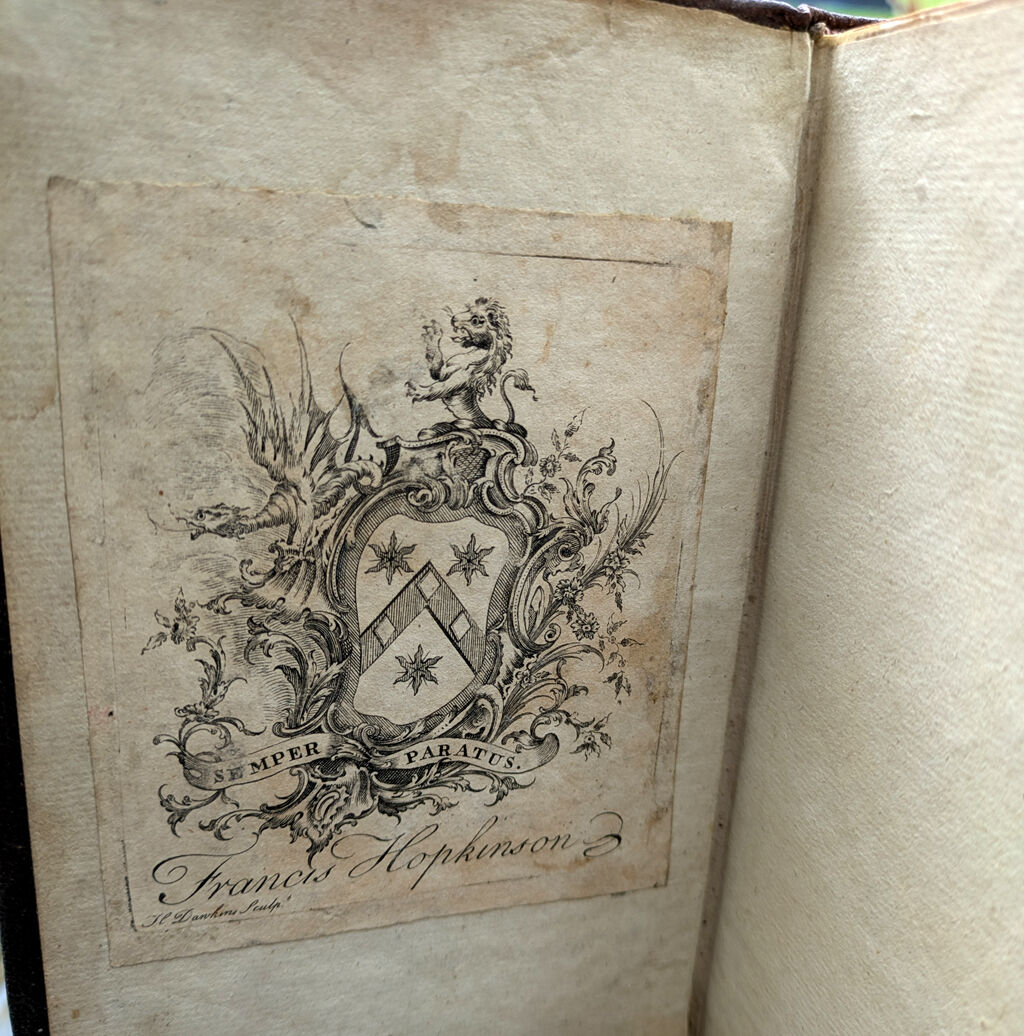
A bookplate reading “Francis Hopkinson” in a book of poems now in the possession of the Bordentown Historical Society.,

