The students are home and the campus is quiet — save for the usual summer din of construction — but Princeton University is still offering ample opportunity to learn this summer without ever stepping foot in a classroom.
Three campus galleries are offering visual food for thought with exhibits that highlight the interdisciplinary nature of higher education.
Ongoing in the atrium of the Friend Center is the 10th edition of the Art of Science exhibit, which celebrates expressions of creativity at the intersection of science and art. The current display, on view through the end of the 2025-’26 school year, features 32 still images and eight videos and animations from 80 creators including students, alumni, faculty, staff, and researchers.
“Art of Science spurs conversation among artists about the nature of art, opens scientists to new ways of ‘seeing’ their own research, and offers a lens through which the general public can engage with both art and science — two fields that for different reasons can feel inaccessible to the non-expert,” materials on the Art of Science website note.
“Powerful modeling and imaging tools now capture our world in novel ways and produce compelling visual artifacts, either by intention or serendipity. When considered through the lens of art, these works push our knowledge of the human experience, enhance and challenge our understanding of the natural world, and expand what we consider art and whom we think of as artists.”
Some examples of works in the exhibit include “Eyes As a Brush, Light As Paint,” by Isla Xi Han, a graduate student in architecture. A description of the work explains that it “used eye-tracking technology to transform the act of looking into physical prints. Recorded eye movements served as instructions for a custom-built machine that ‘printed’ their paths using ultraviolet light onto photosensitive fabric.”
“Enemy at the Gate,” by ecology and evolutionary biology graduate student Jixuan Zheng, shows a worker bee encountering a giant carpenter ant blocking its path back to its hive.
“Haiku Numbers,” by 2024 computer science and visual arts alumnus Luke Shannon, is a visual representation of all of the numbers small than 2^24 that are haikus — a poem with lines of five, seven, and five syllables — when spoken aloud in English.
All of the works can be viewed online as well as in person. For more information, visit artofsci.princeton.edu.
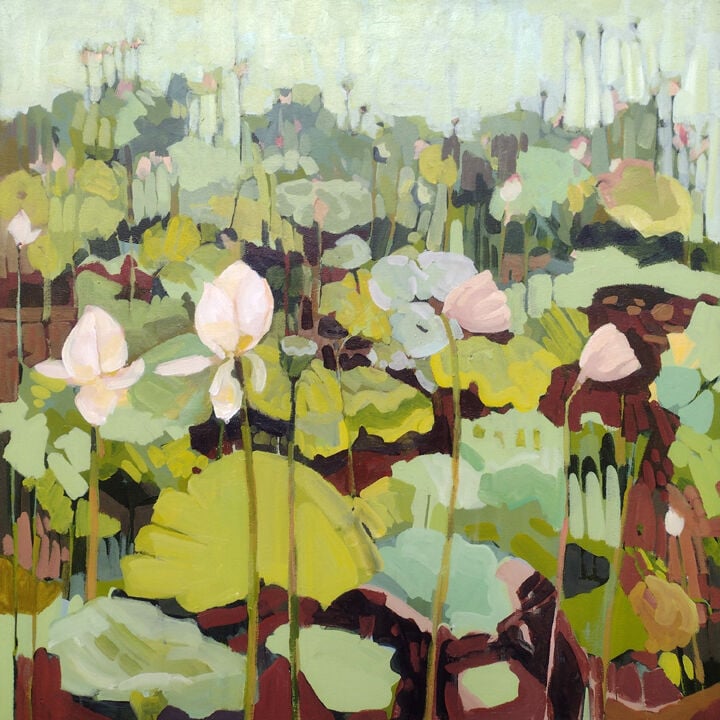
Extract/Abstract, an exhibit by Hamilton-based artist Léni Paquet-Morante opens in Princeton University Art Museum’s Art@Bainbridge gallery on Nassau Street on Saturday, July 19, and remains on view through Sunday, November 9. The exhibit, guest curated by Michael Quituisaca, a graduate student in the university’s Department of Art & Archaeology, features Paquet-Morante’s recent landscape paintings.
“Working across various media, including acrylic painting, ink drawing, and monoprints, the artist prioritizes abstraction through her use of bold colors, impressionistic mark-making, and unusual crops,” reads a description of the exhibit from the Princeton University Art Museum. “Fascinated by tide pools, streams, and other shallow water systems characteristic of the Northeast, Paquet-Morante extracts basic and salient elements from nature and emphasizes the effects of patterned light and atmosphere to bring forward the complex beauty of everyday scenery. Deconstructing and rearranging the physical landscape, these works showcase her interest in capturing multiple perspectives as well as the relationship of her practice to vision, illustration, and memory.”
Morante, in an interview with Community News last fall, described how her work has evolved in recent years. “My work five years ago was primarily making representational landscape paintings outdoors and that led to my interest in shallow water systems as muse,” she said. “I made hundreds of plein-air works, experimented in the studio, and developed confidence with painting. I was as interested in drawing storm drains as tide pools, and in working small as much as large. I’ve pursued a more interpretive landscape recently, to the point that I rarely worked outside in 2024. My practice now includes painting on canvas and paper, monoprints, ink drawing, and sculpture, for an interpretation of landscape and water systems.”
“I’m interested in the notion of landscape,” she continued, “where an intuitive combination of images come together like pieces of a dream or memory. I like to think of the work as an opportunity to think of landscape as one would still life, or language, with parts that can be rearranged, have new scale relationships, new hierarchies. And, importantly, I’m interested in the work presenting evidence of its formation process.”
Art@Bainbridge, Princeton University Art Museum, 158 Nassau Street. Open Monday through Saturday, 11 a.m. to 6 p.m., and Sunday, noon to 6 p.m. artmuseum.princeton.edu.
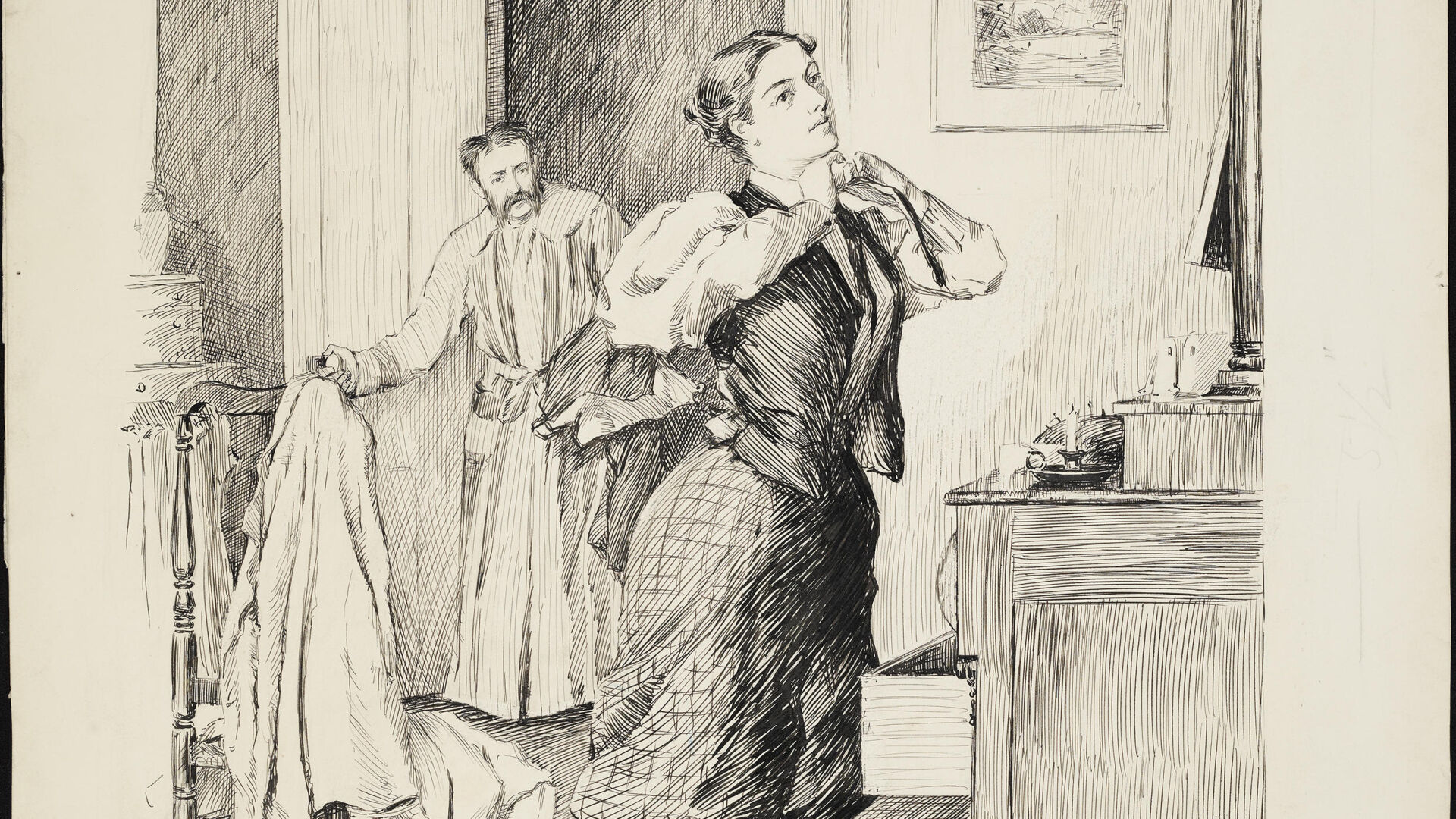
“Fashion, Feminism, and Fear: Clothing and Power in the 19th Century” opened in late June at the Mudd Manuscript Library and remains on view through March 31, 2026. Curated by Princeton University Library collections specialists, April Armstrong and Emma Paradies, the exhibit showcases cartoons from the late 19th century demonstrating the societal reaction to a seismic shift in fashion: the advent of women wearing pants.
“In the late 19th century, some women made the boldest, most bizarre fashion choice imaginable — they started wearing pants,” exhibit materials state. “These new costumes, whether pantaloons, bloomers, or knickerbockers, subverted long-held expectations and set the stage for the ‘New Woman’ to emerge. To some, including William H. Walker (1871-1938), women in pants became a symbolic representation of the end of the world as they knew it.”
Seeley G. Mudd Manuscript Library, 65 Olden Street. Summer hours Monday through Friday, 9 a.m. to 4:15 p.m., through August 22. library.princeton.edu/fashion-feminism-and-fear.
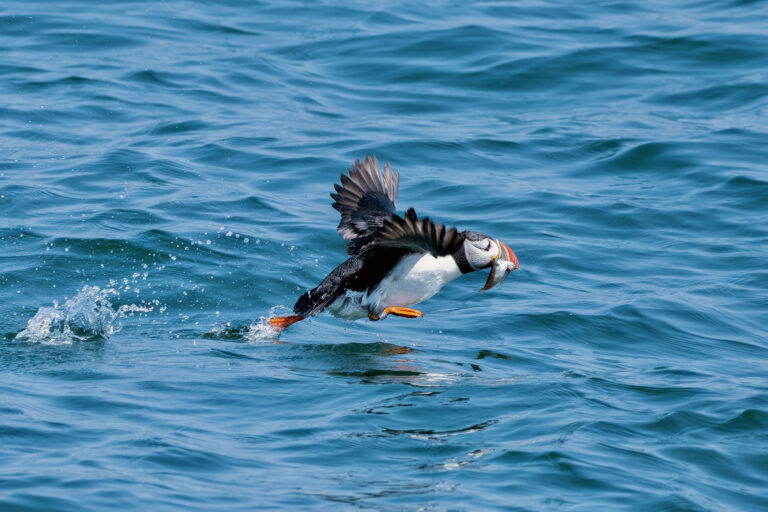
‘Atlantic Puffin: Wings of Resilience’ by computer science graduate student Yiming Zuo shows an Atlantic puffin taking flight with a fresh catch in its mouth. Conservation efforts along the Maine coast have brought the bird back from the brink of extinction.,