Simmering tensions over the future of Trenton Water Works boiled over this month as city leaders resisted mounting pressure to relinquish sole control of the troubled utility.
The state Department of Environmental Protection says the 200-year-old utility — serving more than 225,000 people in Trenton and four neighboring towns — is teetering on the brink of failure. Officials from the state and surrounding towns argue it must be restructured.
But city leaders, residents and water employees are pushing back, citing fears of lost autonomy, job security and community control.
TWW serves all of Trenton and Ewing, and portions of Hamilton, Lawrence and Hopewell townships.
The DEP has had a continuous presence at the plant since 2022 under a Unilateral Administrative Order, which gave the state temporary operational oversight.
The regionalization plan calls for the creation of a new public utility that would operate the system.
Each member municipality would be represented on the governing board, with voting power proportional to water usage — a model similar to the Ewing-Lawrence Sewage Authority.
DEP Commissioner Shawn LaTourette appeared before Trenton City Council on Aug. 18 to discuss TWW’s future. He pleaded with Trenton officials to approve a state-supported study of options with an eye toward regionalization.
The meeting descended into a fiery, emotional forum as council members accused LaTourette of strong-arming the city and dismissing their efforts to stabilize the utility.
Some of the reporting in this article is based on a video review of the meeting by the Ewing Observer, which was posted by the City of Trenton.
“This is personal for me,” Councilwoman Teska Frisby told the commissioner, defending the city’s minority workforce at the plant.
“You have beautiful Black people in here,” she said. “You have minorities in here. And they’re doing their things. These are top-notch quality, certified people. Why not empower us to maintain our water system?”
She added: “I don’t want this to feel like a Black Wall Street incident about to happen to us once again.”
“Black Wall Street” refers to the Greenwood District of Tulsa, Oklahoma in the early 20th century. Greenwood featured banks, hotels, theaters, newspapers, and numerous Black-owned shops, earning it the nickname as “Black Wall Street.”
In 1921, the area was devastated during the Tulsa Race Massacre, when white mobs attacked residents and burned the Black-owned busineses in the district.
LaTourette pushed back. “I recognize your passion, but I want to be abundantly clear on this point and for no one to mistake me. Compliance with the law is your obligation, not mine,” he said. “The problem here is not made better because over the last two years the DEP has been helping you.”
He added that the water system’s problem is “deeply systemic and structural. One might say it’s an outgrowth of systemic racism itself.”
“The problem with the decades of disinvestment, is that there is a hole dug so deep that you cannot get yourself out of it.”
LaTourette reiterated that the goal is “not to sell off TWW or to take it away from the City, but to help put it on a better footing.”
The commissioner cited years of state oversight, lawsuits and engineering reports showing that the city lacks the technical, managerial and financial capacity to maintain long-term compliance with water safety standards.
“The same cyclical problems arise, and it places the system at continued risk of catastrophic failure,” LaTourette said.
The regionalization plan
The push for regionalization began in earnest in January, when the mayors of Trenton, Ewing, Hamilton, Lawrence and Hopewell issued a joint statement calling the status quo “unsustainable.”
The mayors’ comments came after the DEP released two independent assessments: a Technical, Managerial and Financial Capacity evaluation by H2M Engineers and a 360° organizational review by Black & Veatch and American Public Infrastructure.
The assessments, funded by the state, concluded that Trenton Water Works is at “extremely high risk of systemic failure,” citing decades of underinvestment, poor staffing and political interference.
They support the creation of a new regional public utility to modernize the system, stabilize finances, and allow for professionalized, apolitical management.
“Creating a new public utility, with governance that allows for greater operational independence and collaboration across municipalities, is a necessary step forward,” the five mayors wrote.
Trenton Mayor Reed Gusciora has walked a fine line. While he joined the other mayors in supporting a regionalization study, he has repeatedly emphasized that Trenton should retain ownership unless suburban municipalities agree to fair terms.
“TWW is a vital public utility with a 220-year legacy of service,” Gusciora said in May. “Its future must reflect the best interests of those it serves.”
Gusciora added that Trenton’s acquisition of the water system in the 1850s was done through referendum and legislation, and any new governance model should reflect the same democratic process.
But City Council has so far resisted.
During the Aug. 18 meeting, Council Vice President Jasi-Mikae Edwards and Councilwoman Jenna Figueroa Kettenburg criticized the DEP for failing to include the council in earlier planning stages.
Others on the dais expressed skepticism about the financial and political motivations behind the push.
“This plan penalizes Trenton residents for failures that occurred under DEP watch,” said Councilwoman Figueroa Kettenburg. “Why now and why us?”
For its part, the water utility has planned to hold “H2Open” town hall-style forums in order to allow for more public input.
The meetings are scheduled at the Lawrence Township Senior Center on Thursday, Sept. 4, 6:30 p.m. and in Hopewell Township at Stony Brook Elementary School on Wednesday, Sept. 10, 7:30 p.m.
Meetings were also held in Trenton on Aug. 25, Ewing on Aug. 26, and Hamilton on Aug. 27.
Support for regionalization from surrounding towns has grown more assertive since the mayors issued their letter. Ewing Mayor Bert Steinmann said in April that the system’s structure is unsustainable and must be overhauled.
“This has to happen. It’s got to be regionalized,” Steinmann told the Ewing Observer. “The city cannot sustain Trenton Water Works the way it is structured today, and for a lot of reasons.”
He pointed to years of delayed capital work, such as the North Olden Avenue water main replacement in Ewing. Approved years ago, the project only resumed recently after council gridlock in Trenton delayed progress.
Steinmann said he has already begun working with Hamilton Mayor Jeff Martin and others to explore how governance, costs and oversight could be shared. He added that the burden would fall hardest on Trenton and Ewing, the only towns without alternate water sources.
“Lawrence, Hamilton and Hopewell have some options. Not great ones, but at least they have them. We don’t,” Steinmann said.
“We are now at a crossroads with Trenton Water Works,” said Martin in a July statement. “I remain hopeful that the city’s leadership will put the public health of 200,000 residents at the forefront of their decision-making process…. I remain ready to act to ensure everyone has reliably clean and safe drinking water.”
Grassroots pushback and a fight for control
A number of Trenton residents fear the city is on the verge of giving away a historic community asset.
A group called the “The Trentonians for Trenton Water Works Committee” says it has collected more than 4,000 signatures against any restructuring effort.
The group has blanketed city streets with billboards reading “Stop Regionalization” and “Stop Mayor Reed Gusciora.” They are holding public forums and urging council members not to yield to pressure from outsiders.
“To any parties or special interest groups who are advocating to take over the water works, we say the residents of Trenton will push back like we always have,” said Robin Vaughn, a former city councilwoman. “We will fight for the right to self-govern.”
Vaughn and others point to a 2010 referendum in which city residents rejected a proposed $80 million sale of the water works to New Jersey American Water by a 4-to-1 margin, despite a $1.2 million PR campaign in favor of the sale.
But not all Trenton resident — even those who supported voting against the sale of the utility in 2010 — are opposed to the idea of a regional utility taking control of TWW.
Jim Carlucci, a former Trenton resident who was involved the opposition to the sale in 2010, is now a supporter of regionalization of the utility.
“It was a real grassroots effort that succeeded, because people saw it for what it was—losing control of a vital resource,” Carlucci is quoted as saying in a July 15 article by the Jersey Vindicator.
But confidence in the city’s ability to manage TWW eroded quickly after the referendum, Carlucci said.
“The fact is, just months after working to stop the sale of TWW to American Water, I was part of a small group of people who proposed turning the Water Works into a regional utility,” Carlucci said in an email to Community News Service.
“And [I] feel even more strongly about it now, after 15 years of continued management and operational failures at TWW,” he said.
Another supporter of regionalization is Trenton resident Marc Leckington, who has created a website at trentonwaterworks.substack.com titled, “From the Mains of Trenton.”
The states that it is “dedicated to uncovering the truth behind one of the most urgent — and underreported — public health crises in New Jersey: the slow-motion collapse of Trenton Water Works.”
The site has articles with headlines like: “One Pump Away from Catastrophe,” “When Hostility Replaces Leadership,” and “Is Trenton Water Works Playing Games with Transparency?”
“This is not just a story about rusty pipes or government mismanagement,” the website states. “People’s health and safety — across Trenton and surrounding communities — is being put at risk by a failing utility, a paralyzed City Council, and a chronic lack of leadership.”
In an article titled “ Starving the Water System from the Inside,” Leckington claims that the City of Trenton is siphoning money out of the water system that could otherwise go toward solving its problems.
He cites a report released by the state that says starting in 2022 the City began a new practice of ‘charging’ TWW for services rendered on its behalf. That year, the internal transfer was $1.89 million. In 2023 it grew to $1.97 million.
“On top of that, the City continues to remove $2.65 million every year from TWW revenues to pad its general fund,” he said.
The article states that all totaled, more than $4.5 million is “siphoned out” annually. “To put that in perspective, TWW’s annual budget is about $57 million.”
$1 billion in repairs needed
Despite the recent rancor, few dispute the system’s needs. Officials say Trenton Water Works must undertake at least $1 billion in capital upgrades over the next 10 to 15 years.
These include lead line replacements, upgrades to the central pump station, electrical systems, and a federally noncompliant open-air reservoir.
A long-awaited rate study is underway and could lead to significant price hikes for all users. Trenton Water Works currently charges about a third of what private utilities in nearby towns charge per gallon.
DEP says the city’s inability to access low-interest financing is one of the many reasons a regional public utility would be a better model.
In a strongly worded letter dated July 29, Commissioner LaTourette laid out the DEP’s case in full. The document warned of “ongoing significant risks to water availability and public health” and demanded formal commitment from Trenton to participate in the regionalization study.
LaTourette described deteriorating conditions inside the plant, including “corroded, broken and deteriorating equipment,” makeshift tarp-covered electrical systems, and “standing water” near exposed wires.
He cited four single points of potential catastrophic failure: the filtration plant roof, central pump station, raw intake from the Delaware River, and the electrical system. Failure at any one of these, he said, could halt service to more than 200,000 people.
LaTourette said the DEP would reduce day-to-day operational support and instead pivot toward enforcement and compliance.
“While DEP’s regular presence at TWW over the last two years has helped improve short-term stability, it is plain to see that the status quo is not sustainable,” he wrote.
Following the meeting, TWW spokesman Michael Walker said,“We appreciate the time the Commissioner took to share his perspectives with the City Council, and we are grateful that he got to learn about how we feel with significant passion.”
What’s next?
Council President Yazminelly Gonzalez said the governing body would meet again to evaluate the proposals and testimony.
“We’re going to sort through what we found to be true and not true,” she said.
Councilwoman Jennifer Williams thanked city staff and the commissioner for enduring “four and a half hours on a Monday night.”
LaTourette urged continued involvement. “Engage in a process to design it,” he said. “If you don’t like how that process ends up, don’t vote for it.”
The council has not yet taken formal action. Meanwhile, suburban mayors are continuing to organize and apply pressure.
“I’m hoping to talk to the commissioner soon to see if he has any additional thoughts on it,” said Martin. “I’m hopeful he’ll call the mayors in again.”
Martin said one option is the towns’ lawsuit against Trenton and the TWW, which is currently on hold. He said that they have always preferred collaboration over litigation, but acknowledged that if no other solution emerges, they may pursue that path.
He said other possibilities remain on the table too, including Hamilton building its own water filtration plant or partnering with other municipalities to construct one jointly.
“Hamilton has a border with the Delaware River that we can do intake from, same as the city can,” he said. “Obviously that’s a huge up-front capital expense and not a preferred path forward in the short term. But it could be a viable option in the long term if that’s a route we need to start to explore too.”
For now, the stalemate continues — and so does the risk.
“The people of the greater Trenton area deserve nothing less than your full and unequivocal commitment to this effort,” LaTourette wrote to City officials in his July 29 letter.
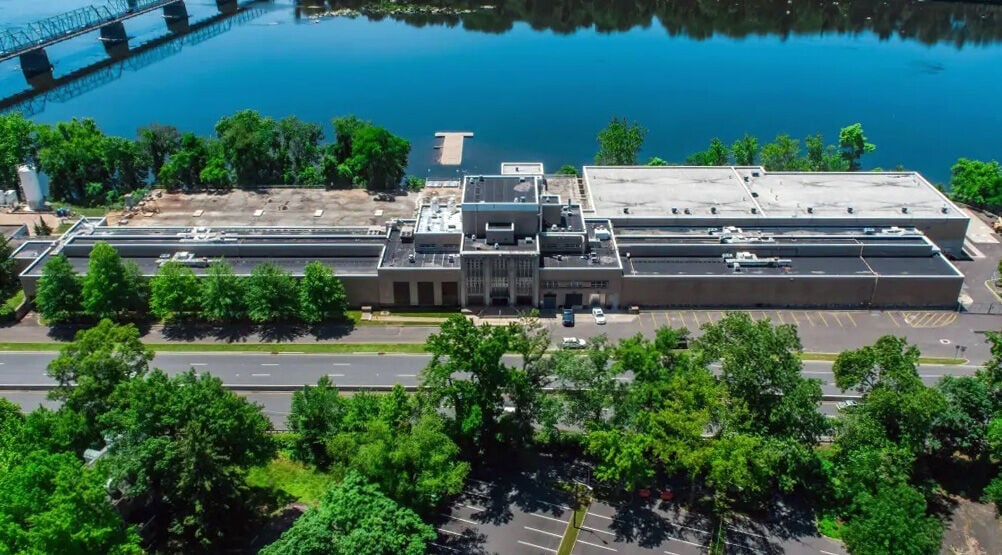
Trenton Water Works water filtration plant on the Delaware River. (Photo by Michael Walker courtesy of TWW.),

