There are two October Surprises for art lovers this fall.
Scheduled for the same weekend, the pair of events mix the art worlds of Trenton and Princeton and possess the art power to reverberate beyond the region, state, and nation.
One of the events is the Capital Philharmonic of New Jersey in Trenton’s October 25 world premiere of “Oh God … Beautiful Machine.”
The full-program concert features the music by Princeton University composer in residence Vince di Mura and a poetry text by Trenton-based Pulitzer Prize-winning poet Yusef Komunyakaa.
The work uses a symphonic orchestra, jazz ensemble, a women’s and children’s choirs, Chinese instrumentalists, and words to create a “love letter to the earth.””
As a statement from the CPNJ notes, “At the heart of this composition is Komunyakaa’s poetic vision — a reflection on environmental peril, resilience, and reverence for life on Earth.”
And that “the collaboration between di Mura and Komunyakaa has resulted in a masterwork that does not preach but instead calls for gratitude and awareness.”
The title is taken from the following line written by the poet, “Oh, God, what a beautiful machine/ all this breathing ivory/Speaking to the world.”
The use of the word “ivory” suggests how the piece reverberates. The word’s multiple references include both a prized product gleaned from elephant slaughter and a playful euphonism for piano keys.
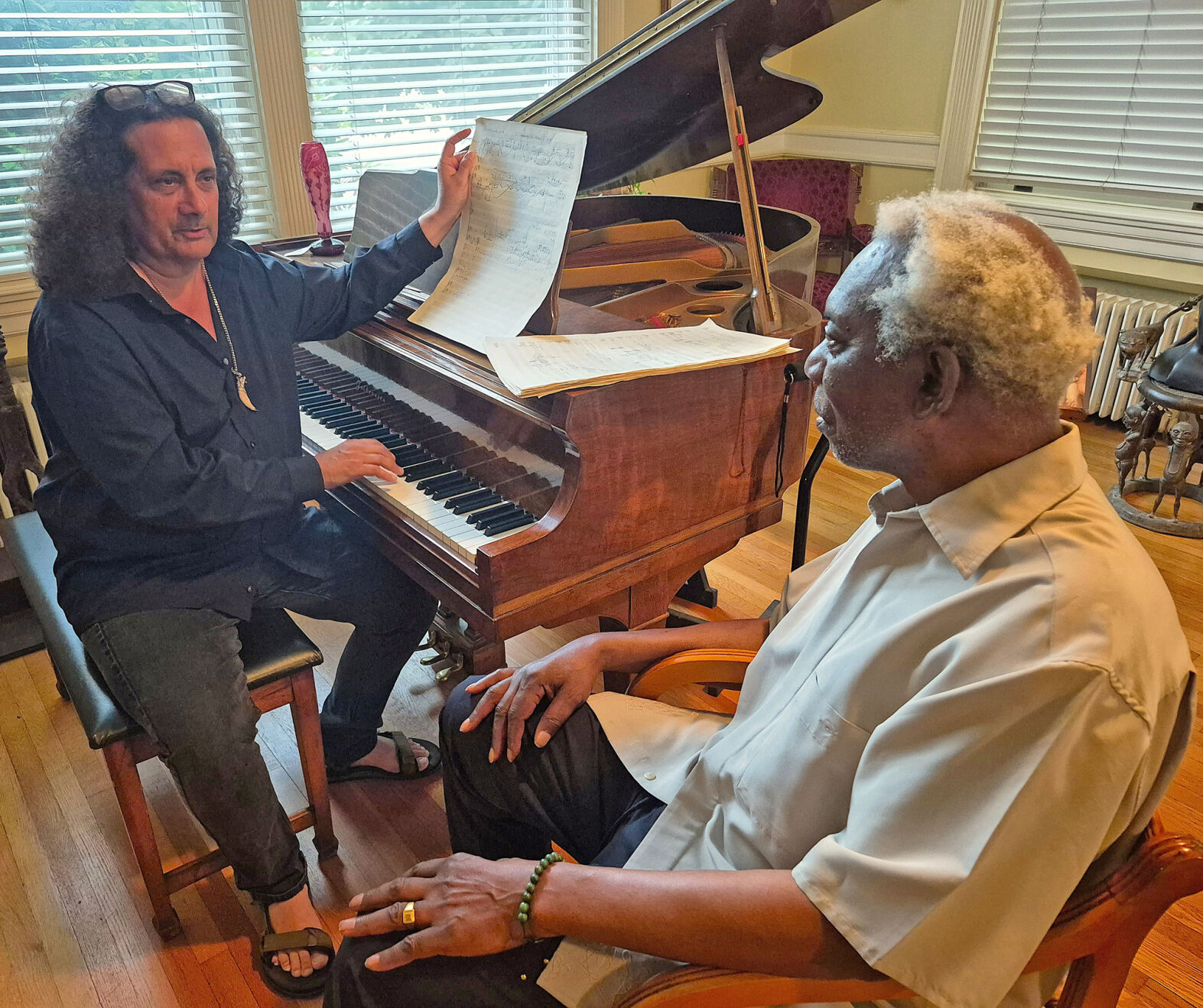
During an interview at the poet’s home, the two collaborators, speaking as one, say their work is reflective on instances of climate change and aimed to promote awe, hence the evocation in the title.
The spark for the approximately 90-minute opus started when di Mura was inspired to create music based on Komunyakaa’s poem, “A Song of Buffalo Grass.”
The work that reflects on the slaughter of buffalos evokes music in the opening: “As wind sang through the grass.” By the end of the 13-line poem readers encounter cowboys who cannot “talk mercy or speak of love.”
Komunyakaa and di Mura say the actual 19th century American accounts of such slaughters provided a path from past to present day phenomena.
Mentioning his interest in the work, di Mura talks about a need to honor nature.
That need turned to a conversation between the two artists and soon engaged the two in what Komunyakaa calls a “beckoning.”
It was one that also called others, including the late Trenton-based arts collector, arts community organizer, and philanthropist Lawrence Hilton.
Others in the Trenton arts community also heard the call, and eventually The Lawrence Hilton Foundation commissioned the work for the Capital Philharmonic of New Jersey’s season opener at the War Memorial building in Trenton.
Both the composer and poet say the work is “a meditation on the interaction between human beings and nature – an interaction that can be benign, caring, abusive, and retaliatory.”
They also use the words “massive,” “important,” and “risky” to describe the work they have been obsessing over for the past year.
“It is all to honor the text,” says the composer about his varied and grand choices to provide the context for Komunyakaa’s “language-rich exploration of a universal phenomenon unfolding around us at this moment.”
Di Mura says his intent is also to make the music “accessible” and incorporate his many musical influences, ranging from the orchestral works of 19th century Romantic composer Gustav Mahler to rock to Broadway.
To reinforce that claim, di Mura points out that his resume includes his arrangement for “My Way. A Tribute to the Music of Frank Sinatra,” a show that has seen 1,200 productions since it was created in 2000.
“Oh God . . . Beautiful Machine” is one in a series of collaborations between di Mura and Komunyakaa that are also based in history.
One was “For Lost Words,” a concept album based on the poet’s works inspired by his service in Vietnam.
Another was “Echoes on the Great Migration,” inspired by the African American movement from the oppressive rural South to Northern cities in the decades before and after World War II.
That work was designed as a choreopoem, a theater approach that combines poetry, dance, and song. It was developed by internationally known Trenton-born artist Ntozake Shange, author of “For Colored Girls Who Have Considered Suicide/When the Rainbow is Enuf.”
Despite their different backgrounds and art forms, di Mura and Komunyakaa say it seems that something moved them to work on this piece.
Di Mura, 65, grew up in Middlesex, New Jersey. The son of a father who operated a body shop and hairstylist mother demonstrated an early aptitude for music that was supported by his parents.
Piano lessons led to more serious training at the French School of Music in Plainfield and the Manhattan School of Music, then graduate studies at Temple University
Trained in composition and classical approach to piano, Di Mura made a switch in his late 20s and turned to jazz and show music.
He initially worked playing music for community theater productions before joining nonprofit professional theaters in central New Jersey.
The North Brunswick resident joined Princeton University in 1987 and is now known as an internationally active composer, arranger, and jazz pianist.
Komunyakaa, 78, was born and raised in Bogalusa, Louisiana. The son of a Southern Baptist-raised carpenter, the poet says he learned the value of work and self-governing.
Inspired by the men in his family who had served in World War I and World War II and looking for his own path, Komunyakaa enlisted in the United States Army in 1968 and was sent to Vietnam in 1969.
There he was selected to work as a correspondent and later an editor for the military newspaper The Southern Cross and received a Bronze Star for his military journalism.
After leaving the military, he attended the University of Colorado, where he received a bachelor of arts in 1975 and discovered his ability as a writer. Within four years, he had earned a master’s from Colorado State University and self-published two books, “Dedications and Other Darkhorses” and “Lost in the Bonewheel Factory.”
He began using personal and blues music references from his early life in Louisiana in the 1984 volume “Copacetic.” Later, his experiences in Vietnam found their way into his critically lauded 1988 book, “Die Cai Dau.”
Komunyakaa received the Pulitzer Prize and the Kingsley Tufts Poetry Awards for his book “Neon Vernacular: New & Selected Poems 1977-1989.”
From 1985 to 1996, he taught English at Indiana University in Bloomington.
Prior to retiring recently from New York University, where he started in 2006, Komunyakaa joined the faculty of Princeton University in 1997 and purchased a house on West State Street in Trenton, where he resides.
The two collaborators met at Princeton University, where Di Mura says he was initially drawn to Komunyakaa’s poetry but connected deeper through their mutual interest in jazz and the blues.
It is no surprise that their new work draws on those musical styles.
“It’s based on the jazz format,” says di Mura about the shape of the new work. “We start with a statement, move to improvisation, and then back to statement.”
He adds that the work involves movements that pay homage to visionaries or “saints,” such as Paul Robeson, Herbie Hancock, and Carlos Santana, and threads styles ranging from Native American, Afro-Caribbean, Bossa Nova, and Mississippi Gospel.
However, most importantly, the work is infused with the sound and spirit of “The Blues.”
As di Mura explains in his Spotify series “Conversation with the Blues,” available on YouTube, the blues is an American sound born from African slaves and rooted in a three-chord musical progression.
Connecting it to jazz and rock-n-roll, he says “the blues is in our (musical) DNA.”
Komunyakaa calls the blues “the poetry of sound” and “language of music.”
Additionally, as he says in a past U.S. 1 interview, “The blues is political. We don’t think about the blues as political, but the blues musician could talk about things that were universal or public. And if not directly, through innuendo or signifying [a form of wordplay], which takes us back to the heart of folklore.”
Talking about his connection with the blues, Komunyakaa says, “(My) whole thing with the blues goes back to when I was five years old. I was listening to the music, but I was making up the words. I would make up the lyrics. It may have been my initiation to poetry. I didn’t know what I was doing, but I loved the musicality of language.”
Di Mura also got interested in the blues at a young age, crediting his older brother with introducing him to it. He also confesses to stealing a family member’s album by legendary blues singer B.B. King.
Jazz and Blues also formed the connection to Hilton, who was one of the prime movers making Trenton’s Candlelight Lounge a serious jazz destination (the series ended when the building was sold).
Hilton also was an important figure in the visual art world. In addition to operating his own galleries in Trenton, he has interacted with national and regional museums and is connected to the New Jersey State Museum’s noted collection of art by African Americans.
Calling the commission “an exciting development,” the CPNJ describes the concert as “the culmination of a vision commissioned by Larry Hilton, a devoted supporter of the arts in Trenton, whose sudden passing on July 2 has given us a bittersweet urgency to carry this project forward.”
In an early statement of intent by di Mura and Komunyakaa, they referred to the work as a “timely and worthy collaboration … [that] promises to be and seminal musical and social event, with far reaching effects. “
They also say that the work has a “diverse and eclectic sound.” One reflective of Trenton and New Jersey – a small but small but densely populated state with one of the most diverse populations in the world.
The premiere will be directed by Sebastian Grand, music director of the Delaware County Symphony, Youth Orchestra of Bucks County, and McLean Symphony, and assistant conductor of Bucks County Symphony.
The event includes a pre-concert festival with vendor tables, pre-concert talk with the composer, and a pre-concert performance.
O God…Beautiful Machine, Patriots Theater at the War Memorial, 1 Memorial Drive, Trenton. Saturday, October 25, 7:30 p.m. 800-514-3849 or www.capitalphilharmonic.org.
The other significant event occurring that same weekend is the Trenton City Museum’s exhibition “Mel Leipzig at 90,” featuring an overview of the nationally known Trenton-based artist.
That exhibition opens on Friday, October 24, continues through January 4, and marks a series of events celebrating Leipzig’s artistry, humanity, and cultural influence on the region – he taught thousands of art students through his 40-year tenure as an art professor at Mercer County Community College.
Leipzig is an artist who embraced a personal approach to realism during the ascendancy of abstract expressionism and pop art.
His persistent vision and discipline have resulted in his work now being part of important museum collections, including the Whitney Museum and American Academy of Arts and Letters in New York City, New Jersey State Museum and the Zimmerli Museum in New Jersey, and around the nation. He is also represented by Gallery Henoch in New York City.
In addition to training with important 20th century artists, such as Josef Albers, Neil Welliver, Morris Kantor, and James Brooks, he also boasts artistic interaction with important American artists and designers. That list includes Lois Dodd, Audrey Flack, Michael Graves, and Robert Venturi and Denise Scott Brown.
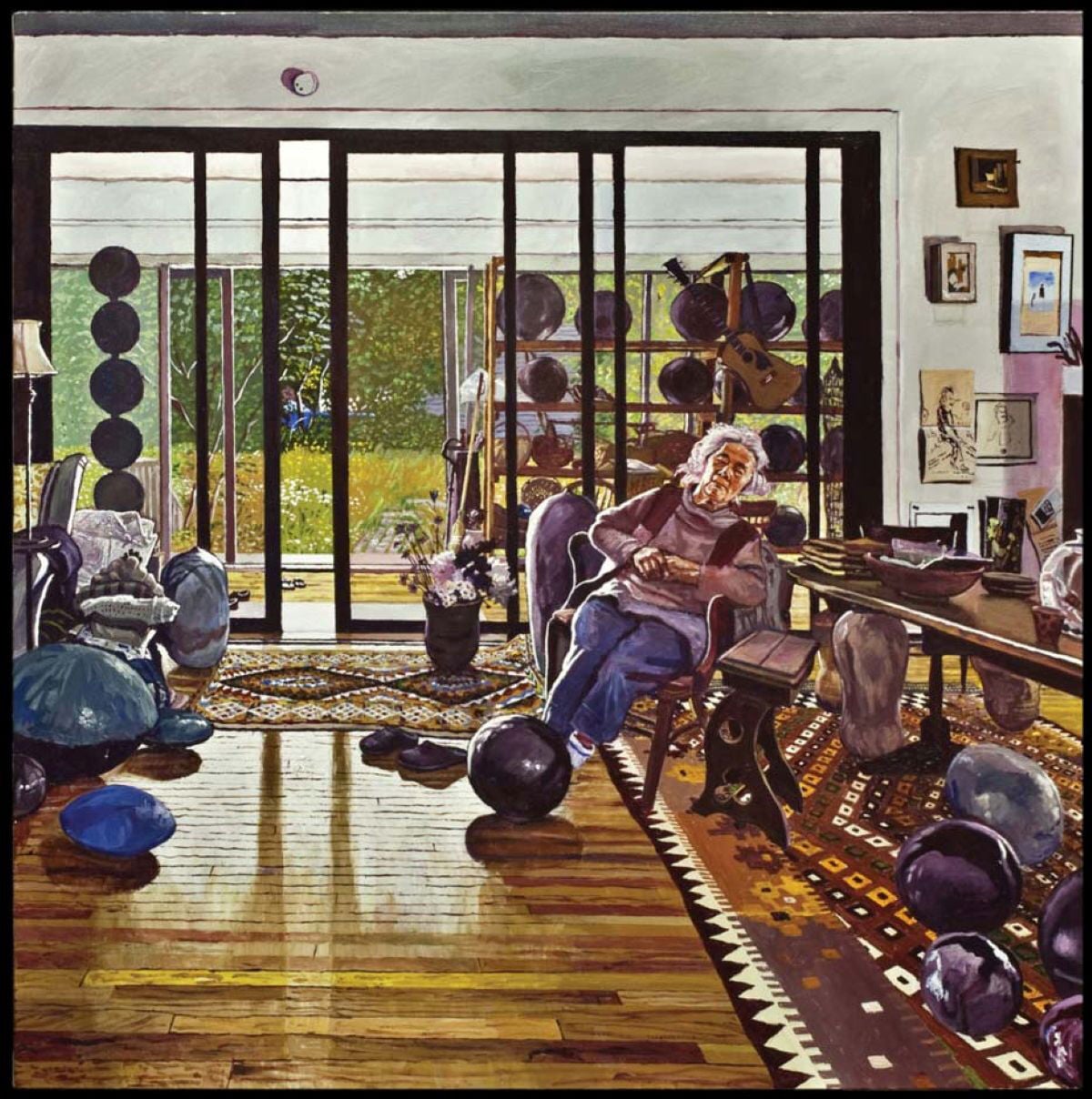
Also, in connection to another important fall event, Leipzig’s triptych of the late American ceramist Toshiko Takaezu will be on view with Takaezu’s work when the Princeton University Art Museum reopens on Friday, October 31.
The Trenton City Museum and subsequent exhibitions are designed to spotlight the artist’s development through various stages of his career – culminating in more than 500 paintings.
It is a path that starts with a disciplined adherence to traditional Western techniques and leads to an innovative and bolder style inspired by contemporary street artists.
As Leipzig says in a transcript from a conversation at Rider University, “When I first became interested in painting the figure realistically around 1970, I felt that my main compositional concern was integrating the figure with the background. And since I made a commitment to being a realist I thought that I should record as much realistic information as I could in both the figure and the background.”
As a model for several Leipzig paintings and an arts writer, I noted the following about Leipzig’s approach to approach in the introductory brochure for a 1985 solo exhibition at the New Jersey State Museum: “(Leipzig) explores a scene for possibilities, arrangements and variations, then records his decision in a sketch that clearly defines the ‘set’ to hold his still drama. The characters are then brought in (sometimes alone, sometimes in groups) into the actual physical scene and are encouraged to find that comfortable point between the environment and themselves. After examining the grouping for its design richness, he blocks some of his models until the composition is fully enhanced. Sometimes he records a model’s pose that he likes in a drawing, transfers it to scene already recorded and uses a cutout and searches with it on the drawing to find the perfect complement to the scene. Sometimes he uses the same model in different poses in the same painting, so if one looks closely at a work the same figure can be seen several times. Once the composition is made in drawings, a color sketch is completed and the work finally reaches the canvas.”
The approach resulted in a skill that one New York Times reviewer said exacted “precision, empathy and a volume of detail that would overwhelm a photograph.”
The empathy comes from his interest in human beings. As Leipzig wrote for one of his exhibitions, “I love painting people. And I like looking at people. All people. I don’t like the idea of having to paint ‘perfect’ or ‘ideal’ people. I like people who look like people, like real people.”
However, another New York Times critic focused on the artist’s approach. “Mr. Leipzig is a talented but idiosyncratic artist whose style can take a little getting used to. In addition to never working from photographs, since 1990 he has also been painting with a limited palette, in four colors: dark blue, dark red, yellow and white.
“I can understand his desire to work from sketches or in situ, but the limited palette is bizarre. For starters, it makes many of the paintings seem similar at first glance, which is never good for an artist. It also makes it difficult for Mr. Leipzig to achieve realistic flesh tones, especially since he uses acrylic paints, which tend to be much brighter and more intensely colorful than oils.
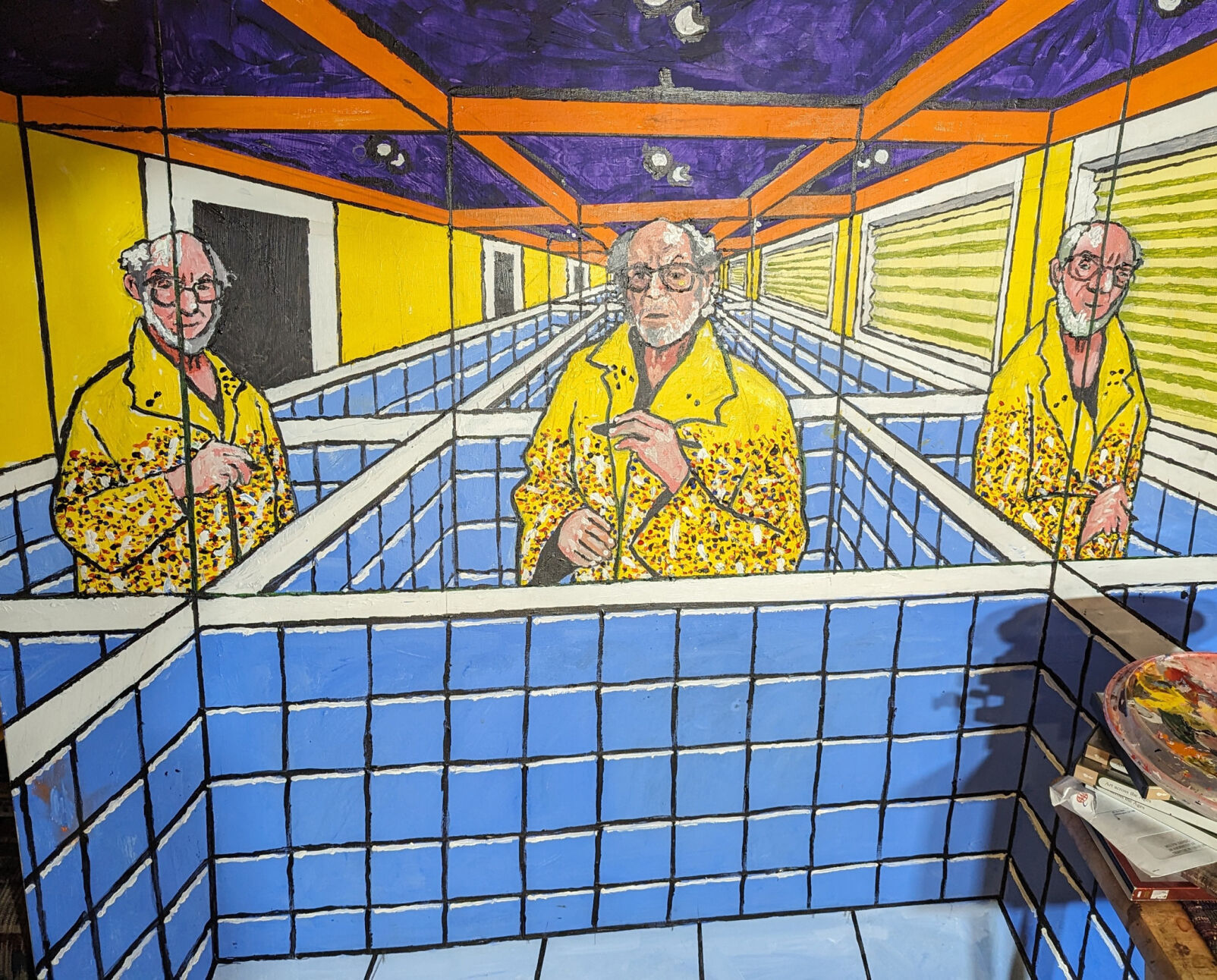
“But there is no doubting the freshness and immediacy of his best paintings; Mr. Leipzig in the last couple of years has achieved a peak in his art. He has become so confident that he has begun to play around with visual distortion, extending, twisting, or exaggerating the perspective of ceilings, walls or floors to create interesting visual effects.”
Then a change of approach and palette mark a new phase in the artist’s career.
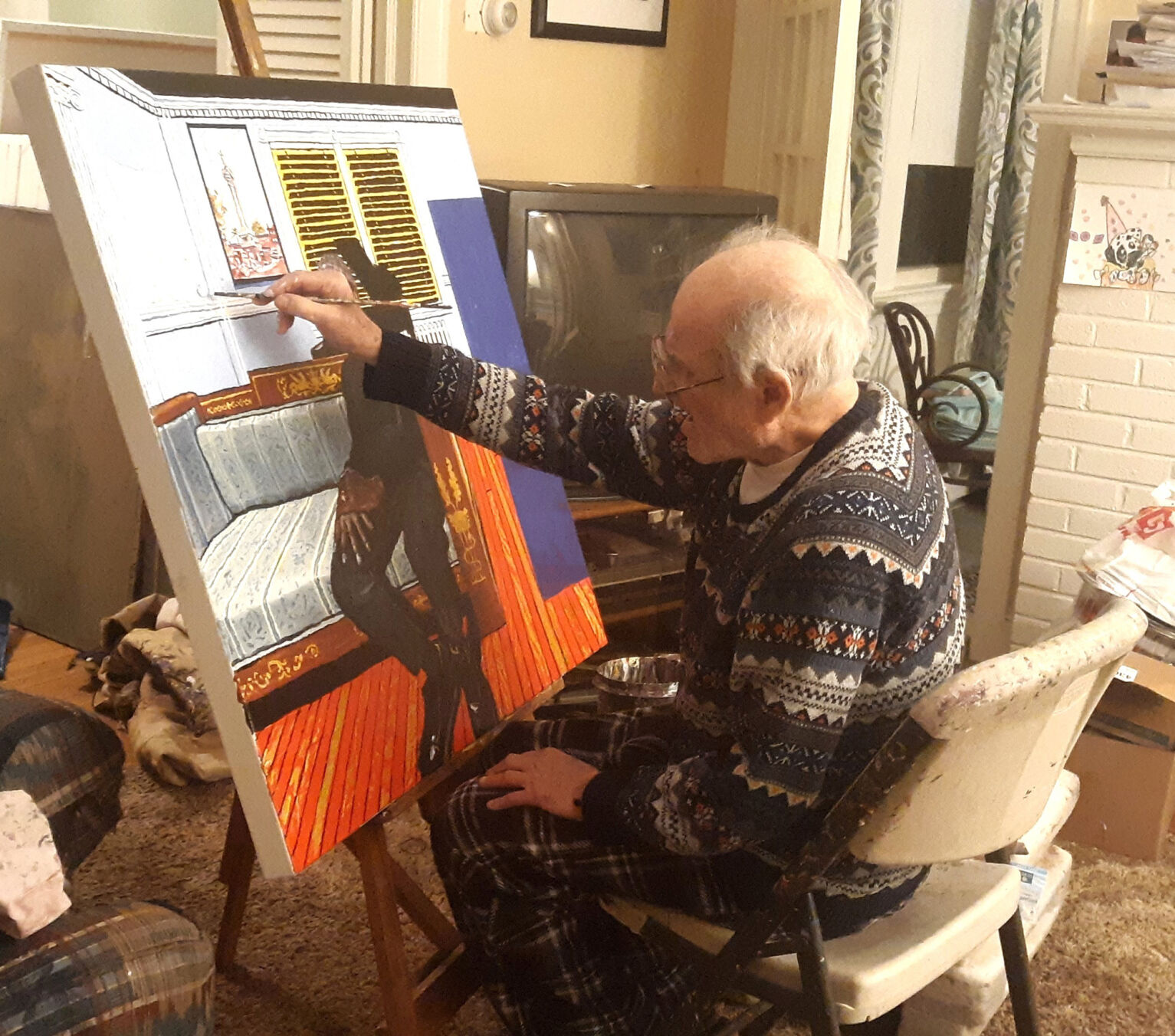
As he said during that Rider discussion, “Around 2005, I was doing a painting of my son, Joshua, and his girlfriend at the time, in an apartment they rented in Ewing. I realized that my son might all of a sudden say that he was moving. What was I to do with the painting, as I needed the background of the apartment? I decided to cut out doing a sketch and color study and go directly to the painting and just see what happens. I think my paintings became much more fluid by painting directly, without any studies. So I have continued with direct painting. I believe it made my paintings more fluid. Also in using that method I was able to do some large, complicated compositions.”
Additionally, he noted, “Since 1990, I limited my palette to four colors a dark red, a blue, a yellow and white. Margaret O’Reilly, who was the chief curator of fine arts and is now the director at the New Jersey State Museum, suggested I add the color black. Strong darks or blacks are important for me in structuring the space in my paintings. I prefer now to use black. However, since I use black I am using black outlines in my paintings. Also I am now using pure brilliant blue, red, and yellow in the backgrounds of many of my paintings. In that, I have been influenced by the work of the young graffiti artists of Trenton, who I have been painting as part of my ongoing Artists Series. You will notice that I have yellow, red and green skies in some of my paintings.”
While his past paintings had the artist visiting the subjects in their homes or offices, his most recent approach has been to invite artists to his home and model in his studio – aka his living room – with many posing on the same couch.
While he may modify the couch’s color and design, he stays focused on his core approach. “I paint the person first, because the person is the reason that I am doing the painting. And since the people I paint are not professional models, but persons with work schedules and often busy lives, I want to make sure that I am able to portray them on canvas. I imagine you could say that it is the human face that most captivates me.”
What Leipzig says in 1985 still holds today: “What I like about realism is that everything is open game. You can paint everything. It broadens you. “
However, he adds, “I don’t think an artist is always aware of why he’s doing things. What I do in composition is intuitive. Things that look poetic are practical. But all of a sudden art explains some things to yourself. That’s what Hopper said: ‘When I do my painting, my paintings tell me things about myself.’ Words really can’t express it. Sometimes you may have some feelings and the paintings can really capture those things.”
Leipzig also painted the above-mentioned Hilton, titled “Larry Hilton, Champion of African American Art.” That image will be used by the CPNJ and in the exhibition.
He also painted Komunyakaa and Vince di Mura.
Summing up his work, Leipzig is on record as saying, “I want people to want to look at my paintings and want to be drawn into them. My paintings don’t have any message. Except if I paint people realistically, I guess you could say that I am a humanist.
“Painting, as hard as it often can be, is very life giving,” he says about his commitment to his art. “I don’t know what I would do if I didn’t paint…just sit around?”
Beyond the Trenton City Museum exhibitions, there are several city-and regional celebrations are set. In addition to his works on view on the permanent collection of the New Jersey State Museum, Leipzig’s Graffiti and Tattoo Artists Paintings will be on view at the Trenton Free Public Library, December1 to February 21, and a exhibition of work by Leipzig and artists who trained with him will be on view at Mercer County Community College in West Windsor from January 12 to February 27. Other small exhibits and programs are also being developed.
Mel Leipzig at 90, Trenton City Museum, Ellarslie Mansion in Cadwalader Park, Trenton. Opening reception Friday, October 24. On view through January 4. Free. www.ellarslie.org.