When Lauren M. Gunderson’s play, “I And You,” premiered in 2013 at California’s Marin Theatre Company, it won the American Theater Critics Association New Play Award. Since then, almost 300 productions have been staged worldwide. That premiere was directed by Sarah Rasmussen, who is now McCarter Theatre’s artistic director. Naturally, Rasmussen is excited to direct the world premiere of “I & You: The Musical” at the McCarter Theatre from September 13 through October 12. Composer/lyricist Ari Afsar makes the transformation a true wonder of music and poetry.
The story of “I & You: The Musical” begins with an English project on Walt Whitman’s epic poem, “Song of Myself,” that causes teenagers Caroline and Anthony’s orbits to collide. Caroline, home-bound with a chronic illness, channels her anger through songwriting and social media. She’s resistant to Anthony, the model student and basketball player who knocks on her bedroom door to announce he’s her project partner for the assignment, of which she was unaware. Since it’s due the next day, they’re forced to pull an all-nighter, which alters them in ways they could never imagine.
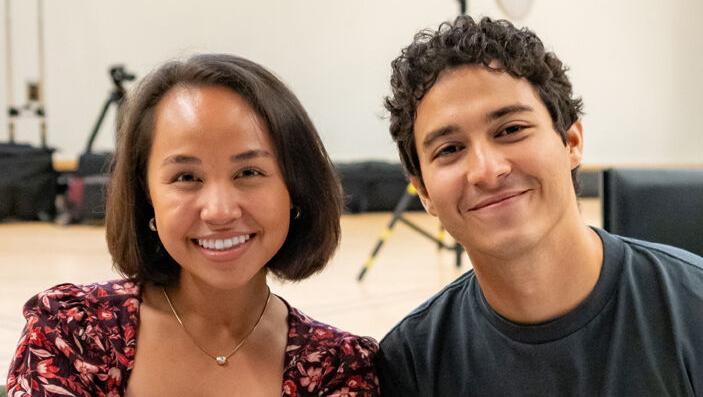
Jasmine Forsberg, who starred in the Broadway and national tour of “SIX,” has been cast as Caroline. Her Broadway credits also include “Stephen Sondheim’s Old Friends,” with Bernadette Peters and Lea Salonga, and “Here Lies Love.” Benji Santiago, who made his Broadway debut as Younger Noah in “The Notebook,” will play Anthony. Santiago also starred as Usnavi in “In the Heights” at The Muny. “Jasmine and Benji have unbelievably incredible voices — and illustrious careers as young artists. Not only are they Broadway stars, they have the warmth, humor, and mature depth of Caroline and Anthony,” says Rasmussen.
During the pandemic, Gunderson watched a virtual reading of her play by two actors known for their work in Broadway musicals. At that point she wondered what “I & You” would be like sung. “I love a small play that is actually very big, so this feels even more intimate to sing,” she says. “And it’s such a play full of feeling and nuance that music in some ways is wonderful and in some ways is very hard. It’s hard to be nuanced musically sometimes. It’s easy to say ‘I love you, I’m going to sing my heart out about it’ as opposed to doubt and curiosity. Music is perfect for those, but it’s a different kind of singing for a musical. And Ari has wowed us again with her ability to work this one.”
Gunderson says “again” because her first collaboration with Afsar was their musical “We Won’t Sleep,” originally titled “Jeannette,” about Jeannette Rankin, the first woman elected to Congress four years before the 19th amendment’s ratification. When they started collaborating on “I & You: The Musical” in 2022, Gunderson already had an outline for where the songs would go. “I didn’t know exactly how they would flow, that’s what we really discovered together. ‘I & You’ seems like a very simple story, but it is very detailed about what exactly happens to change these characters moment by moment … Every scene is a chess match that is so subtle and so specific about what is offered, what confession allows for another openness to occur, to fall into place.”
Whitman’s “Song of Myself” is central to Gunderson’s personal literary history. “For me in high school, a lot of it was about the freedom and rule-breaking of Whitman, ‘I just refuse to be in any sort of pentameter or meter or rhyme.’ That felt very nice to a 16-year-old Lauren who wanted to break all the rules too. And now I think it’s the humanity, the empathy, and the tenderness and hope of a lot of his writing that quenches a moral thirst in me.”
Transforming the play into a musical was such a natural step to take since “Whitman is so poetically musical in his form and content, but obviously aligning this to the characters was a big change,” says Gunderson. In the play, Caroline aspired to be a photographer. In the musical, she’s a songwriter who wants to go to New York to hone her talent. “She gets to use that as a way to talk a little bit more specifically about music, about what it is, the universal truth of it.”
As Anthony and Caroline explore the truths and mystery of Whitman’s poetry, we witness a metamorphosis of their relationship. If you’re looking for a spoiler as to the story’s ending, you won’t find it here, although Gunderson already knew the ending before she wrote it. That’s the beginning of her writing process. “I always like to know the ending, but ‘I & You’ taught me how effective that approach can be, because there’s no way that you accidentally get to the end of writing ‘I & You,’ and you’re like, ‘oh, that’s the twist, oh, fascinating.’ No, no, no. You have to know the twist and write towards it, because you have to earn it and plant little clues the whole time or else it doesn’t work.” Knowing the ending provides her a structure that also allows for “surprise and discovery along the way.”
Gunderson admits that “in some ways I gave Ari a rather monumental task to embrace Whitman as a co-lyricist. But she has found a beautiful way to do it and has her amazing history and education as a [vocal] jazz specialist. It’s perfect. Whitman and jazz are actually two amazing American traditions that speak nicely to each other.” Afsar is on the same frequency, saying that “the representation of an old soul of jazz is the way that I’ve interpreted Walt Whitman. The way Walt Whitman is being expressed in the music is through that genre.”
The challenge of writing songs using text from “Song of Myself” is its sprawling 52 stanzas of free verse, decidedly lacking the rhyme and meter typical of Whitman’s era. His avoidance of traditional poetic structure “is antithetical to especially musical theater rules of perfect rhymes,” says Afsar. She should know: her first professional role was as Cindy Lou Who in “Dr. Seuss’ How the Grinch Stole Christmas!” when she was 10, and she starred as Elizabeth Schuyler Hamilton in the Chicago production of “Hamilton.”
Afsar takes her cue from Anthony, who loves Whitman and jazz; she writes songs for him that are inspired by vocalese, a style in which “you take an instrumental solo and add words to it and then you sing it.” Her songwriting works in the opposite way “since the texts are there first and then it’s creating a vocalese. So it’s a nod to a vocalese. I introduce the melody of his texts in more of a solo approach, as if it was an instrumental solo.” She even uses whole verses, including Whitman’s preface to “Leaves of Grass,” in which the poet describes how to lead a meaningful life. “When Anthony sings Walt Whitman, it’s jazz,” as in the song “Dream with Me.” “I don’t know how to define it in a genre, I can describe it in feeling, earnest and raw and sweet. That’s the overarching feeling of him,” says Afsar.
“In this two-person musical it’s important for each character to have a distinctive sound,” she points out. Caroline’s favorite song is Jerry Lee Lewis’s “Great Balls of Fire.” To Afsar that “felt like her rage, and so what is the rage of today, and what does that sound like today for a young 17-year-old? She’s a punk singer-songwriter girl à la 90s angry style of music, which is very ‘in’ right now in today’s pop music.” Whereas Anthony talks about his obsession with Coltrane, “Caroline embodies music because she’s a songwriter. And the most vulnerable thing you can do as a songwriter is share your music,” says Afsar. When Caroline shares a song she’s written with Anthony, a new connection is forged.
The beauty of the music lies in the poetry of “Song of Myself”: “For every atom belonging to me as good belongs to you”— the third line of “Song of Myself” — is the seed of what Gunderson considers “one of the most beautiful songs in the show, called ‘Every Atom.’ It’s this repetitive melody that Ari’s put to that lyric in particular, so that is the core of the play in many ways.” Gunderson is especially fond of the song “Spotted Hawk,” which “has the most earwormy hook in the whole play because it’s the one I find myself bursting out [she sings ‘Spotted Hawk’ then laughs].” The spotted hawk is the bird to which the poem’s speaker famously compares himself in stanza 52: “I too am not a bit tamed, I too am untranslatable/I sound my barbaric yawp over the roofs of the world.” Caroline begins to understand Whitman when she sings that song.
Under the music direction of Sujin Kim-Ramsey, an offstage band will be backing the two actors. “Our wonderful set designer, [Tony Award-winner] Beowulf Boritt, was able to come over when we were doing a band workshop. That doesn’t usually happen, that the set designer gets to be immersed in the music and listen to it,” says Rasmussen. “We are in Caroline’s room for the setting, and we are making sure that it feels like hers and reflects the energy of what we learn about her through her music and through the book. We have a wonderful projection designer, Stefania Bulbarella, who will be doing some things with imagery in the songs in a way that people can watch it, like visual art, they can take away something different of what that means to them … We’re all on a ride together, but we’re all going to have our own experience of that.”
For Gunderson, different themes resonate in the musical. It’s about “unexpected connectivity — a deep root that connects way more of us than we often feel in a society that’s certainly now designed to embitter us and to question our understanding and respect for each other … it’s about unity, an ephemerality and a soulfulness that I want [everyone] to have. The plays that have meant the most to me tread into the arena of wonder, and this musical wants to do that the closer you get to the end. What could these two young people possibly have to say to a 50-year-old father or a 70-year-old grandmother, but the truth is our humanity doesn’t stop in terms of whatever age we are. We’re sharing a lot more than we think. It should be a good and healthy revelation that engenders the kind of empathy that theater does best, so I hope this musical does that. It’s also funny and loving, I want people to be delighted and laugh, and then cry and feel the universality in a human story.”
“I & You: The Musical,” the first commissioned work Rasmussen brings to the McCarter stage, is a co-production made possible by the Helen Gurley Brown BOLD Theater Ventures Fund, under the auspices of the Emily Mann LAB. In May 2026, Rasmussen will direct “I & You: The Musical” at Maryland’s Olney Theatre Center. After that? “We love the idea of taking this to Broadway,” says Gunderson. “I think we can make something spectacular and unique that would be quite at home and successful there.” However, she’d be just as happy if a production were done at her alma mater, Emory University.
I & You: The Musical, Berlind Theatre at McCarter, 91 University Place, Princeton. September 13 through October 12. www.mccarter.org or 609-258-2787.