A federal investigation into labor trafficking allegations at the BAPS Akshardham temple in Robbinsville has been closed, attorneys for the Hindu spiritual organization told a judge.
The decision clears the way for a civil lawsuit to move forward in court after nearly four years on hold.
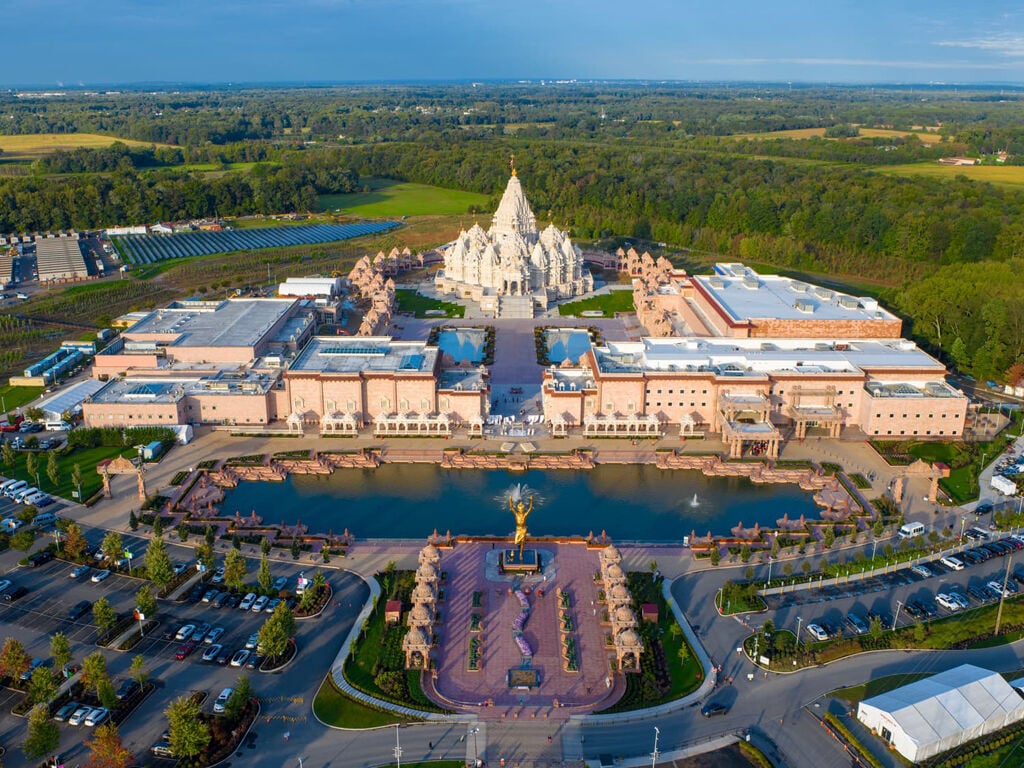
The BAPS temple, which celebrated its grand dedication opening ceremony in 2023, is the largest Hindu mandir in the Western Hemisphere, and the third-largest in the world.
In a letter dated Sept. 18, Paul J. Fishman, an attorney for BAPS, said the U.S. Department of Justice recently informed them it has ended its probe into the Bochasanwasi Shri Akshar Purushottam Swaminarayan Sanstha (BAPS) and its affiliates.
With the DOJ investigation now closed, the civil case will resume in federal court. BAPS attorneys said they will confer with opposing counsel to propose a schedule for the next phase of litigation, including a formal response to the plaintiffs’ amended complaint.
The DOJ had been investigating claims made by dozens of former workers who alleged they were recruited from India under religious visas, forced to work long hours on temple construction, and paid as little as $1.20 an hour.
The plaintiffs in the civil lawsuit, many of whom are from marginalized Dalit communities in India, filed their initial complaint in May 2021, the same day federal agents raided the Robbinsville temple complex.
Agents from the FBI and Homeland Security Investigations were involved in what became a highly publicized action. The lawsuit accused BAPS and its leaders of violating the federal Trafficking Victims Protection Act and the Fair Labor Standards Act.
Workers alleged that their passports were confiscated, they lived in guarded compounds on the temple grounds, and they were compelled to perform heavy stone-cutting and construction labor for long days with little time off.
An amended complaint filed later that year added more plaintiffs and extended the allegations to BAPS affiliates in several other states, including Georgia, Illinois, Texas and California.
The claims raised questions not only about wages and working conditions, but also about caste discrimination and whether BAPS misused R-1 religious worker visas to bring laborers to the United States.
Because of the parallel DOJ probe, the civil case was put on hold under a federal statute that requires courts to stay proceedings while trafficking investigations are pending.
That stay remained in effect for nearly four years.
Earlier this month, the plaintiffs filed a motion to lift the stay or sever the trafficking claims to allow their other causes of action to proceed. BAPS attorneys told the court that motion is now moot.
“The DOJ has closed its investigation of BAPS and the other entities and individuals named as defendants in this lawsuit,” Fishman wrote to U.S. District Judge Georgette Castner and Magistrate Judge Tonianne Bongiovanni.
BAPS has consistently disputed the allegations, saying the workers were volunteers performing religious service, known as seva, rather than employees.
Leaders of the Hindu denomination have said the artisans were motivated by faith and tradition, not coercion, and that some plaintiffs later withdrew from the case after claiming they were misled into joining the lawsuit.
In a statement on Sept, 18, BAPS said it “welcomes the decision by the United States Department of Justice and the United States Attorney’s Office for the District of New Jersey to close their investigation of BAPS and the creation of BAPS Swaminarayan Akshardham.”
The organization called the decision “a clear and powerful message” supporting what it has maintained from the outset: that the Robbinsville temple “was built through the love, dedication, and volunteer service of thousands of devotees from all walks of life.”
BAPS added that the temple stands as “an enduring symbol of how the [Hindu] community has become an integral part of the fabric of the United States,” and said it emerged from the investigation “with renewed strength and deepened faith—in God and in the enduring spirit of this nation.”
The 2021 raid was not the only problem BAPS has faced in Robbinsville, though. In 2023, township officials ordered two houses linked to the temple vacated after discovering they had been illegally converted into makeshift dormitories for volunteers.
According to a story posted by Robbinsville Township, one house, where 33 women were staying, was found to have dangerously high carbon monoxide levels from a faulty water heater, along with blocked exits that raised safety concerns. A second property housed 22 people and was also declared unsafe.
Mayor David Fried warned that the conditions “could have been really bad,” and vowed the township would crack down on similar dwellings.
Members of Township Council released a statement at the time saying that they were “profoundly disturbed.”
“The conditions found within those buildings, the number of occupants residing there, along with the myriads of fire code and Uniform Construction Code violations are obviously unacceptable.
“The safety and well-being of all residents and visitors to Robbinsville Township is paramount, and we will continue to do everything within our power to hold the person(s) responsible for these violations accountable,” the statement said.
Attorneys for BAPS said the homes were owned by devotees offering free lodging to volunteers, not by the organization itself, and described the arrangement as part of the faith’s tradition of seva.
Still, township records showed rooms lined with cots and cited violations including unapproved construction and the absence of smoke and carbon monoxide alarms.
In their statement, the members of council said, “All Code violations found will be pursued in Municipal Court. Robbinsville Township Administration and the Police Department have referred the case to the Mercer County Prosecutor’s Office.”
Township spokesman John Nalbone on Sept. 18 said that the homeowners were cited by the Township for violations and the fines were paid.
He also added that BAPS says that since the DOJ dropped its investigation without any findings, charges or violations, there is no basis for the civil lawsuit.
BAPS is a global Hindu fellowship founded in India in 1907. It has built some of the largest Hindu temples outside India, including the Robbinsville Akshardham, a sprawling marble complex that opened in 2014 while it was still under construction. It has since become one of the most prominent religious landmarks in New Jersey.
The Robbinsville site was planned as the centerpiece of BAPS’s North American activities, drawing devotees and visitors from across the country.