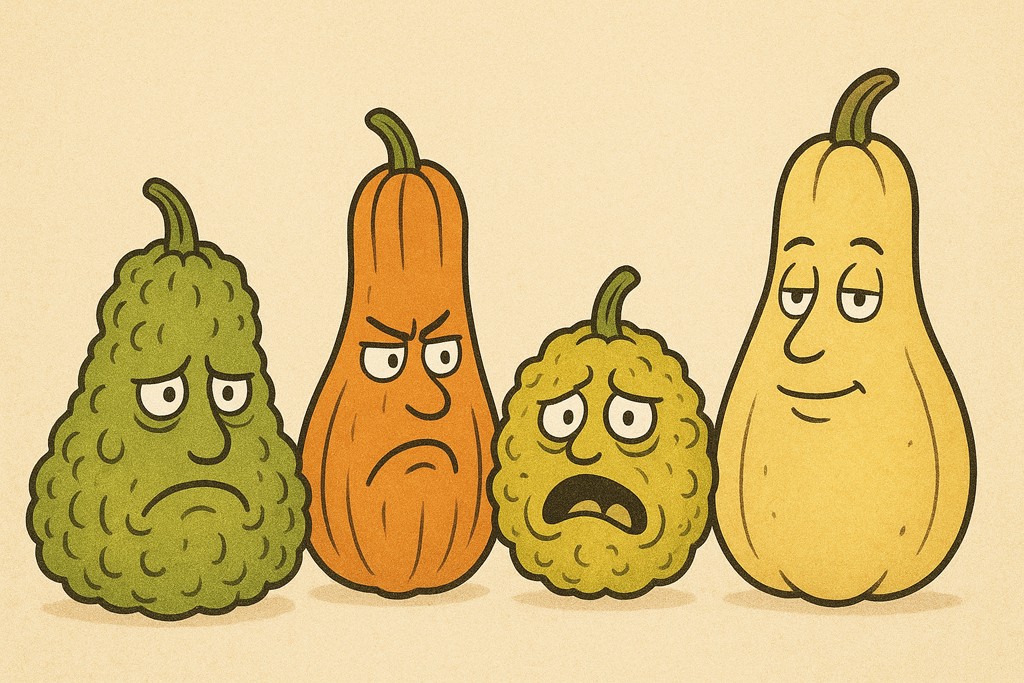
Last October at a supermarket, I saw a pallet-sized cardboard box, one of those massive containers that hold watermelons in the summer months. Instead of traditional orange pumpkins, which had a neighboring display, this box of blue-hued variants was labeled “Decorative Pumpkins.”
Next to it was another box with small, caramel-colored pumpkins called “Hot Chocolate Pumpkins.” Soon thereafter, I came across a box of fall gourds, surprisingly dubbed “Ugly Gourds.” And I had to know more.
It turns out “Decorative Pumpkins” are labeled as such mostly to distinguish them from other pumpkins that are grown for eating. “Hot Chocolate Pumpkins” are named for their color, not for any warm winter beverages hidden inside. A pumpkin is a gourd, but gourds are classified differently because they don’t usually taste very good, and can even be poisonous. And “Ugly Gourds?”
Nontraditional pumpkins and gourds have long inhabited the autumn porch displays of Martha Stewart types, who enjoy outdoing themselves every year, and in the process making their neighbors feel just a little bit inferior—these are the people who buy decorative corn stalks, Indian corn, and tons of mums.
Once called ornamental gourds, it seems that in recent years, some of the most popular gourds have been the most bizarre-looking. Hence, “Ugly Gourds.”
Many people might consider the color varieties of ugly gourds attractive—they come in shades of green, yellow, red, and gray, in solid, striped or mottled patterns. But many of them also feature “warts,” bumps on the surface that have become more common due to intentional cross-breeding by farmers.
One of the advantages of ugly gourds is that they’re kind of scary, even without carving or drawing a face on them. It’s a different, fear-of-the-plague sort of scary, but spine-chilling nonetheless. No one wants to touch them, but everyone is fascinated to look at them. And what’s more charming than a little kid in costume asking, “Mommy, what’s wrong with that pumpkin?”
We humans like to rub salt in the wounds of our selectively bred creations’ insecurities by bestowing all sorts of memorable but embarrassing names: for proof, see tomato varieties (Dancing with Smurfs, Evil Olive, Kellogg’s Breakfast) or watch 10 minutes of a dog show (Celebra’s Good Enough for Government Work, Starfire’s Spank Me Hard Call Me Crazy, and GCHG CH Calicops Sassafras Gonnakikurass are all registered names for competing dogs). This may be proof that we have become drunk with the power of science, or perhaps just drunk.
In our defense, these names could also be the result of God’s failure in the bible, when granting Adam the authority to name the plants and animals around him, to include the two-word caveat “within reason.”
Either way, ugly gourds are no exception to weird naming, with varieties that include Knucklehead Pumpkins, Ugly Mugly, Warty Goblin, Wings and Warts, Warts Galore, Warts Plethora, Bunch O Warts (warts are big among the ugly gourd crowd), Fancy Warted Gourd Blend and last but not least, the “Lunch Lady.”
How to choose an ugly gourd? The outside should be firm, but don’t go bumping uglies in public—that’s the kind of thing that can draw stares, offend people, or even land you in jail. (What you do in your own home is your own business, however.) Instead, focus on visual variety and novelty.
Lindsey Grasso, of Timothy’s Center for Gardening in Robbinsville, confirmed that she’s seen growth in the popularity of ugly gourds in the past five or ten years, with Warted Gourds a best-seller, from $1.49 for the smallest, up to $8.99 for extra large ones. Social media has played a large role in that growth, she said, inspiring buyers with images of creative displays.
Grasso also said that “ugly gourds have great personalities,” which, no offense, is exactly what you’d expect to hear from someone selling ugly gourds.
Ugly gourds inspire (in me, anyway) all kinds of promotional ideas: an “Ugly Pageant,” with the winner named the ugliest gourd of 2025, or an “Ugly Gourd Makeover,” which would transform a gourd that’s lacking confidence into an empowered knockout, ready to be carried off and displayed with the non-ugly gourds.
The truest sign of ugly gourds’ acceptance is their infiltration of a Halloween institution: the jack o’ lantern. The variety of shapes, colors, and textures among ugly gourds allows for a correspondingly wide variety of jack o’ lanterns. What better way to celebrate the newfound societal respect for ugly gourds than by eviscerating them, disposing of the innards, and displaying their corpses in public?
I plan to create an ugly gourd jack o’ lantern this year, and I’m curious to see how it compares to a traditional jack o’ lantern. Will its failure to conform to societal standards of gourd beauty actually prove an advantage by offending the aesthetic standards of squirrels, thus repelling the creatures who would normally devour my pumpkin a few bites at a time, over the course of a week or two? Time will tell.
Enjoy the season’s decorations, but remember the non-edible status of this column’s subject: in other words, gourmets, gorge on these gory, non-gorgeous gourds by letting your eyes feast, not your taste buds.